Tokyo U. launches medical Japanese LLM
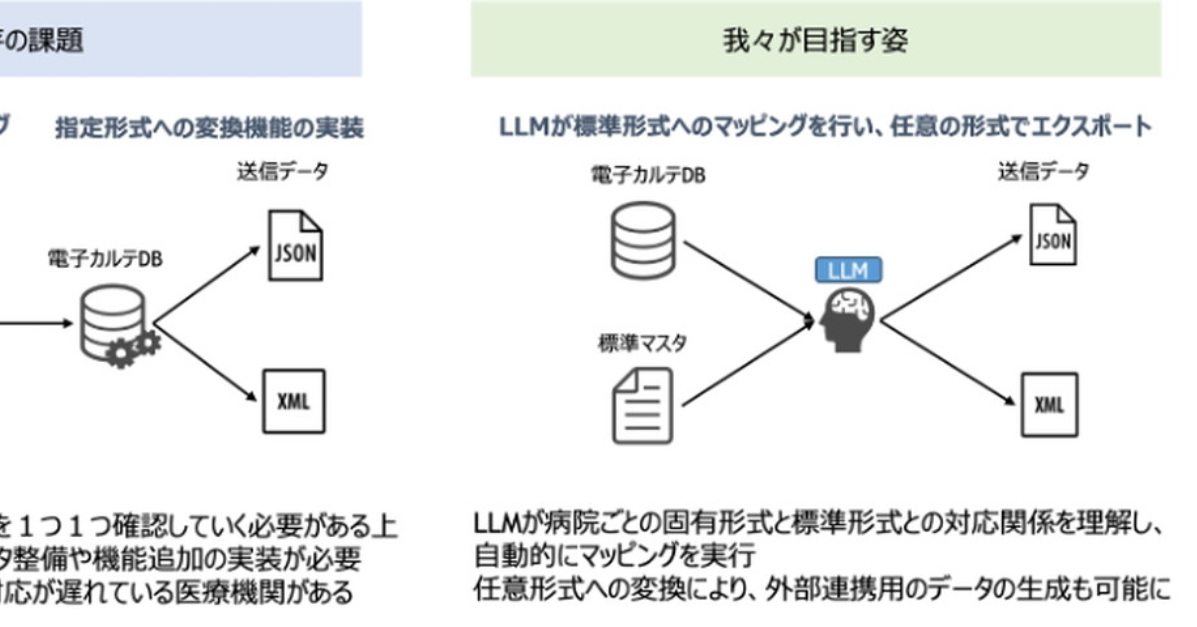
💡109B Japanese medical LLM free for researchers—ideal for healthcare AI devs.
⚡ 30-Second TL;DR
What Changed
Tokyo U. Matsuo-Iwasawa lab leads development
Why It Matters
Advances Japanese medical AI research by offering a large-scale domain-specific LLM freely, enabling faster innovation in healthcare NLP for Japanese practitioners.
What To Do Next
Request free access to Weblab-MedLLM-Qwen-2.5-109B-Instruct for Japanese medical AI experiments.
Key Points
- •Tokyo U. Matsuo-Iwasawa lab leads development
- •Medical-focused Japanese LLM with 109B parameters
- •Free access for researchers
- •Based on Qwen-2.5 Instruct architecture
- •Involves Sakura Internet collaboration
🧠 Deep Insight
Background and context from public sources — not the original article. 7 sources cited.
🔑 Enhanced Key Takeaways
- •Qwen2.5 series supports context lengths up to 131,072 tokens with generation capability of 8,192 tokens, enabling the 109B model to handle complex medical documents and long clinical texts[5]
- •The Qwen2.5 architecture incorporates Grouped Query Attention (GQA) and SwiGLU-activated feed-forward networks, which reduce computational overhead while maintaining performance—critical for deploying a 109B medical model in resource-constrained research environments[2]
- •Qwen2.5-Instruct models demonstrate superior instruction-following and structured output generation (particularly JSON), with enhanced resilience to diverse system prompts—valuable for medical domain adaptation where precise clinical terminology and structured medical records are essential[5][6]
🛠️ Technical Deep Dive
Qwen2.5 Base Architecture (applicable to 109B variant):
- Decoder-only Transformer backbone with rotary positional embeddings (RoPE) and QKV bias for length generalization[2]
- Grouped Query Attention (GQA) with multiple query heads and reduced key/value heads for improved cache utilization[2]
- SwiGLU-activated feed-forward networks with dimensionality optimization[2]
- Pre-normalization with RMSNorm for training stability[2]
Performance Characteristics:
- Context window: Full 131,072 tokens with 8,192 token generation capability[5]
- Qwen2.5-72B-Instruct achieves 86.6 on HumanEval and 88.2 on MBPP coding benchmarks, indicating strong reasoning capabilities transferable to medical domain[3]
- Quantization support (8-bit and 4-bit via GPTQ) enables deployment flexibility with up to 2.5× throughput improvements[2]
Medical Domain Optimization:
- Predecessor Med-Qwen2-7B demonstrates improved accuracy in medical document analysis, diagnosis support, and specialized medical text generation[3]
- Qwen2.5-Math variant employs Chain-of-Thought (CoT) and Tool-Integrated Reasoning (TIR) for complex multi-step problems, applicable to medical reasoning tasks[4]
🔮 Future ImplicationsAI analysis grounded in cited sources
⏳ Timeline
📎 Sources (7)
Factual claims are grounded in the sources below. Forward-looking analysis is AI-generated interpretation.
Weekly AI Recap
Read this week's curated digest of top AI events →
👉Related Updates
AI-curated news aggregator. All content rights belong to original publishers.
Original source: ITmedia AI+ (日本) ↗
This is a summary, not the original. Read the source, or get the weekly briefing.
Weekly AI briefing
One email a week. Unsubscribe anytime.