Tiangong 100 AI Chip Enters Mass Production
💡A mass-produced 96-TOPS plug-in accelerator could expand vehicle-side large-model compute without a platform redesign.
⚡ 30-Second TL;DR
What Changed
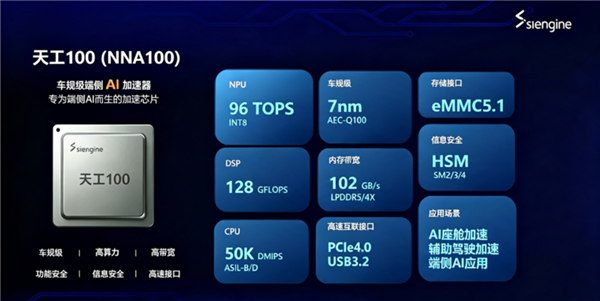
The automotive-grade Tiangong 100 chip uses a 7nm process and delivers 96 TOPS of AI performance.
Why It Matters
The chip could lower the integration barrier for automakers seeking to add generative AI and large-model capabilities to existing vehicle platforms. Successful ecosystem adoption will depend on software compatibility, automotive certification, latency, thermal performance, and real-world benchmarks.
What To Do Next
Request the Tiangong 100 SDK, supported runtimes, and latency-per-watt benchmarks from SiEngine, then prototype an inference workload on an existing automotive compute platform.
Key Points
- •The automotive-grade Tiangong 100 chip uses a 7nm process and delivers 96 TOPS of AI performance.
- •Mass production and volume shipments to automakers and Tier 1 suppliers have begun.
- •Its plug-in hardware design is intended to expand vehicle AI compute without replacing the main controller or changing existing software and hardware.
🧠 Deep Insight
AI-generated analysis for this event.
🔑 Enhanced Key Takeaways
- •SiEngine is a joint venture between Ecarx and Arm China, positioning the Tiangong 100 as a strategic play to leverage Ecarx's deep integration within the Geely automotive ecosystem.
- •The chip utilizes a proprietary NPU architecture specifically optimized for Transformer-based large language models (LLMs) and multimodal AI tasks in automotive environments.
- •The 'plug-in' capability is facilitated by a high-speed PCIe interface, allowing it to act as a co-processor alongside existing SoCs like the Qualcomm Snapdragon Ride or Ecarx's own Makalu series.
- •The Tiangong 100 is designed to meet ISO 26262 ASIL-B functional safety standards, a critical requirement for automotive-grade hardware that interacts with vehicle control systems.
- •SiEngine has integrated a dedicated software stack that supports mainstream AI frameworks, enabling developers to port existing LLM applications to the vehicle with minimal refactoring.
📊 Competitor Analysis▸ Show
| Feature | SiEngine Tiangong 100 | Horizon Robotics Journey 6 | NVIDIA Orin-X |
|---|---|---|---|
| Process | 7nm | 16nm/7nm | 7nm |
| AI Performance | 96 TOPS | Up to 560 TOPS | 254 TOPS |
| Primary Role | AI Accelerator (Plug-in) | Integrated SoC | Integrated SoC |
| Target Market | LLM/AI Expansion | ADAS/AD | ADAS/AD/Cockpit |
🛠️ Technical Deep Dive
- Architecture: Features a heterogeneous computing structure with a high-efficiency Neural Processing Unit (NPU) optimized for INT8 and FP16 precision.
- Memory: Supports LPDDR5/5X memory interfaces to ensure high bandwidth for large model inference.
- Interface: Utilizes PCIe Gen 3/4 connectivity to minimize latency when communicating with the host SoC.
- Power Efficiency: Designed for a low thermal design power (TDP) profile, allowing for passive or minimal active cooling in constrained vehicle environments.
- Model Support: Native hardware acceleration for Transformer blocks, attention mechanisms, and common activation functions used in modern LLMs.
🔮 Future ImplicationsAI analysis grounded in cited sources
⏳ Timeline
Weekly AI Recap
Read this week's curated digest of top AI events →
👉Related Updates


AI-curated news aggregator. All content rights belong to original publishers.
Original source: cnBeta (Full RSS) ↗