The Rise of AI-Powered One-Person Companies
💡Learn how to leverage AI agents to build a high-margin, one-person business with near-zero marginal costs.
⚡ 30-Second TL;DR
What Changed
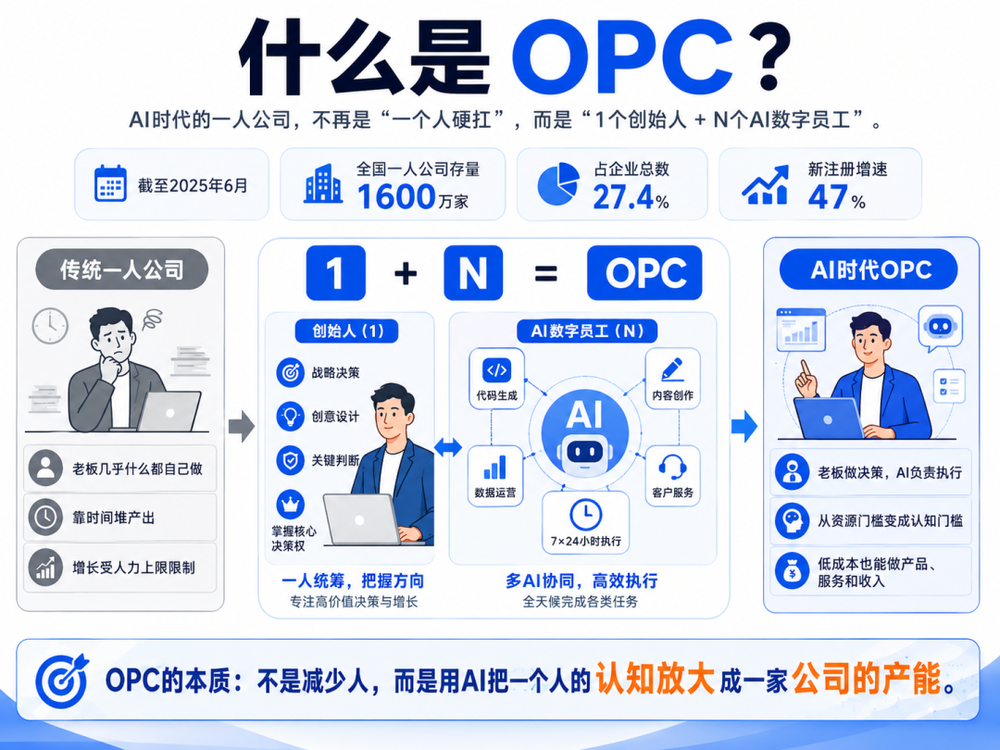
OPC模式定義為『1個創辦人 + N個AI數字員工』,大幅降低創業門檻。
Why It Matters
This trend signals a shift in the labor market and startup ecosystem, where individual developers can compete with larger firms by utilizing AI agents to scale operations without traditional headcount.
What To Do Next
Identify a repetitive task in your workflow and build a custom AI agent using frameworks like LangChain or CrewAI to automate it.
Key Points
- •OPC模式定義為『1個創辦人 + N個AI數字員工』,大幅降低創業門檻。
- •六大商業模式包括:專業服務、高端顧問、知識產品、數位產品、創意內容及平台整合。
- •AI將創業門檻從『資源密集型』轉向『認知密集型』,邊際成本趨近於零。
- •案例顯示單人運作的數位產品(如Clawdbot)可達到百萬美元級別的營收。
🧠 Deep Insight
Web-grounded analysis with 22 cited sources.
🔑 Enhanced Key Takeaways
- •The solopreneur economy is experiencing significant growth, with 30.4 million U.S. solopreneurs generating over $1.75 trillion in output, rivaling larger firms, and solo-founded startups surging from 23.7% in 2019 to 36.3% by mid-2025.
- •AI agents are enabling a fundamental shift from automation to true delegation, allowing solopreneurs to act as "directors" of AI-powered systems that handle 80-85% of execution at 2-5% the cost of a traditional team, rather than being laborers.
- •The rise of AI-powered OPCs is supported by the convergence of accessible AI agents that can execute work (e.g., writing code, automating workflows, research), no-code automation tools (e.g., Zapier, Make.com), and global access to knowledge, making it possible to build complex systems without engineering teams.
- •AI leaders like Sam Altman and Dario Amodei predict the emergence of billion-dollar one-person companies as early as 2026, particularly in sectors like proprietary trading, developer tools, and automated customer service, highlighting a structural shift in how value is created.
🛠️ Technical Deep Dive
- Core AI Technologies: AI automation tools leverage Natural Language Processing (NLP) and Large Language Models (LLMs) to interpret data, learn from patterns, and make real-time decisions.
- Agentic Capabilities: Unlike traditional chatbots, AI agents are capable of reasoning, taking action, and completing multi-step workflows autonomously, performing tasks like email sorting, lead tagging, scheduling, and even early idea validation and audience research.
- Workflow Orchestration: Platforms such as Zapier, Make.com, and n8n connect thousands of web applications, allowing AI agents to interact with existing tools (e.g., Google Sheets, CRMs) and orchestrate complex, multi-step automations without constant human oversight.
- No-Code/Low-Code Development: The availability of no-code AI agent builders (e.g., SageFlow) and low-code app builders (e.g., Vibe coding platforms like Hostinger Horizons) significantly lowers the technical barrier for entrepreneurs to deploy AI solutions.
- Specialized AI Agents: Specific examples include AI-driven tools for automating startup submissions to directories (BacklinkBot), creating teams of collaborative AI agents (CrewAI), and standalone AI devices for natural language commands (Rabbit r1).
- Hardware Acceleration: Custom Language Processing Unit (LPU) hardware, like Groq, delivers significantly faster AI inference, enabling near-instantaneous responses from LLMs.
- Local LLM Deployment: Tools like Ollama allow users to run LLMs (e.g., Llama, Mistral) on their own machines, offering privacy-first AI solutions.
- Advanced Agentic Models: AI models like Anthropic's Claude Opus 4.5 are trained on specialized data to complete long-running agentic tasks, including software engineering and administrative work, enabling the replication of enterprise software with minimal human intervention.
🔮 Future ImplicationsAI analysis grounded in cited sources
⏳ Timeline
📎 Sources (22)
Factual claims are grounded in the sources below. Forward-looking analysis is AI-generated interpretation.
Weekly AI Recap
Read this week's curated digest of top AI events →
👉Related Updates



AI-curated news aggregator. All content rights belong to original publishers.
Original source: 虎嗅 ↗