The Mid-game Battle for China's Mini-games
Insights into the massive mini-game market competition between China's top two tech giants.
30-Second TL;DR
What Changed
WeChat and Douyin are the primary battlegrounds for mini-game distribution.
Why It Matters
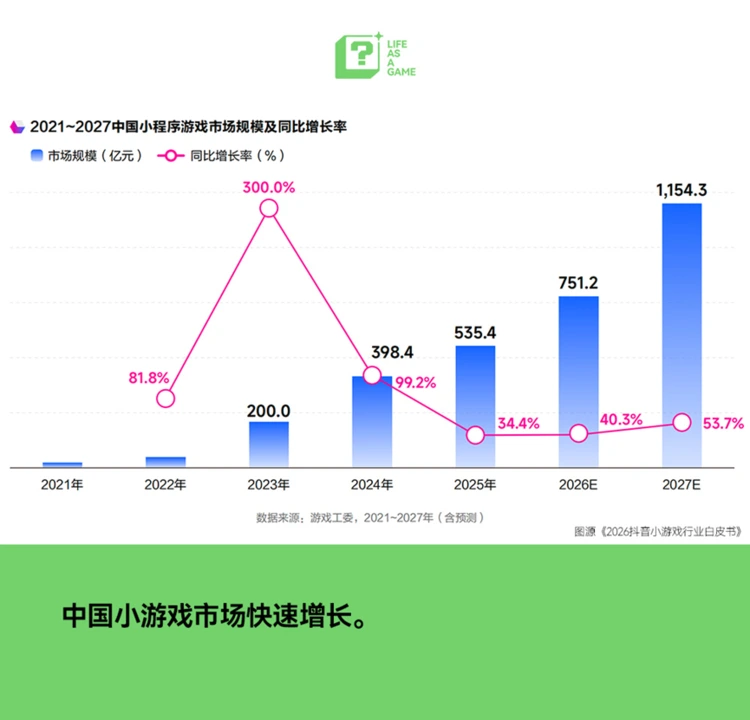
WeChat and Douyin are competing for a massive 100-billion-yuan market in the mini-game sector.
What To Do Next
Analyze the distribution algorithms of WeChat and Douyin if you are developing lightweight AI-integrated games.
Key Points
- •WeChat and Douyin are the primary battlegrounds for mini-game distribution.
- •The market size for mini-games has reached the 100-billion-yuan scale.
- •Competition is intensifying as platforms vie for user retention and monetization.
Deep Insight
AI-generated analysis for this event — not the original article.
Enhanced Key Takeaways
- •Mini-game developers are increasingly adopting 'hybrid monetization' models, combining in-app advertising (IAA) with in-app purchases (IAP) to maximize LTV in a highly competitive landscape.
- •The regulatory environment in China has tightened, requiring mini-games to obtain ISBN (International Standard Book Number) licenses for monetization, which has created a barrier to entry for smaller studios.
- •WeChat's 'Mini Game' ecosystem leverages its deep integration with social sharing and the 'WeChat Pay' infrastructure, while Douyin focuses on algorithmic content discovery and live-streaming integration to drive user acquisition.
- •Cloud gaming technology is being integrated into mini-game platforms to allow high-fidelity 3D games to run instantly without requiring large downloads, bridging the gap between mini-games and native apps.
- •Data privacy regulations and the deprecation of certain tracking identifiers have forced platforms to shift toward first-party data and platform-owned attribution tools to measure ad effectiveness.
Competitor Analysis
- WeChat Mini Games
- Social/Chat/Moments
- Douyin Mini Games
- Algorithmic Feed/Live
- Kuaishou Mini Games
- Algorithmic Feed/Social
- WeChat Mini Games
- IAP/IAA Hybrid
- Douyin Mini Games
- IAA/Live Commerce
- Kuaishou Mini Games
- IAA/Ad-driven
- WeChat Mini Games
- High (Social Loops)
- Douyin Mini Games
- High (Content Discovery)
- Kuaishou Mini Games
- Moderate
- WeChat Mini Games
- Low (Web-based)
- Douyin Mini Games
- Low (Web-based)
- Kuaishou Mini Games
- Low (Web-based)
| Feature | WeChat Mini Games | Douyin Mini Games | Kuaishou Mini Games |
|---|---|---|---|
| Primary Traffic Source | Social/Chat/Moments | Algorithmic Feed/Live | Algorithmic Feed/Social |
| Monetization Focus | IAP/IAA Hybrid | IAA/Live Commerce | IAA/Ad-driven |
| User Retention | High (Social Loops) | High (Content Discovery) | Moderate |
| Technical Barrier | Low (Web-based) | Low (Web-based) | Low (Web-based) |
Technical Deep Dive
- Mini-games typically utilize a lightweight runtime environment based on WebAssembly (Wasm) and WebGL to execute high-performance code within the host app's container.
- Platforms employ a proprietary 'Mini-Game Engine' (e.g., WeChat's engine) that optimizes memory management and rendering pipelines to handle complex 3D assets.
- Asset loading is managed through asynchronous streaming and caching mechanisms to minimize initial load times, often utilizing CDN-accelerated delivery for game resources.
- Cross-platform development is facilitated by engines like Cocos Creator and LayaAir, which compile game logic into platform-specific packages while maintaining a unified codebase.
Future ImplicationsAI analysis grounded in cited sources
Timeline
- 2017-12WeChat launches 'Tiao Yi Tiao' and the Mini Game platform, marking the birth of the sector.
- 2019-06WeChat introduces the 'In-App Purchase' capability for mini-games, shifting the revenue model from pure ads to hybrid.
- 2021-02Douyin officially opens its mini-game platform to third-party developers, challenging WeChat's dominance.
- 2023-08China's NPPA accelerates ISBN license approvals for mini-games, formalizing the market's regulatory status.
- 2025-01Market reports confirm the mini-game sector surpasses the 100-billion-yuan annual revenue milestone.
Weekly AI Recap
Read this week's curated digest of top AI events →
AI-curated news aggregator. All content rights belong to original publishers.
Original source: 钛媒体 ↗
This is a summary, not the original. Read the source, or get the weekly briefing.
The weekly digest
One email a week. Unsubscribe anytime.