The hidden cost of AI: Data and knowledge extraction
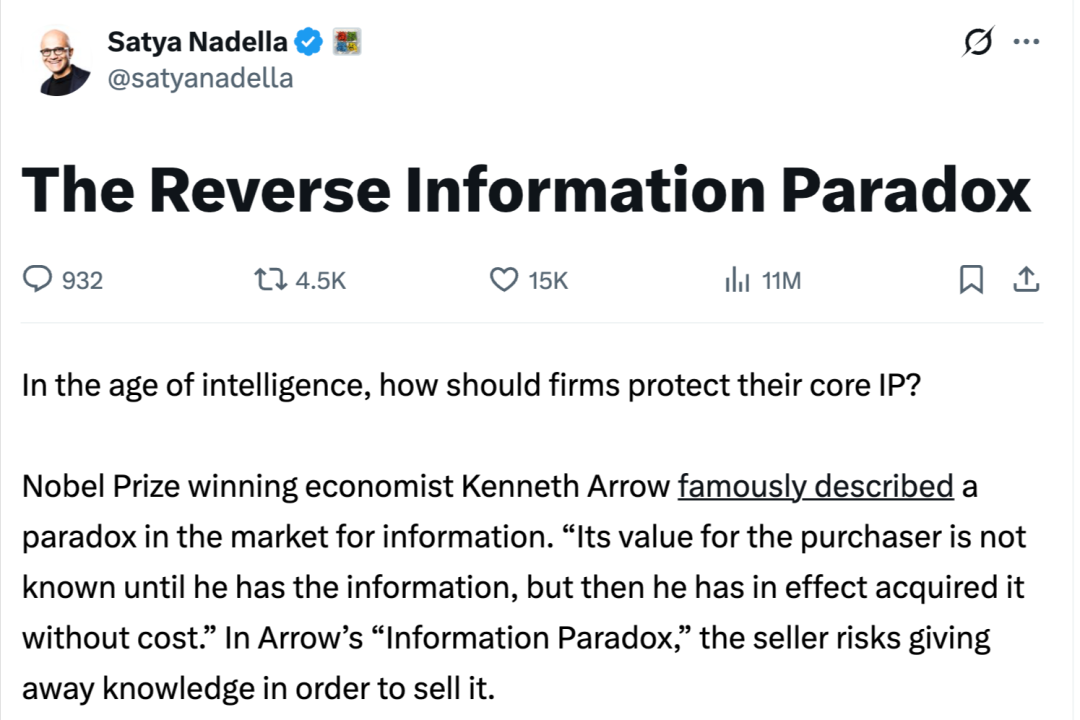
💡A sobering look at how your proprietary data and expertise are being used to train your AI competitors.
⚡ 30-Second TL;DR
What Changed
Users face a 'reverse information paradox' where they must disclose proprietary data to get value from AI.
Why It Matters
This analysis warns of the long-term erosion of competitive advantage for firms that rely heavily on LLMs without data protection, suggesting a shift toward owning the 'production means' of intelligence.
What To Do Next
Implement strict data governance and use private, local, or fine-tuned models to prevent leakage of proprietary 'know-how' to public AI providers.
Key Points
- •Users face a 'reverse information paradox' where they must disclose proprietary data to get value from AI.
- •High-end professional expertise is being distilled into AI models via specialized data labeling and training.
- •Code generation is uniquely vulnerable to AI due to the zero-cost verification provided by compilers.
- •Companies are building 'training environments' to clone entire organizational workflows.
🧠 Deep Insight
AI-generated analysis for this event.
🔑 Enhanced Key Takeaways
- •The 'Data Flywheel' effect has shifted from simple model improvement to 'Model Collapse' mitigation, where companies now prioritize synthetic data filtering to prevent AI from training on its own low-quality output.
- •Legal frameworks like the EU AI Act and emerging US copyright precedents are increasingly classifying 'knowledge extraction' as a potential violation of trade secret protections when applied to proprietary enterprise workflows.
- •Differential Privacy (DP) and Federated Learning are being adopted by high-security firms to prevent model inversion attacks, where adversaries attempt to reconstruct training data from model weights.
- •The rise of 'Data Sovereignty' platforms allows enterprises to utilize RAG (Retrieval-Augmented Generation) architectures that keep proprietary data in isolated silos, preventing it from being ingested into the base model's permanent memory.
- •AI-native companies are now implementing 'Data Poisoning' as a defensive strategy, intentionally introducing subtle artifacts into their proprietary datasets to render them useless if scraped by unauthorized third-party crawlers.
🛠️ Technical Deep Dive
- RAG (Retrieval-Augmented Generation): Decouples knowledge from model weights, allowing enterprises to query proprietary data without retraining the base model.
- Differential Privacy (DP): Adds statistical noise to training datasets to ensure that individual data points cannot be identified or extracted from the final model parameters.
- Federated Learning: Enables model training across decentralized edge devices or servers, ensuring that raw data never leaves the local environment.
- Model Inversion Attacks: A class of adversarial techniques where an attacker queries a model repeatedly to reconstruct the training data used to build it.
- Synthetic Data Generation: The process of using AI to create high-quality, non-proprietary training data to reduce reliance on sensitive user-provided inputs.
🔮 Future ImplicationsAI analysis grounded in cited sources
⏳ Timeline
Weekly AI Recap
Read this week's curated digest of top AI events →
👉Related Updates


AI-curated news aggregator. All content rights belong to original publishers.
Original source: 虎嗅 ↗