The Crisis of AI Detection in Higher Education
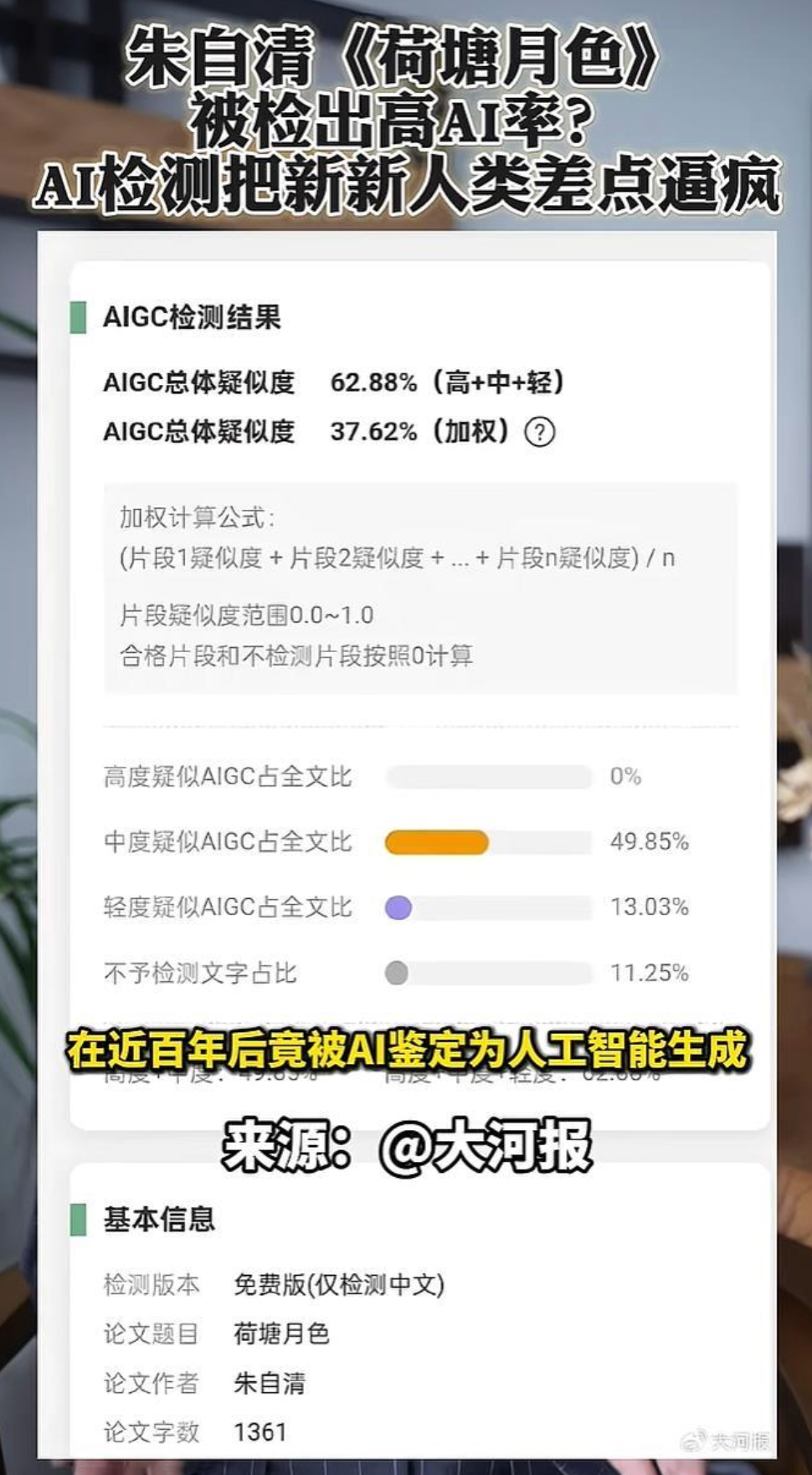
💡Understand why current AI detection is failing and the technical challenges of verifying human-authored content.
⚡ 30-Second TL;DR
What Changed
Universities are setting strict AIGC percentage limits for graduation theses.
Why It Matters
The unreliability of AI detection is forcing a re-evaluation of academic integrity policies and creating a demand for more transparent, verifiable authorship tools.
What To Do Next
If building academic tools, prioritize providing 'provenance logs' or version history metadata rather than relying solely on black-box probability scores.
Key Points
- •Universities are setting strict AIGC percentage limits for graduation theses.
- •Current detection tools suffer from high inconsistency and false positives, even flagging classic literature.
- •Detection logic relies on information entropy and multi-feature analysis, yet remains a 'black box' to users.
- •Students are resorting to 'anti-AI' writing techniques to bypass flawed detection systems.
🧠 Deep Insight
Web-grounded analysis with 25 cited sources.
🔑 Enhanced Key Takeaways
- •False positives in AI detection tools disproportionately affect non-native English speakers, students with learning differences, and those who employ formal, technical, or overly structured writing styles, leading to unfair accusations.
- •Many higher education institutions and teaching centers, such as the University of Pittsburgh, have explicitly advised against or even disabled AI detection tools, citing their unreliability and the substantial risk of false positives as insufficient evidence for academic misconduct.
- •The focus for educators is shifting from solely policing AI misuse to designing 'AI-resistant' assignments that necessitate personal voice, critical reflection, real-world application, or process-based evidence, alongside developing clear institutional policies for ethical AI tool use.
- •AI detection tools frequently struggle to accurately identify 'hybrid' content, where students combine their original writing with AI assistance for tasks like brainstorming, drafting, or editing, and their accuracy significantly decreases when AI-generated text is paraphrased or lightly edited by a human.
🛠️ Technical Deep Dive
- AI detectors analyze patterns in text, including word choice predictability, sentence structure uniformity, and stylistic consistency, by comparing submitted text against millions of AI-generated samples used during training.
- Algorithms assign probability scores, rather than definitive answers, indicating the likelihood of AI generation.
- Key metrics include 'perplexity' (how predictable the writing is) and 'burstiness' (how much sentence length and structure vary), as AI-generated text often exhibits lower perplexity and more uniform burstiness.
- Some systems attempt to identify hidden digital 'watermarks' or metadata traces embedded by AI tools, though these can be easily removed through editing.
- The technology relies heavily on Machine Learning (ML) and Natural Language Processing (NLP) models, which are trained on vast datasets of both human-written and AI-generated content.
- Underlying models for some detectors include BERT, GPT-2, and GPT-3, with tools like Originality.AI being based on GPT-3 and capable of detecting content from advanced models like ChatGPT, GPT-4o, Gemini Pro, and Claude 3.5.
- Advanced detection methods involve mathematical fingerprinting, statistical pattern analysis, frequency domain analysis, and compression analysis, as AI-generated content exhibits distinct entropy distributions and spectral characteristics.
- Newer tools are incorporating deeper contextual and style analysis, considering a student's previous writing, subject matter relevance, and the assignment prompt to make more nuanced distinctions.
🔮 Future ImplicationsAI analysis grounded in cited sources
⏳ Timeline
📎 Sources (25)
Factual claims are grounded in the sources below. Forward-looking analysis is AI-generated interpretation.
- trinka.ai
- skylineacademic.com
- macmillanlearning.com
- hastewire.com
- reddit.com
- pressbooks.pub
- thesify.ai
- pitt.edu
- evelynlearning.com
- schoolai.com
- cornell.edu
- structural-learning.com
- edcircuit.com
- digitaleducationcouncil.com
- copyleaks.com
- grammarly.com
- quetext.com
- ucla.edu
- gptzero.me
- scifocus.ai
- originality.ai
- originality.ai
- verityai.co
- hastewire.com
- forumbee.com
Weekly AI Recap
Read this week's curated digest of top AI events →
👉Related Updates



AI-curated news aggregator. All content rights belong to original publishers.
Original source: 虎嗅 ↗