Tesla sued over fatal Texas crash involving Autopilot
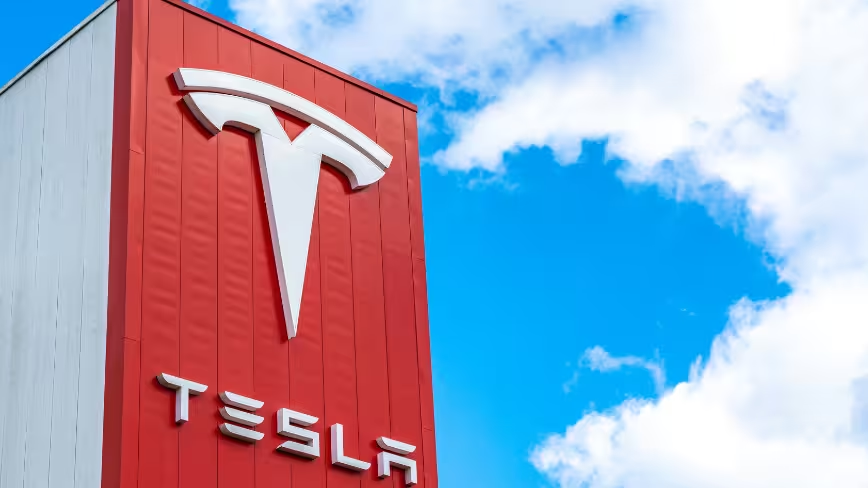
Critical legal precedent for autonomous driving liability and safety system accountability.
30-Second TL;DR
What Changed
Wrongful-death suit filed after a Model 3 crashed into a home near Houston.
Why It Matters
This litigation highlights the ongoing legal risks surrounding autonomous driving features. It may force Tesla to increase transparency regarding Autopilot performance data in future court proceedings.
What To Do Next
Review your autonomous system's edge-case logging protocols to ensure robust data trails for liability protection.
Key Points
- •Wrongful-death suit filed after a Model 3 crashed into a home near Houston.
- •Plaintiff alleges Autopilot was engaged at the time of the fatal incident.
- •Legal strategy mirrors the $243m Florida verdict against Tesla.
Deep Insight
AI-generated analysis for this event — not the original article.
Enhanced Key Takeaways
- •The lawsuit specifically alleges that Tesla's 'Autosteer' and 'Traffic-Aware Cruise Control' systems failed to detect the residential structure, raising questions about the system's object recognition capabilities in non-highway environments.
- •Legal experts note that this case is being filed in a jurisdiction known for strict product liability standards, which may increase the evidentiary burden on Tesla to prove the system was not misused.
- •Tesla's defense strategy in similar Texas-based litigation has historically relied on 'driver responsibility' clauses within the owner's manual, arguing that Autopilot is a Level 2 driver-assist system requiring constant supervision.
- •The National Highway Traffic Safety Administration (NHTSA) has opened a specialized investigation into this specific crash to determine if the vehicle's data logs contradict the plaintiff's claims regarding Autopilot engagement.
- •This filing follows a series of recent shareholder derivative lawsuits that allege Tesla's marketing of 'Full Self-Driving' and 'Autopilot' has misled consumers and investors regarding the actual safety maturity of the software.
Competitor Analysis
- Tesla Autopilot
- Level 2 ADAS
- Waymo Driver
- Level 4 Autonomous
- Mobileye SuperVision
- Level 2+ ADAS
- Tesla Autopilot
- Vision-Only (Tesla Vision)
- Waymo Driver
- LiDAR, Radar, Cameras
- Mobileye SuperVision
- Cameras, Radar, LiDAR
- Tesla Autopilot
- Public Roads (Supervised)
- Waymo Driver
- Geofenced Areas (Unsupervised)
- Mobileye SuperVision
- Public Roads (Supervised)
- Tesla Autopilot
- Included/Subscription
- Waymo Driver
- Per-ride/Fleet
- Mobileye SuperVision
- OEM Integration Cost
| Feature | Tesla Autopilot | Waymo Driver | Mobileye SuperVision |
|---|---|---|---|
| System Type | Level 2 ADAS | Level 4 Autonomous | Level 2+ ADAS |
| Sensor Suite | Vision-Only (Tesla Vision) | LiDAR, Radar, Cameras | Cameras, Radar, LiDAR |
| Operational Domain | Public Roads (Supervised) | Geofenced Areas (Unsupervised) | Public Roads (Supervised) |
| Pricing Model | Included/Subscription | Per-ride/Fleet | OEM Integration Cost |
Technical Deep Dive
- Tesla Autopilot utilizes a vision-only architecture known as Tesla Vision, which relies on a neural network processing feed from eight external cameras.
- The system employs a transformer-based neural network for occupancy network prediction, which attempts to create a 3D representation of the environment.
- Autopilot's object detection pipeline is trained on massive datasets of 'edge cases' to identify static obstacles, though it has historically struggled with stationary objects like emergency vehicles or structures in low-contrast lighting.
- The vehicle's Electronic Control Unit (ECU) logs 'Autopilot Heartbeat' data, which records whether the driver's hands are detected on the steering wheel and if the system is actively steering or braking.
Future ImplicationsAI analysis grounded in cited sources
Timeline
- 2015-10Tesla releases Autopilot software update 7.0 for Model S.
- 2016-05First fatal crash involving Autopilot occurs in Florida.
- 2021-08NHTSA opens a formal investigation into Tesla Autopilot's performance regarding emergency vehicles.
- 2023-10Tesla wins a high-profile wrongful death trial in California regarding Autopilot safety.
- 2024-04Tesla settles a lawsuit involving a fatal 2018 crash of an Apple engineer.
Weekly AI Recap
Read this week's curated digest of top AI events →
Related Updates

AI-curated news aggregator. All content rights belong to original publishers.
Original source: The Next Web (TNW) ↗
This is a summary, not the original. Read the source, or get the weekly briefing.
The weekly digest
One email a week. Unsubscribe anytime.