Tesla FSD Supervised Officially Entering China Market
💡Tesla's FSD is the industry benchmark for end-to-end AI driving; its China entry is a major shift in the global AI lands
⚡ 30-Second TL;DR
What Changed
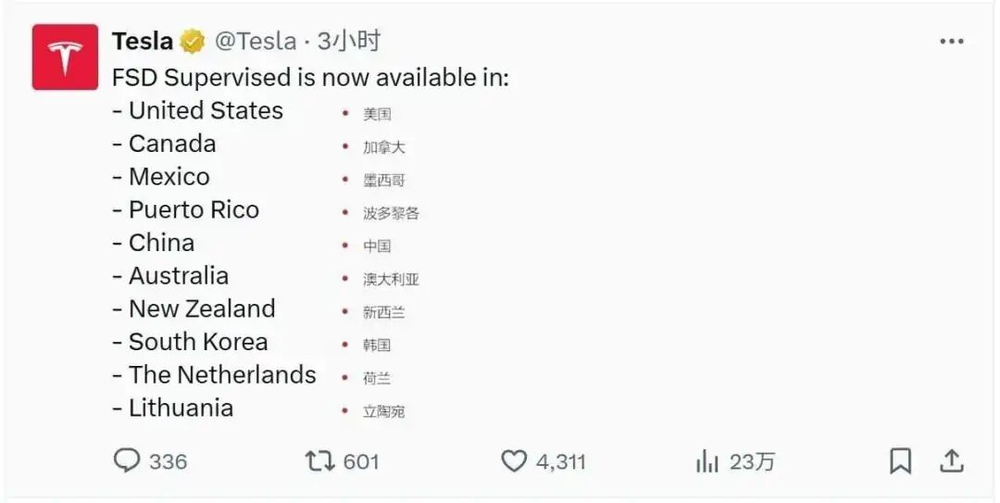
Tesla officially listed China as a region where FSD Supervised is available on its X account.
Why It Matters
Tesla's entry into the Chinese market will intensify competition in the high-level autonomous driving sector, forcing domestic players like Huawei and Xpeng to accelerate their end-to-end AI model development.
What To Do Next
Monitor the performance of end-to-end autonomous driving models in complex urban environments to benchmark against Tesla's upcoming local deployment.
Key Points
- •Tesla officially listed China as a region where FSD Supervised is available on its X account.
- •The company is hiring nearly 90 local R&D and testing roles across major Chinese cities.
- •Technical preparation includes updating vehicle manuals to include FSD V14 features and preparing for local data training.
- •Hardware limitations (HW3.0 vs HW4.0) may restrict full FSD capabilities for older vehicle models.
🧠 Deep Insight
Web-grounded analysis with 23 cited sources.
🔑 Enhanced Key Takeaways
- •The official May 21, 2026, announcement formalized FSD Supervised availability in China, but full regulatory approval for a fleet-wide rollout is still pending, with Tesla targeting Q3 2026 for broader clearance.
- •Tesla has established a dedicated data center in Shanghai and partnered with Baidu for mapping services to comply with Chinese data localization rules, and has adapted its in-car voice assistant using ByteDance's Doubao model and DeepSeek Chat for AI interactions.
- •Unlike other global markets where Tesla discontinued the one-time FSD purchase in February 2026 for a subscription-only model, China retains the one-time purchase option at 64,000 yuan (approximately $9,400 USD), with no monthly subscription yet introduced.
- •HW4's FSD computer is 3-5 times faster than HW3, featuring 5-megapixel cameras compared to HW3's 1.2-megapixel units, offering superior environmental perception and smoother responses, and receives full FSD V14.x updates first, while HW3 gets optimized "lite" versions.
- •The recruitment drive for Smart Driving Test Technicians and ADAS Test Operators spans nine major Chinese cities, including Beijing, Shanghai, and Guangzhou, indicating a significant operational investment to accelerate localization and real-world testing.
📊 Competitor Analysis▸ Show
| Feature/Aspect | Tesla FSD Supervised (China) | XPeng XNGP | Huawei ADS 3.0 | BYD (with LiDAR option) | Baidu Apollo Go (Robotaxi) |
|---|---|---|---|---|---|
| Automation Level | L2 (Supervised) | L2+ (targeting L3 in ~2 years) | L2+ (Urban NOA) | L2+ (with LiDAR) | L4 (Robotaxi) |
| Pricing (China) | 64,000 yuan (one-time purchase) | Not specified (integrated into vehicle packages) | Not specified (integrated into vehicle packages) | 12,000 yuan (LiDAR option for Seagull) | Service-based (robotaxi fares) |
| Key Features | Auto lane change, summon, autopark, predictive AI (V14), audio inputs, real-time blocked road detection | Localized scenario adaptation, domestic data accumulation, urban NOA | Deeply deployed urban NOA | LiDAR sensors, Urban NOA (on some models) | Autonomous taxi service, large fleet operations |
| Hardware Focus | Vision-only (HW3/HW4 cameras) | Cameras, radar, ultrasonic, often LiDAR | Cameras, radar, ultrasonic, often LiDAR | Cameras, radar, ultrasonic, LiDAR | Cameras, radar, ultrasonic, LiDAR |
| Market Position | Entering competitive L2+ market, aims for broader regulatory approval | Strong domestic player, claims to surpass Tesla in local conditions | Leading in urban NOA ADAS market | Expanding advanced features to affordable segments | Dominant in China's robotaxi sector |
🛠️ Technical Deep Dive
- FSD V14 Core Enhancements: The system now utilizes auto-regressive transformers, enabling its AI to predict the movement of objects, pedestrians, and vehicles rather than merely reacting, thereby mimicking human-like decision-making.
- Audio Input Integration: FSD V14 is the first version to actively incorporate audio inputs, primarily for detecting emergency vehicles, with potential for broader sound recognition in the future.
- Increased Processing Capacity: FSD V14 features a larger model and context size, allowing it to process three times more information, leading to more refined decision-making.
- Navigation and Perception Integration: The update includes a deeper integration of navigation and routing into the vision-based neural network, enabling real-time handling of blocked roads and detours based purely on visual data, overcoming limitations of static maps.
- Improved Urban Driving & Planning: V14 offers enhanced negotiation of complex intersections, unprotected left turns, and better gap acceptance for merges on highways. It also refines handling for lane changes, vehicle cut-ins, and road obstacles.
- Hardware Differences (HW3 vs. HW4):
- Processing Power: HW4's FSD computer is 3-5 times faster than HW3, powered by AMD Ryzen APUs, facilitating more complex autonomous driving computations.
- Camera System: HW4 features 5-megapixel cameras, a significant upgrade from HW3's 1.2-megapixel units, offering sharper imagery, better low-light performance (via red-tinted lenses), and a wider field of view with a streamlined two-camera setup.
- Performance & Reliability: HW4 provides smoother responses, superior environmental perception, and greater reliability, especially in adverse conditions, handling traffic signs, parking, and highway assist with higher precision compared to HW3.
- Software Update Cadence: HW4 receives full, advanced FSD updates (e.g., v14.x) first, while HW3 typically receives optimized "lite" versions with a delay.
- Power Consumption: HW4 consumes approximately twice as much power at idle compared to HW3.
🔮 Future ImplicationsAI analysis grounded in cited sources
⏳ Timeline
📎 Sources (23)
Factual claims are grounded in the sources below. Forward-looking analysis is AI-generated interpretation.
Weekly AI Recap
Read this week's curated digest of top AI events →
👉Related Updates

AI-curated news aggregator. All content rights belong to original publishers.
Original source: 虎嗅 ↗