Tencent: WeChat AI Agent launch not imminent
💡Understand Tencent's AI strategy and why they are delaying the launch of their highly anticipated WeChat Agent.
⚡ 30-Second TL;DR
What Changed
WeChat Agent development is ongoing but lacks a specific launch timeline.
Why It Matters
Tencent's cautious approach suggests that large-scale agentic workflows in super-apps require deep architectural changes and model maturity before public release.
What To Do Next
Monitor the 'Hunyuan' model's progress on OpenRouter and evaluate its performance in code/agentic scenarios for potential integration.
Key Points
- •WeChat Agent development is ongoing but lacks a specific launch timeline.
- •Tencent is focusing on improving the 'Hunyuan' model, with a significantly better version expected later this year.
- •Tencent views AI Agents as a bigger threat to e-commerce platforms than to their own content-heavy ecosystem.
- •Advertising revenue remains strong, driven by AI-powered recommendation engines and the video account (Channels) ecosystem.
🧠 Deep Insight
Web-grounded analysis with 28 cited sources.
🔑 Enhanced Key Takeaways
- •Tencent's overarching AI strategy positions AI as an "intelligent engine" for productivity and innovation across industries, complemented by globalization as an "expansion engine" for Tencent Cloud's advanced capabilities worldwide.
- •Tencent has introduced an Agent Development Platform (ADP) and Agent Runtime, providing an end-to-end stack for building and deploying agentic AI with capabilities such as a cloud sandbox that can scale to hundreds of thousands of concurrent agents.
- •WeChat is developing its own independent AI model, internally codenamed, which has completed foundational capability development and is slated for public rollout later in 2026, specifically for deeper integration into the mini-program ecosystem.
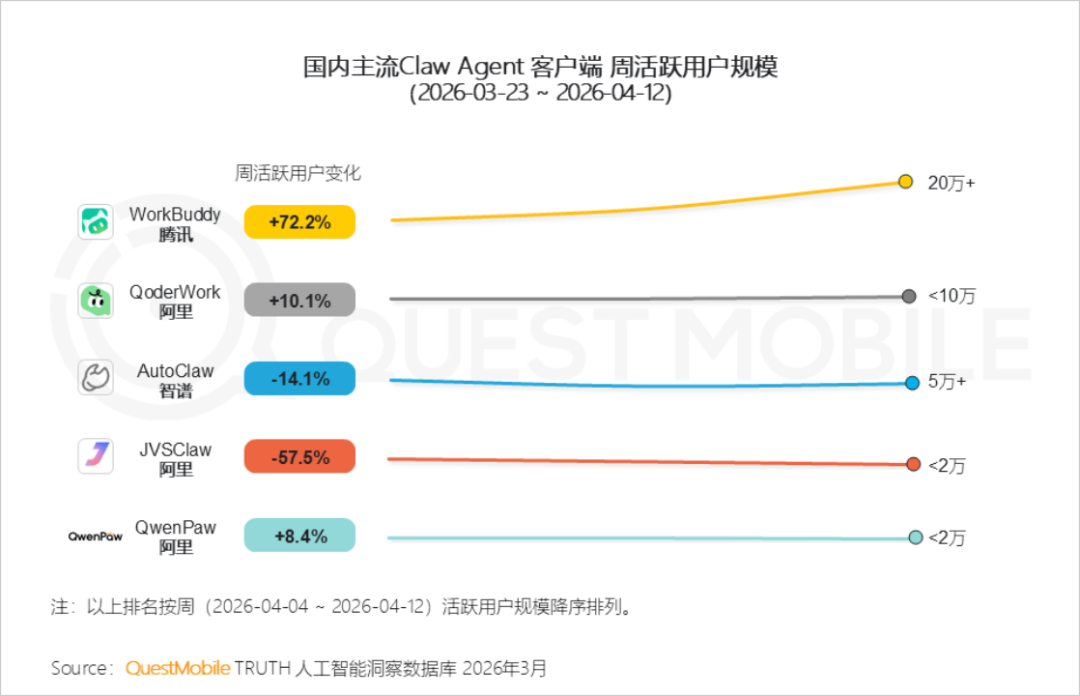
- •Tencent has already integrated its QClaw AI agent as a WeChat mini-program, enabling remote PC control, file transfers, and commands via audio and images, with the Hunyuan 3.0 model expected to launch in April 2026 to further enhance these agent capabilities.
- •Tencent's AI investments are yielding concrete financial returns, with AI-driven ad recommendation models boosting advertising revenue growth by 20% in Q1 2026 and contributing to a 20% growth in enterprise services revenue, particularly from AI-related cloud services.
📊 Competitor Analysis▸ Show
| Competitor | Key Features | Monthly Active Users (MAU) (Q1 2026) | Pricing Model |
|---|---|---|---|
| Tencent Yuanbao | Native WeChat integration, group search, AI-powered ad recommendations | 150M | Free for consumer use, paid enterprise APIs available |
| Baidu ERNIE Bot | Enterprise API leader, full ecosystem integration (Maps, Cloud, government contracts) | 220M | Free for consumer use, paid enterprise APIs available |
| Alibaba Quark (Tongyi Qianwen) | Best for long-context documents and student queries, open-source model family | 180M | Free for consumer use, paid enterprise APIs available |
| ByteDance Doubao | Strongest multimodal and video search, integrates into Douyin, aggressive API pricing | 260M | Free for consumer use, paid enterprise APIs available |
| Kimi (Moonshot AI) | 2M-token context window, best for research workflows | 90M | Free for consumer use, paid enterprise APIs available |
🛠️ Technical Deep Dive
- Hunyuan-Large: A Transformer-based Mixture-of-Experts (MoE) model with 389 billion total parameters, activating 52 billion during inference.
- Hunyuan-A13B: Utilizes an MoE architecture with 80 billion total parameters, but only 13 billion active during inference. It was trained on 20 trillion tokens, including 250 billion STEM-specific tokens, and features dual-mode reasoning ('slow-thinking' and 'fast-thinking') for flexible problem-solving.
- Hunyuan Image 3.0: An open-sourced text-to-image model with 80 billion total parameters and 13 billion activated during inference, employing an MoE architecture with the Transfusion method within a unified autoregressive framework. It was trained on 5 billion image-text pairs and 6 trillion tokens.
- Hunyuan 3D 3.0: Features a hierarchical 3D-DiT (Diffusion Transformer) architecture with 10 billion parameters, achieving a threefold improvement in modeling accuracy and supporting 1536³ geometric resolution. Hunyuan3D 2.0 uses a two-stage pipeline for mesh creation and texture synthesis, while Hunyuan3D-2.1 incorporates Physically-Based Rendering (PBR) texture synthesis.
- Hunyuan Video: A 13 billion parameter diffusion transformer model designed for high-quality text-to-video generation.
- Hunyuan-T1 (March 2025): A Hybrid-Transformer-Mamba Mixture-of-Experts (MoE) model, reportedly 2x faster than GPT-4, with enhanced accuracy in math, coding, and scientific reasoning, and improved long-context retention. It uses a Mamba (state-space model) architecture for dynamic computation focus and a dual feedback mechanism for training.
- WeChat AI Agent (QClaw): Integrates as a mini-program within the WeChat ecosystem. It supports external large models like Kimi, MiniMax, GLM, and DeepSeek, alongside smaller self-developed models. Its architecture includes specialized modules for intent recognition, service discovery, parameter extraction, and execution monitoring, embedding directly into WeChat's core interface.
🔮 Future ImplicationsAI analysis grounded in cited sources
⏳ Timeline
📎 Sources (28)
Factual claims are grounded in the sources below. Forward-looking analysis is AI-generated interpretation.
- Google Search Source
- Google Search Source
- Google Search Source
- Google Search Source
- Google Search Source
- Google Search Source
- Google Search Source
- Google Search Source
- Google Search Source
- Google Search Source
- Google Search Source
- Google Search Source
- Google Search Source
- Google Search Source
- Google Search Source
- Google Search Source
- Google Search Source
- Google Search Source
- Google Search Source
- Google Search Source
- Google Search Source
- Google Search Source
- Google Search Source
- Google Search Source
- Google Search Source
- Google Search Source
- Google Search Source
- Google Search Source
Weekly AI Recap
Read this week's curated digest of top AI events →
👉Related Updates


AI-curated news aggregator. All content rights belong to original publishers.
Original source: 虎嗅 ↗