Tars AWE 3.0 Sets Robot Assembly Record
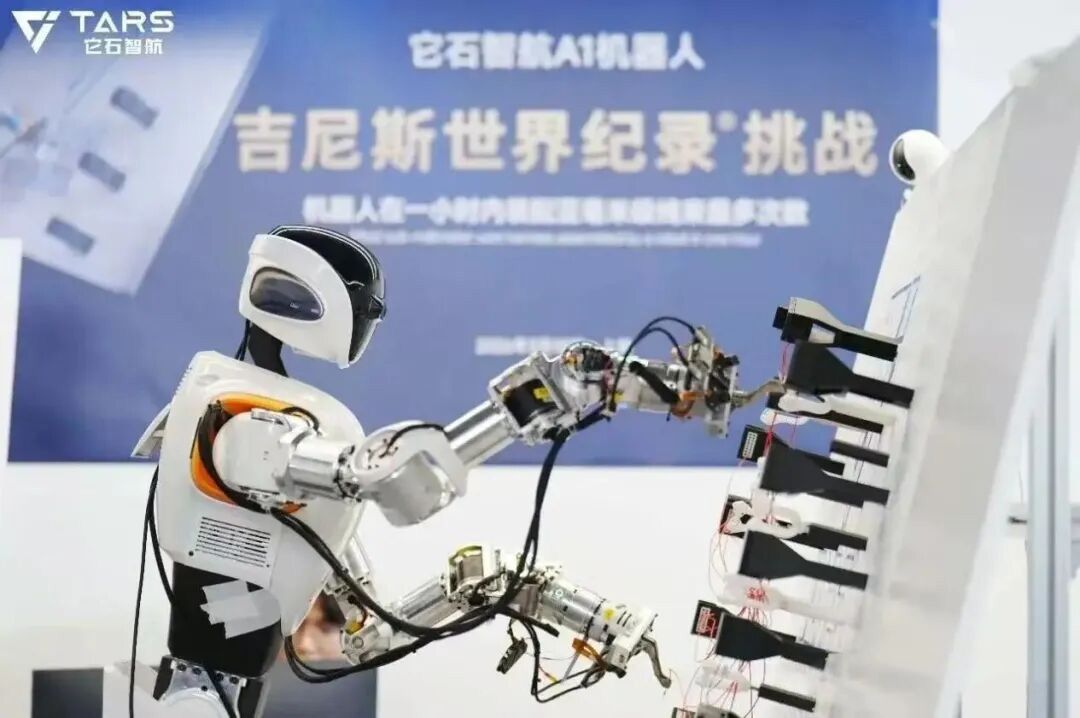
💡World-record embodied AI for assembly—essential benchmark for robotics builders
⚡ 30-Second TL;DR
What Changed
A1 robot achieved Guinness World Record in precision assembly
Why It Matters
This breakthrough accelerates embodied AI adoption in manufacturing, enabling higher precision automation and reducing human error in assembly lines.
What To Do Next
Test AWE 3.0 demos on Tars Robotics site for your embodied AI precision tasks.
Key Points
- •A1 robot achieved Guinness World Record in precision assembly
- •Over 100 sub-millimeter flexible assembly cycles in 1 hour
- •Powered by new AWE 3.0 embodied AI model
- •Demonstrates advanced robotics precision capabilities
🧠 Deep Insight
AI-generated analysis for this event — not the original article.
🔑 Enhanced Key Takeaways
- •The AWE 3.0 model utilizes a proprietary 'Vision-Tactile Fusion' architecture, allowing the A1 robot to adjust grip force in real-time based on haptic feedback during sub-millimeter assembly tasks.
- •Tars Robotics has announced that the AWE 3.0 model will be offered via an API-first platform, targeting third-party industrial robot manufacturers to integrate embodied AI capabilities into existing hardware.
- •The record-breaking assembly task involved the precise insertion of micro-connectors into high-density printed circuit boards, a process previously requiring human intervention due to the fragility of components.
📊 Competitor Analysis▸ Show
| Feature | Tars A1 (AWE 3.0) | Tesla Optimus Gen 3 | Figure 02 |
|---|---|---|---|
| Primary Focus | High-Precision Industrial Assembly | General Purpose/Logistics | General Purpose/Humanoid |
| Precision | Sub-millimeter | Millimeter-scale | Millimeter-scale |
| Pricing | Enterprise Licensing | Not Public | Subscription/Unit Sale |
| Key Benchmark | 100+ cycles/hr (Assembly) | 1000+ units/hr (Sorting) | 500+ units/hr (Manipulation) |
🛠️ Technical Deep Dive
- •Model Architecture: AWE 3.0 employs a Transformer-based policy network trained on a multimodal dataset combining synthetic simulation data and real-world tactile sensor streams.
- •Tactile Sensing: The A1 robot utilizes high-resolution optical tactile sensors (similar to GelSight technology) integrated into the fingertips to detect micro-slips at 1kHz frequency.
- •Latency: The inference engine for AWE 3.0 runs on edge-computing modules with a sub-10ms latency, critical for the high-speed closed-loop control required for sub-millimeter precision.
- •Training Methodology: Utilizes 'Sim-to-Real' transfer learning with domain randomization to ensure the model generalizes across varying lighting conditions and component textures.
🔮 Future ImplicationsAI analysis grounded in cited sources
⏳ Timeline
Weekly AI Recap
Read this week's curated digest of top AI events →
👉Related Updates


AI-curated news aggregator. All content rights belong to original publishers.
Original source: Pandaily ↗
This is a summary, not the original. Read the source, or get the weekly briefing.
The weekly digest
One email a week. Unsubscribe anytime.