Synthetic Diamond Emerges as AI Chip Cooling Solution
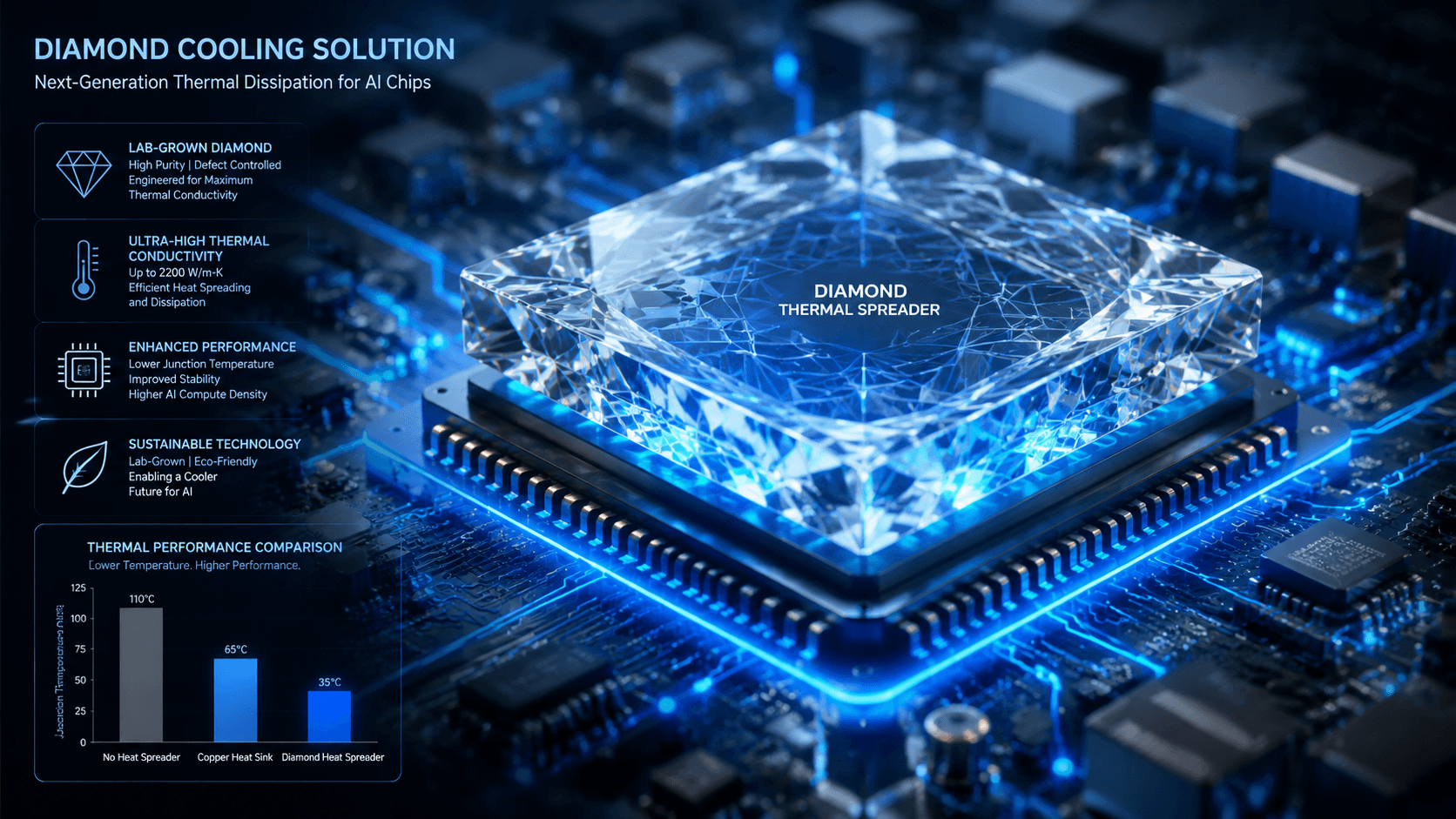
Discover how synthetic diamond is solving the critical thermal bottleneck for next-gen 1,000W+ AI chips.
30-Second TL;DR
What Changed
AI chips are hitting 1,000W+ thermal design power, requiring advanced cooling.
Why It Matters
The adoption of synthetic diamond could resolve thermal bottlenecks in high-performance computing, enabling more powerful GPU architectures.
What To Do Next
Evaluate the thermal specifications of your next-gen hardware deployments and investigate diamond-based heat spreaders for high-TDP components.
Key Points
- •AI chips are hitting 1,000W+ thermal design power, requiring advanced cooling.
- •Synthetic diamond offers superior thermal conductivity compared to traditional materials.
- •China produces 95% of the world's synthetic diamonds, impacting global AI hardware supply.
Deep Insight
AI-generated analysis for this event — not the original article.
Enhanced Key Takeaways
- •Synthetic diamond's thermal conductivity can exceed 2,000 W/mK, significantly outperforming copper (~400 W/mK) and aluminum (~200 W/mK) in heat dissipation efficiency.
- •The integration of synthetic diamond often involves Chemical Vapor Deposition (CVD) processes to create thin-film diamond heat spreaders directly on semiconductor substrates.
- •Beyond AI chips, synthetic diamond is seeing increased adoption in high-power radio frequency (RF) devices and power electronics for electric vehicles to manage extreme thermal loads.
- •Major Chinese synthetic diamond manufacturers, such as Henan Huanghe Whirlwind and Zhongnan Diamond, are pivoting from industrial abrasive applications to high-purity electronic-grade diamond production.
- •Cost remains the primary barrier to mass adoption, as the CVD production process for high-quality electronic-grade diamond is significantly more expensive than traditional thermal interface materials.
Competitor Analysis
- Thermal Conductivity (W/mK)
- 2,000 - 2,200
- Cost Profile
- Very High
- Primary Application
- High-end AI/RF Chips
- Thermal Conductivity (W/mK)
- ~400
- Cost Profile
- Low
- Primary Application
- Standard CPUs/GPUs
- Thermal Conductivity (W/mK)
- ~200
- Cost Profile
- Very Low
- Primary Application
- Consumer Electronics
- Thermal Conductivity (W/mK)
- ~170 - 285
- Cost Profile
- Moderate
- Primary Application
- Power Electronics
| Material | Thermal Conductivity (W/mK) | Cost Profile | Primary Application |
|---|---|---|---|
| Synthetic Diamond | 2,000 - 2,200 | Very High | High-end AI/RF Chips |
| Copper Heat Spreaders | ~400 | Low | Standard CPUs/GPUs |
| Aluminum Heat Sinks | ~200 | Very Low | Consumer Electronics |
| Aluminum Nitride | ~170 - 285 | Moderate | Power Electronics |
Technical Deep Dive
- Thermal Management Mechanism: Synthetic diamond acts as a heat spreader, rapidly conducting heat away from the hot spots of the die to the cooling system, reducing thermal resistance at the chip-package interface.
- CVD Growth Process: High-purity diamond is synthesized using Microwave Plasma Chemical Vapor Deposition (MPCVD), allowing for the control of crystal structure and impurity levels necessary for electronic applications.
- Integration Method: Diamond layers are typically bonded to the chip using specialized metallization layers or direct wafer bonding techniques to minimize interfacial thermal resistance.
- Thermal Expansion Matching: A critical technical challenge is matching the Coefficient of Thermal Expansion (CTE) of diamond with silicon or gallium nitride to prevent mechanical stress and delamination during thermal cycling.
Future ImplicationsAI analysis grounded in cited sources
Timeline
- 2022-05Chinese synthetic diamond manufacturers begin shifting focus toward high-purity electronic-grade production.
- 2024-09Industry reports highlight the first large-scale testing of CVD diamond heat spreaders in high-performance computing (HPC) environments.
- 2026-03Major AI chip designers announce thermal design power (TDP) targets exceeding 1,000W, accelerating the search for advanced cooling materials.
Weekly AI Recap
Read this week's curated digest of top AI events →
Related Updates



AI-curated news aggregator. All content rights belong to original publishers.
Original source: Pandaily ↗
This is a summary, not the original. Read the source, or get the weekly briefing.
The weekly digest
One email a week. Unsubscribe anytime.