☁️AWS Machine Learning Blog•Stalecollected in 3m
Strands + Exa: Web Search Agents
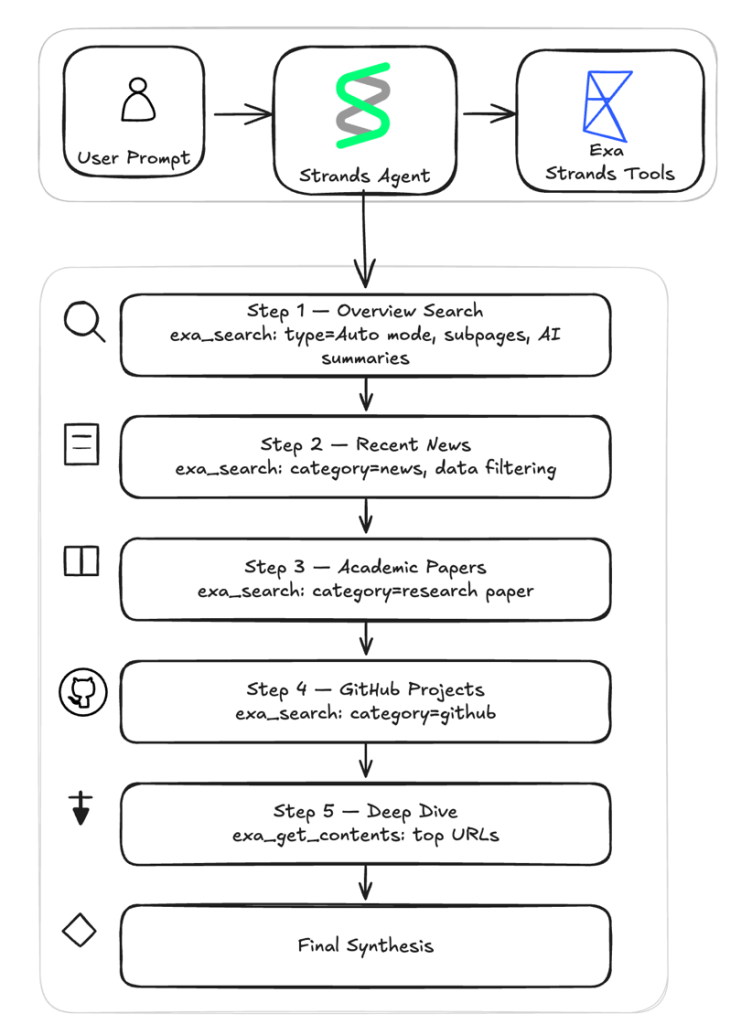
💡Tutorial to add web search to Strands Agents via Exa—build smarter multi-step AI agents.
⚡ 30-Second TL;DR
What Changed
Set up Exa integration in Strands Agents
Why It Matters
Empowers developers to build more intelligent agents that fetch real-time web data, enhancing autonomy in complex workflows. Reduces reliance on static knowledge bases for dynamic tasks.
What To Do Next
Follow the AWS ML Blog tutorial to integrate Exa into your Strands Agents project.
Who should care:Developers & AI Engineers
Key Points
- •Set up Exa integration in Strands Agents
- •Access two core Exa tools for search and browsing
- •Real-world use cases for multi-step agent tasks with web search
🧠 Deep Insight
AI-generated analysis for this event.
🔑 Enhanced Key Takeaways
- •Exa's search architecture utilizes a neural search engine specifically optimized for LLM consumption, providing structured JSON output that reduces token overhead compared to traditional web scraping.
- •The integration leverages Strands Agents' autonomous orchestration layer to handle recursive search loops, allowing the agent to refine queries based on intermediate search results without human intervention.
- •The implementation addresses the 'hallucination' problem in RAG systems by enforcing strict citation requirements within the agent's tool-calling loop, ensuring web-sourced data is grounded in specific URLs.
📊 Competitor Analysis▸ Show
| Feature | Exa (Strands Integration) | Tavily AI | Serper.dev |
|---|---|---|---|
| Search Paradigm | Neural/Semantic Search | LLM-optimized Search | Traditional API Wrapper |
| Data Structure | Cleaned/Parsed Content | Context-ready Snippets | Raw Search Results |
| Primary Use Case | Autonomous Agent Workflows | RAG Pipelines | Simple Search Integration |
| Pricing Model | Usage-based (Token/Query) | Tiered Subscription | Pay-per-request |
🛠️ Technical Deep Dive
- Tool 1: Search API: Utilizes vector-based semantic retrieval to return relevant URLs based on natural language queries, bypassing keyword-matching limitations.
- Tool 2: Contents API: Performs automated HTML cleaning and content extraction, converting raw web pages into LLM-friendly text blocks while stripping boilerplate (ads, navigation).
- Orchestration: Strands Agents utilize a ReAct (Reasoning + Acting) pattern, where the agent model decides whether to call the Exa Search tool or the Exa Contents tool based on the current state of the task.
- Latency: The integration supports asynchronous tool execution, allowing agents to trigger multiple parallel search queries to reduce total task completion time.
🔮 Future ImplicationsAI analysis grounded in cited sources
Autonomous agents will shift from static RAG to dynamic, real-time web exploration.
The ability to recursively search and browse the live web allows agents to solve problems that require information not present in static training datasets.
Search-as-a-Service providers will increasingly optimize for machine-readability over human-readability.
As agentic workflows become the primary consumers of search data, the value proposition shifts from 'best link' to 'most actionable data structure'.
⏳ Timeline
2023-09
Exa (formerly Metaphor) pivots to focus exclusively on LLM-native search infrastructure.
2025-02
Strands Agents framework launches with native support for tool-calling architectures.
2026-04
AWS ML Blog publishes the integration guide for Strands + Exa.
📰
Weekly AI Recap
Read this week's curated digest of top AI events →
👉Related Updates
AI-curated news aggregator. All content rights belong to original publishers.
Original source: AWS Machine Learning Blog ↗