🌍The Next Web (TNW)•Stalecollected in 54m
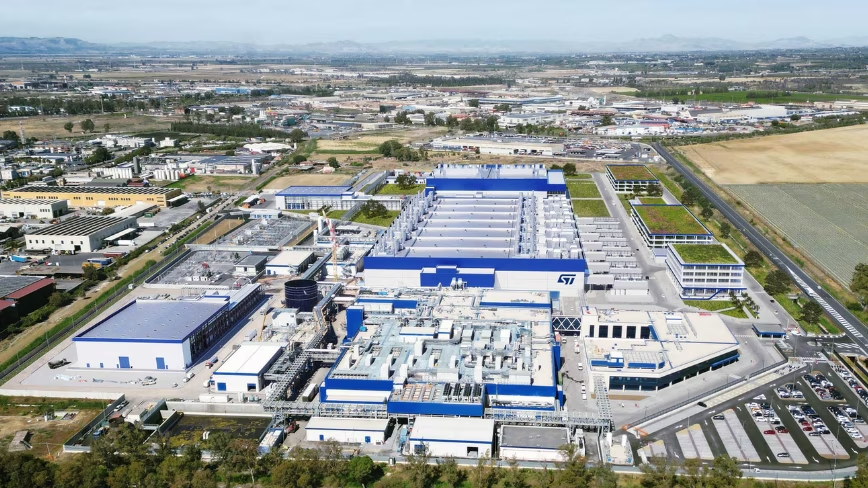
STM Targets $3B Satellite Revenue
💡Space chip revenue boom hints at orbital data centers for AI infra.
⚡ 30-Second TL;DR
What Changed
Shipped >5B RF antenna chips to Starlink
Why It Matters
Signals booming demand for space semiconductors, potentially enabling orbital data centers for distributed AI compute. Strengthens supply chain for satellite networks supporting global AI connectivity.
What To Do Next
Test STMicroelectronics' space-qualified RF chips for AI edge devices in satellite prototypes.
Who should care:Enterprise & Security Teams
Key Points
- •Shipped >5B RF antenna chips to Starlink
- •$3B+ cumulative LEO revenue projected 2026-2028
- •Chips qualified for ESA since 1977
- •Orbital data centers eyed for later expansion
🧠 Deep Insight
AI-generated analysis for this event.
🔑 Enhanced Key Takeaways
- •STMicroelectronics' RF front-end modules (FEMs) for Starlink utilize advanced Silicon-on-Insulator (SOI) technology, which is critical for achieving the high-frequency switching and power efficiency required for phased-array satellite communication.
- •The company's strategy involves leveraging its 'Space-Grade' qualification process, which includes rigorous radiation-hardening testing, to transition from consumer-grade LEO components to high-reliability infrastructure for orbital data centers.
- •STMicroelectronics is expanding its manufacturing capacity for these specific RF components at its Crolles and Agrate facilities to meet the projected demand from the Starlink constellation expansion and other LEO operators.
📊 Competitor Analysis▸ Show
| Feature | STMicroelectronics | Analog Devices (ADI) | Infineon Technologies |
|---|---|---|---|
| LEO RF Focus | High-volume phased-array FEMs | High-performance beamforming ICs | Power management & RF switches |
| Market Position | Dominant in Starlink supply chain | Strong in defense/aerospace | Emerging in satellite power systems |
| Tech Advantage | SOI process integration | Precision signal processing | SiC/GaN power efficiency |
🛠️ Technical Deep Dive
- RF Front-End Modules (FEMs): Integration of power amplifiers (PA), low-noise amplifiers (LNA), and switches on a single die using SOI technology.
- Radiation Hardening: Utilization of proprietary design-for-reliability (DfR) techniques to mitigate Single Event Effects (SEE) in LEO environments without the cost of traditional bulk-silicon rad-hard processes.
- Beamforming Support: Chips are optimized for high-speed phase shifting required for electronic beam steering in flat-panel user terminals.
🔮 Future ImplicationsAI analysis grounded in cited sources
STMicroelectronics will become the primary supplier for orbital edge computing hardware.
Their established high-volume manufacturing pipeline for space-qualified RF components provides a unique cost advantage for scaling orbital data center infrastructure.
The company will increase its R&D spending on GaN-on-Silicon technology.
To maintain dominance in LEO satellite power and RF efficiency, the company must transition beyond standard SOI to wider-bandgap materials for higher power density.
⏳ Timeline
1977-01
STMicroelectronics (then SGS-ATES) receives first ESA qualification for space-grade components.
2020-05
STMicroelectronics begins mass-scale delivery of RF components for Starlink user terminals.
2023-11
Company announces expansion of 300mm wafer production capacity in Crolles to support RF and power semiconductor demand.
2025-02
STMicroelectronics achieves milestone of 4 billion RF antenna chips shipped to satellite customers.
📰
Weekly AI Recap
Read this week's curated digest of top AI events →
👉Related Updates

AI-curated news aggregator. All content rights belong to original publishers.
Original source: The Next Web (TNW) ↗