SpaceX Starship Completes High-Stakes Flight Test
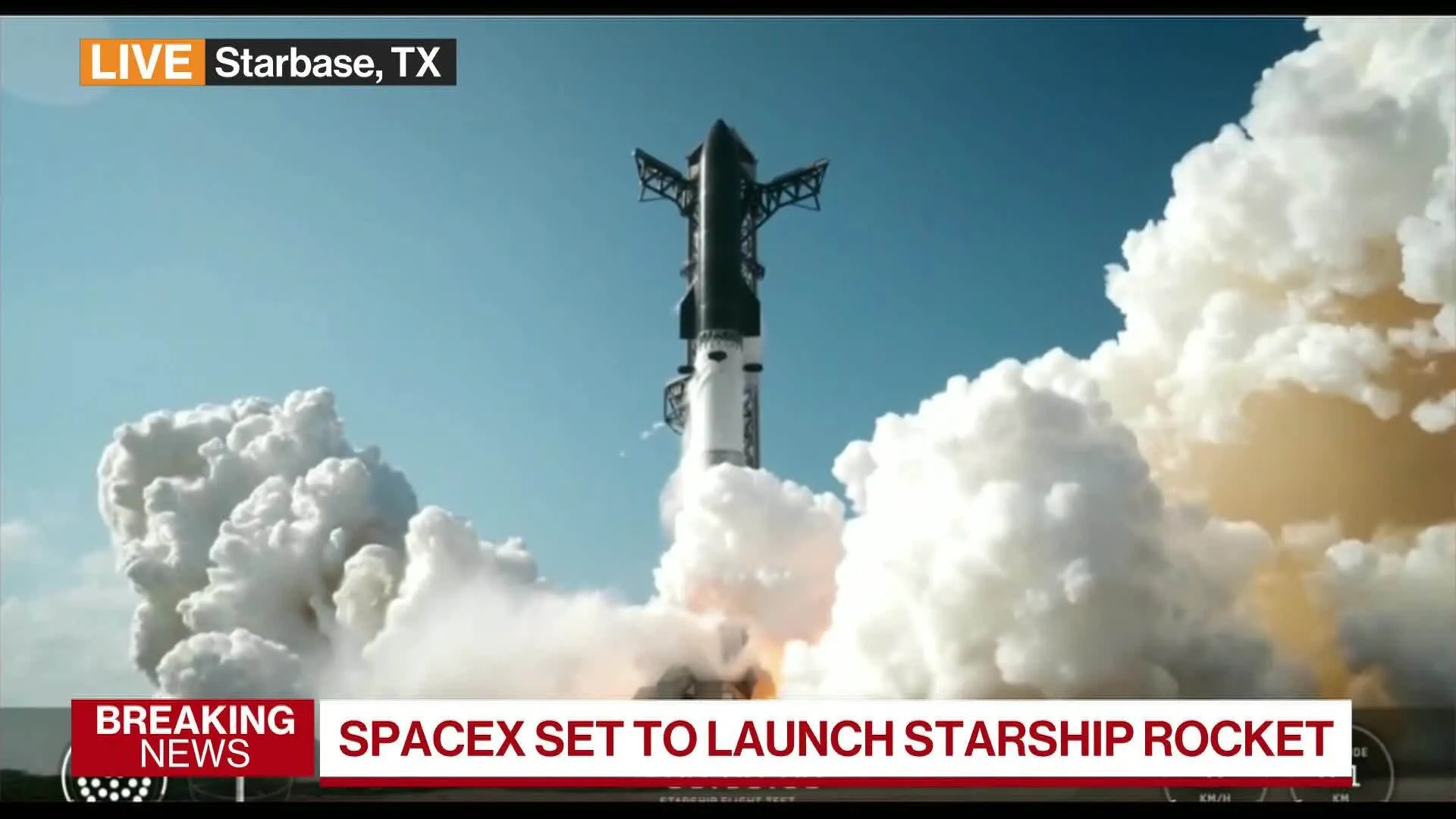
💡SpaceX's Starship is the primary vehicle for future orbital data centers and space-based AI infrastructure.
⚡ 30-Second TL;DR
What Changed
Starship test flight focuses on human space travel and orbital infrastructure
Why It Matters
The success of Starship lowers the cost of deploying massive satellite constellations and edge computing nodes in orbit, potentially revolutionizing global connectivity.
What To Do Next
Monitor SpaceX launch cadence to estimate future costs for deploying space-based edge AI infrastructure.
Key Points
- •Starship test flight focuses on human space travel and orbital infrastructure
- •Supports long-term goals for satellite internet and space-based data centers
- •Demonstrates progress in heavy-lift launch capabilities for tech deployment
🧠 Deep Insight
Web-grounded analysis with 23 cited sources.
🔑 Enhanced Key Takeaways
- •The recent Starship Flight 12 on May 22, 2026, marked the debut of the "next generation Starship and Super Heavy vehicles" (Starship V3), featuring upgraded Raptor engines and launching from a newly designed pad.
- •This specific flight test included the deployment of 20 Starlink simulators and two modified Starlink satellites, designed to validate hardware for the upcoming Starlink V3 generation and test methods for analyzing Starship's heat shield readiness.
- •SpaceX's long-term strategy, as detailed in its S-1 filing for a potential IPO, involves a significant pivot towards AI infrastructure, with a substantial portion of its Q1 2026 capital expenditures (76.4% or $7.72 billion) allocated to AI data centers and GPU clusters.
- •The company has sought FCC approval to launch up to 1 million satellites to function as orbital data centers, a massive expansion intended to leverage continuous solar power and natural radiative cooling in space for energy-intensive AI workloads.
- •SpaceX envisions these orbital data centers utilizing Starlink V3 satellites equipped with Tesla AI chips, forming a decentralized supercomputer network in orbit, which Elon Musk claims could become the lowest-cost AI compute option within five years.
📊 Competitor Analysis▸ Show
| Feature/Category | SpaceX Starship (Heavy-Lift) | Blue Origin New Glenn (Heavy-Lift) | ULA Vulcan Centaur (Heavy-Lift) | SpaceX Starlink (Satellite Internet) | Amazon Leo (Project Kuiper) (Satellite Internet) | OneWeb (Satellite Internet) |
|---|---|---|---|---|---|---|
| Classification | Super Heavy-lift, Fully Reusable | Heavy-lift, Reusable First Stage | Heavy-lift, Future SMART Reuse | LEO Constellation, Global Broadband | LEO Constellation, Global Broadband | LEO Constellation, Enterprise-focused |
| Payload to LEO (Reusable) | 100-150 metric tons | 45 metric tons | 27.2 metric tons | N/A (Satellite Deployment) | N/A (Satellite Deployment) | N/A (Satellite Deployment) |
| Propellant | Liquid Methane/Liquid Oxygen (LOX) | Liquid Natural Gas (Methane)/LOX | Liquid Methane/LOX (BE-4 engines) | N/A (Satellites) | N/A (Satellites) | N/A (Satellites) |
| Status | In development, iterative test flights | Nearing first test flight (early 2025) | Operational (since Jan 2024) | Operational, thousands of satellites | Planned commercial service Q1 2026 | Operational, 656 satellites (Feb 2026) |
| Typical Speeds/Latency | N/A | N/A | N/A | Up to 150 Mbps (beta, 2020), lower latency than GEO | Planned | 50 Mbps download, 10 Mbps upload, 70ms latency |
🛠️ Technical Deep Dive
- Starship is a two-stage, fully reusable super heavy-lift launch vehicle, comprising the Super Heavy booster and the Starship upper stage/spacecraft.
- Both stages are constructed from stainless steel and utilize Raptor engines, which are reusable methane-oxygen staged-combustion engines.
- The Super Heavy booster is powered by 33 Raptor engines, while the Starship upper stage uses six engines (three optimized for sea-level and three for vacuum).
- The total stacked height of Starship is approximately 121-124 meters (398-407 ft) with a diameter of 9 meters (30 ft).
- In its baseline reusable configuration, Starship is designed to deliver 100-150 metric tons to Low Earth Orbit (LEO), with a potential for 250 metric tons in an expendable configuration.
- Key design elements include a common bulkhead separating the methane and oxygen tanks, and the implementation of 'hot staging,' where the upper stage engines ignite before separating from the booster.
- For orbital data centers, the concept involves integrating Tesla AI chips into Starlink V3 satellites, leveraging continuous solar power and the vacuum of space for passive radiative cooling to manage the immense thermal loads of AI computation.
🔮 Future ImplicationsAI analysis grounded in cited sources
⏳ Timeline
📎 Sources (23)
Factual claims are grounded in the sources below. Forward-looking analysis is AI-generated interpretation.
- spacex.com
- spaceflightnow.com
- space.com
- futurumgroup.com
- fandom.com
- skyandtelescope.org
- cryptobriefing.com
- businessinsider.com
- spacewar.com
- substack.com
- wikipedia.org
- uchicago.edu
- eoportal.org
- quora.com
- davidveksler.com
- youtube.com
- spacex.com
- universemagazine.com
- thenetworkinstallers.com
- maxpolyakov.com
- pcmag.com
- washingtontechnology.com
- medium.com
Weekly AI Recap
Read this week's curated digest of top AI events →
👉Related Updates
AI-curated news aggregator. All content rights belong to original publishers.
Original source: Bloomberg Technology ↗