Sound Powers Tiny Flying and Swimming Robots
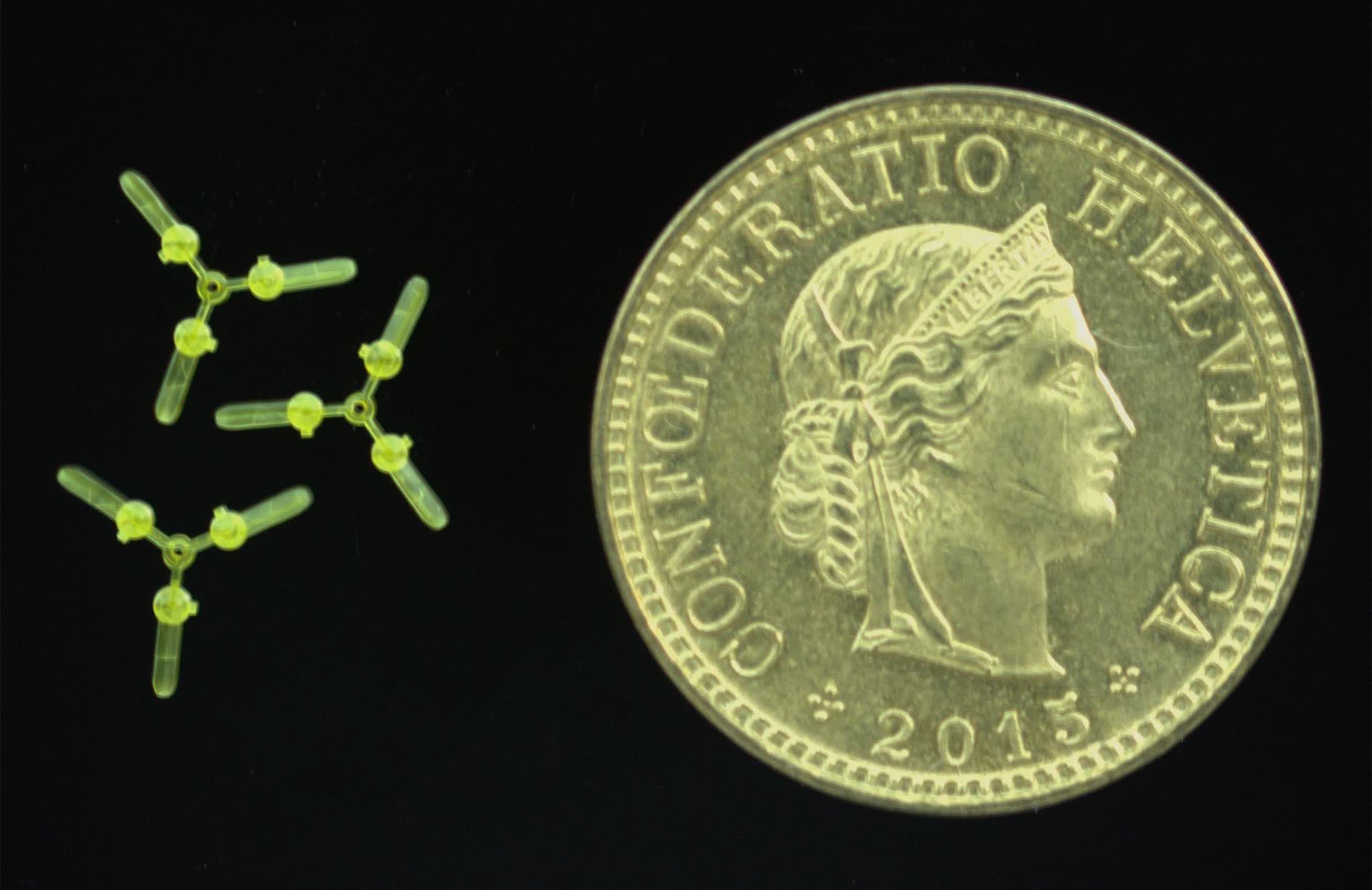
💡A new motor-free propulsion concept could reshape how researchers build tiny embodied robots.
⚡ 30-Second TL;DR
What Changed
EPFL researchers created sound-powered miniature drones and boats.
Why It Matters
This research could expand the design space for miniature embodied robots, especially where motors and batteries are impractical. AI robotics researchers may eventually use such lightweight platforms for sensing, exploration, or swarm experiments.
What To Do Next
Review the published EPFL design and prototype a resonant-cavity actuator as a motor-free propulsion option for your next micro-robotics experiment.
Key Points
- •EPFL researchers created sound-powered miniature drones and boats.
- •3D-printed resonant cavities respond to specific frequencies to generate thrust.
- •The design eliminates conventional motors, gears, and magnetic components.
- •The approach could enable lighter and simpler propulsion for extremely small robots.
🧠 Deep Insight
AI-generated analysis for this event.
🔑 Enhanced Key Takeaways
- •The propulsion mechanism relies on acoustic streaming, where sound waves create localized fluid flow patterns that exert force on the robot's structure.
- •Researchers utilized the phenomenon of 'acoustic levitation' principles adapted for fluid environments to achieve motion without onboard power sources.
- •The 3D-printed cavities are specifically engineered as Helmholtz resonators, which amplify sound pressure at targeted frequencies to maximize thrust efficiency.
- •This technology is being explored for 'swarm robotics' applications, where a single external sound source could simultaneously control and power hundreds of individual units.
- •The robots are designed to operate in both air and water, demonstrating the versatility of acoustic propulsion across different fluid densities.
🛠️ Technical Deep Dive
- Propulsion Mechanism: Utilizes acoustic streaming generated by high-intensity sound waves interacting with asymmetric resonant cavities.
- Structural Design: Employs additive manufacturing (3D printing) to create precise internal geometries that function as Helmholtz resonators.
- Power Source: External acoustic transducers (speakers) provide the energy, eliminating the need for batteries, capacitors, or fuel cells on the robot.
- Frequency Range: Operates within specific ultrasonic or high-frequency audible ranges to minimize noise pollution while maintaining thrust.
- Material Composition: Typically constructed from lightweight, rigid polymers to ensure structural integrity under acoustic pressure.
🔮 Future ImplicationsAI analysis grounded in cited sources
⏳ Timeline
Weekly AI Recap
Read this week's curated digest of top AI events →
👉Related Updates


AI-curated news aggregator. All content rights belong to original publishers.
Original source: cnBeta (Full RSS) ↗