Smack Technologies Raises $61M for Battlefield AI
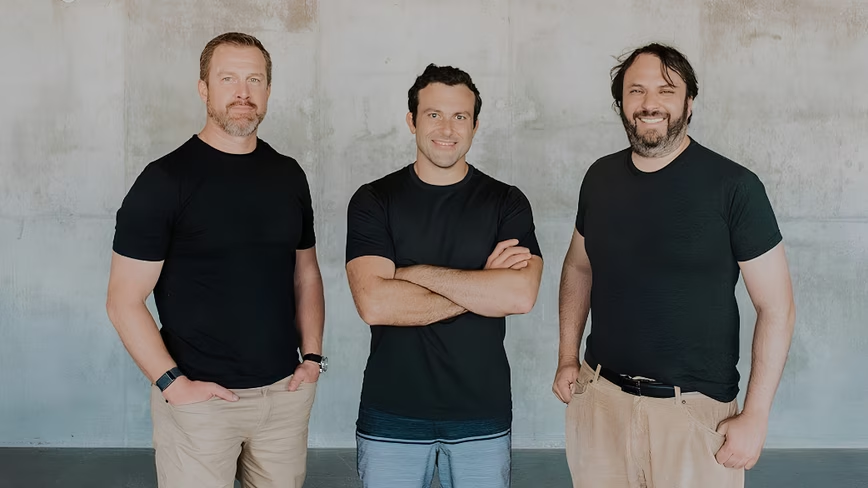
💡A $61M defence-AI round shows how Pentagon demand is reshaping the startup market.
⚡ 30-Second TL;DR
What Changed
Smack Technologies raised $61 million in new funding.
Why It Matters
The funding signals continued investor confidence in defence AI and may increase competition for government contracts. AI practitioners entering this market will need to account for procurement cycles, security requirements, and battlefield reliability rather than consumer-scale deployment alone.
What To Do Next
Review Smack Technologies’ public product and procurement documentation, then map its stated battlefield use cases against your own secure AI deployment requirements.
Key Points
- •Smack Technologies raised $61 million in new funding.
- •The Austin-based startup develops AI software for battlefield use.
- •Pentagon procurement urgency is helping shape a commercial market for defence AI.
🧠 Deep Insight
AI-generated analysis for this event.
🔑 Enhanced Key Takeaways
- •The $61 million Series B round was led by Shield Capital, a venture firm specializing in dual-use technologies, with participation from existing investors including Andreessen Horowitz.
- •Smack Technologies' flagship platform, 'Aegis-OS,' utilizes edge-computing architectures to enable real-time sensor fusion and target identification in GPS-denied environments.
- •The company has secured a strategic partnership with the Defense Innovation Unit (DIU) to integrate its software into the U.S. Army's tactical network modernization program.
- •Smack Technologies is actively recruiting former DARPA program managers to lead its 'Autonomous Decision Support' division, signaling a shift toward human-in-the-loop AI systems.
- •The funding will be specifically allocated to expanding the company's 'Project Obsidian' initiative, which focuses on hardening AI models against adversarial machine learning attacks.
📊 Competitor Analysis▸ Show
| Competitor | Primary Focus | Key Differentiator | Benchmarks |
|---|---|---|---|
| Anduril Industries | Autonomous systems/Hardware | Full-stack hardware integration | High-scale deployment |
| Palantir Technologies | Data analytics/OS | Enterprise-grade data fusion | Proven government scale |
| Shield AI | Autonomous flight/Swarm | Edge-native autonomy | GPS-denied navigation |
🛠️ Technical Deep Dive
- Architecture: Utilizes a proprietary Transformer-based model optimized for low-latency inference on NVIDIA Jetson Orin modules.
- Data Processing: Implements federated learning protocols to train models across distributed tactical nodes without requiring centralized cloud connectivity.
- Security: Employs post-quantum cryptographic standards for all data-at-rest and data-in-transit within the battlefield network.
- Integration: Supports Open Mission Systems (OMS) and Universal Command and Control Interface (UCI) standards for interoperability with legacy military hardware.
🔮 Future ImplicationsAI analysis grounded in cited sources
⏳ Timeline
Weekly AI Recap
Read this week's curated digest of top AI events →
👉Related Updates


AI-curated news aggregator. All content rights belong to original publishers.
Original source: The Next Web (TNW) ↗