SilverTorch: A New Paradigm for Recommendation Systems
💡Meta's new recommendation architecture delivers 23x higher throughput and 20x better cost efficiency.
⚡ 30-Second TL;DR
What Changed
Achieves up to 23.7x higher throughput compared to state-of-the-art methods.
Why It Matters
This research could drastically reduce infrastructure costs for large-scale recommendation engines. It sets a new benchmark for efficiency in handling massive user-generated content datasets.
What To Do Next
Review the SilverTorch research paper to evaluate if your retrieval pipeline can benefit from an 'Index as Model' architecture.
Key Points
- •Achieves up to 23.7x higher throughput compared to state-of-the-art methods.
- •Delivers 20.9x better compute cost efficiency than traditional CPU-based solutions.
- •Unifies all retrieval components for user-generated content under a single architecture.
- •Improves recommendation accuracy alongside performance gains.
🧠 Deep Insight
Web-grounded analysis with 10 cited sources.
🔑 Enhanced Key Takeaways
- •SilverTorch addresses inefficiencies in traditional recommendation systems that relied on fragmented, CPU-based microservices for Approximate Nearest Neighbor (ANN) indexing, feature filtering, and caching, which led to version inconsistency, communication overhead, and limited support for complex model architectures.
- •The system introduces a novel GPU-native Bloom index algorithm for feature filtering, which uses signature-based bit operations to process multiple items simultaneously, and a fused Int8 quantized ANN kernel for reduced memory footprint and faster searches.
- •By unifying the serving stack, SilverTorch enables advanced capabilities such as OverArch scoring layers for learned user-item interactions, multi-task retrieval with in-model value aggregation, and embedding caching for early-stage ranking by pre-loading item embeddings into GPU memory.
- •SilverTorch's "Index as Model" paradigm allows for the natural integration of large language models (LLMs) as just another module, treating them identically to other components for tasks like LLM-based item generation and filtering.
- •The system has been deployed across major Meta products, serving hundreds of models online and recommending content for billions of daily active users, demonstrating its scalability and real-world impact.
🛠️ Technical Deep Dive
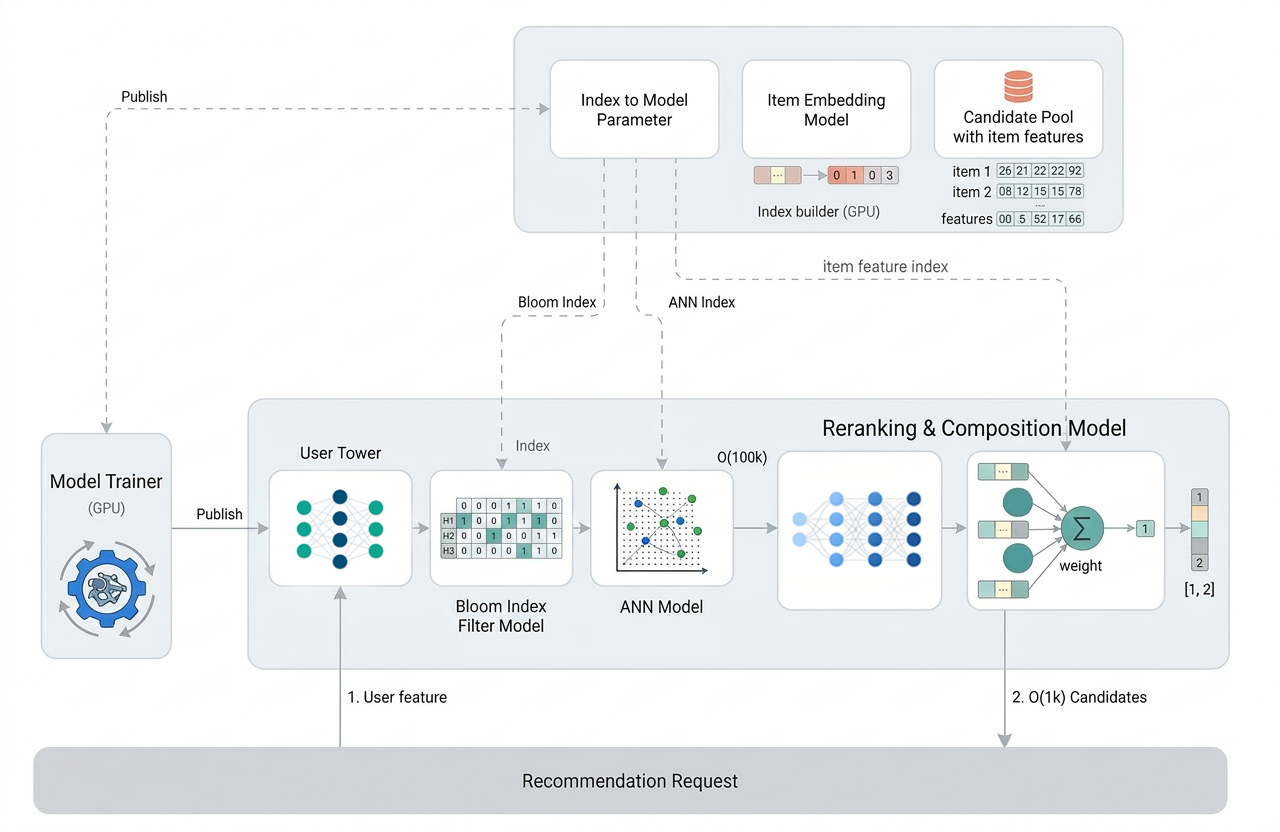
- Architecture: SilverTorch is a unified GPU-based system where all retrieval, filtering, multi-task score aggregation, and early-stage ranking operations are expressed as tensor operators within a single PyTorch-derived computation graph.
- Core Innovations:
- Bloom Index for GPU-based Feature Filtering: This novel algorithm transforms feature filtering into parallel bitwise tensor operations. It constructs an M-bit Bloom filter for each item using K hash functions, enabling efficient filtering by comparing query Bloom filters.
- Fused Int8 Quantized ANN Kernel: This kernel enables searching arbitrary top-k values with a reduced memory footprint by quantizing item embeddings to Int8 precision and leveraging GPU instructions like dp4a. It utilizes an IVF (inverted file indexing) algorithm.
- Co-design: The system co-designs these indexes to eliminate unnecessary computation and memory allocation, achieving a 30x reduction in feature filtering compute for partial candidate sets.
- Serving Components: It consolidates components like the User Tower (computes user embedding), Bloom-index Layer (performs feature-level filtering), and ANN layer (retrieves items).
- Early-Stage Ranking (ESR) Optimization: An in-model embedding cache significantly boosts ESR performance by eliminating network overhead and online embedding computation, achieving up to 10.18x higher Queries Per Second (QPS) in some evaluations.
- Model Publishing: After training, a publish flow composes a SilverTorch model, where item embeddings are calculated on GPUs, quantized to Int8, and processed by the ANN index builder using KMeans++-based training.
- Latency: SilverTorch achieves a 5.6x lower latency compared to CPU-based baselines.
🔮 Future ImplicationsAI analysis grounded in cited sources
⏳ Timeline
📎 Sources (10)
Factual claims are grounded in the sources below. Forward-looking analysis is AI-generated interpretation.
Weekly AI Recap
Read this week's curated digest of top AI events →
👉Related Updates
AI-curated news aggregator. All content rights belong to original publishers.
Original source: Meta Engineering Blog ↗