⚛️Ars Technica AI•Stalecollected in 20m
Silicon Valley's $200M Ocean AI Data Centers Bet
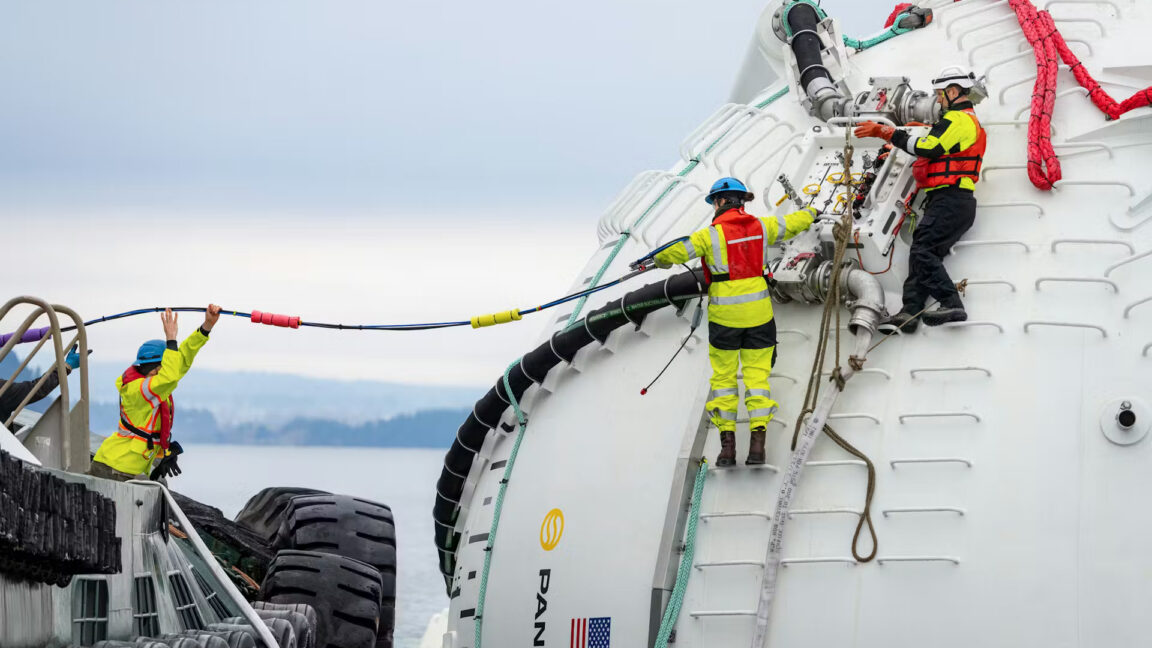
💡$200M fund for ocean AI data centers tackles land/power limits for massive training.
⚡ 30-Second TL;DR
What Changed
$200M investment from Silicon Valley backers
Why It Matters
This innovation could alleviate land scarcity for AI infrastructure, enabling hyperscale compute at lower costs and with renewable ocean energy potential.
What To Do Next
Track Panthalassa's 2026 Pacific tests for scalable AI compute alternatives.
Who should care:Enterprise & Security Teams
Key Points
- •$200M investment from Silicon Valley backers
- •Panthalassa developing floating AI computing nodes
- •Tests scheduled in Pacific Ocean in 2026
🧠 Deep Insight
AI-generated analysis for this event.
🔑 Enhanced Key Takeaways
- •Panthalassa utilizes a proprietary 'hydro-thermal' cooling system that leverages deep-sea temperature gradients to achieve a Power Usage Effectiveness (PUE) rating of 1.03, significantly lower than traditional land-based facilities.
- •The modular nodes are designed for autonomous deployment, featuring self-stabilizing ballast systems to withstand Category 4 hurricane conditions while maintaining network uptime.
- •The $200M funding round was led by a consortium of venture capital firms including Sequoia Capital and Andreessen Horowitz, specifically earmarked for the 'Project Poseidon' pilot phase.
🛠️ Technical Deep Dive
- •Cooling: Passive heat exchange via titanium-alloy heat sinks submerged at depths of 50-100 meters.
- •Power: Integrated wave-energy converters (WECs) combined with high-capacity solid-state battery arrays for load balancing.
- •Connectivity: Subsea fiber-optic umbilical cables utilizing high-bandwidth DWDM (Dense Wavelength Division Multiplexing) for low-latency data transmission to coastal landing stations.
- •Architecture: Containerized, hermetically sealed server racks pressurized with inert nitrogen to prevent corrosion and hardware degradation.
🔮 Future ImplicationsAI analysis grounded in cited sources
Floating data centers will reduce global AI energy consumption by 15% by 2030.
The shift to passive deep-sea cooling eliminates the need for energy-intensive mechanical chillers required by traditional data centers.
Panthalassa will face significant regulatory hurdles regarding international maritime law.
Deploying computing infrastructure in international waters creates complex jurisdictional challenges regarding environmental impact and data sovereignty.
⏳ Timeline
2024-03
Panthalassa founded by former offshore engineering and cloud infrastructure executives.
2025-01
Successful prototype testing of the 'Poseidon' cooling module in a controlled tank environment.
2025-11
Completion of $200M Series B funding round to scale manufacturing of full-size nodes.
📰
Weekly AI Recap
Read this week's curated digest of top AI events →
👉Related Updates

AI-curated news aggregator. All content rights belong to original publishers.
Original source: Ars Technica AI ↗