Shrink Git Clone Costs at Agent Scale
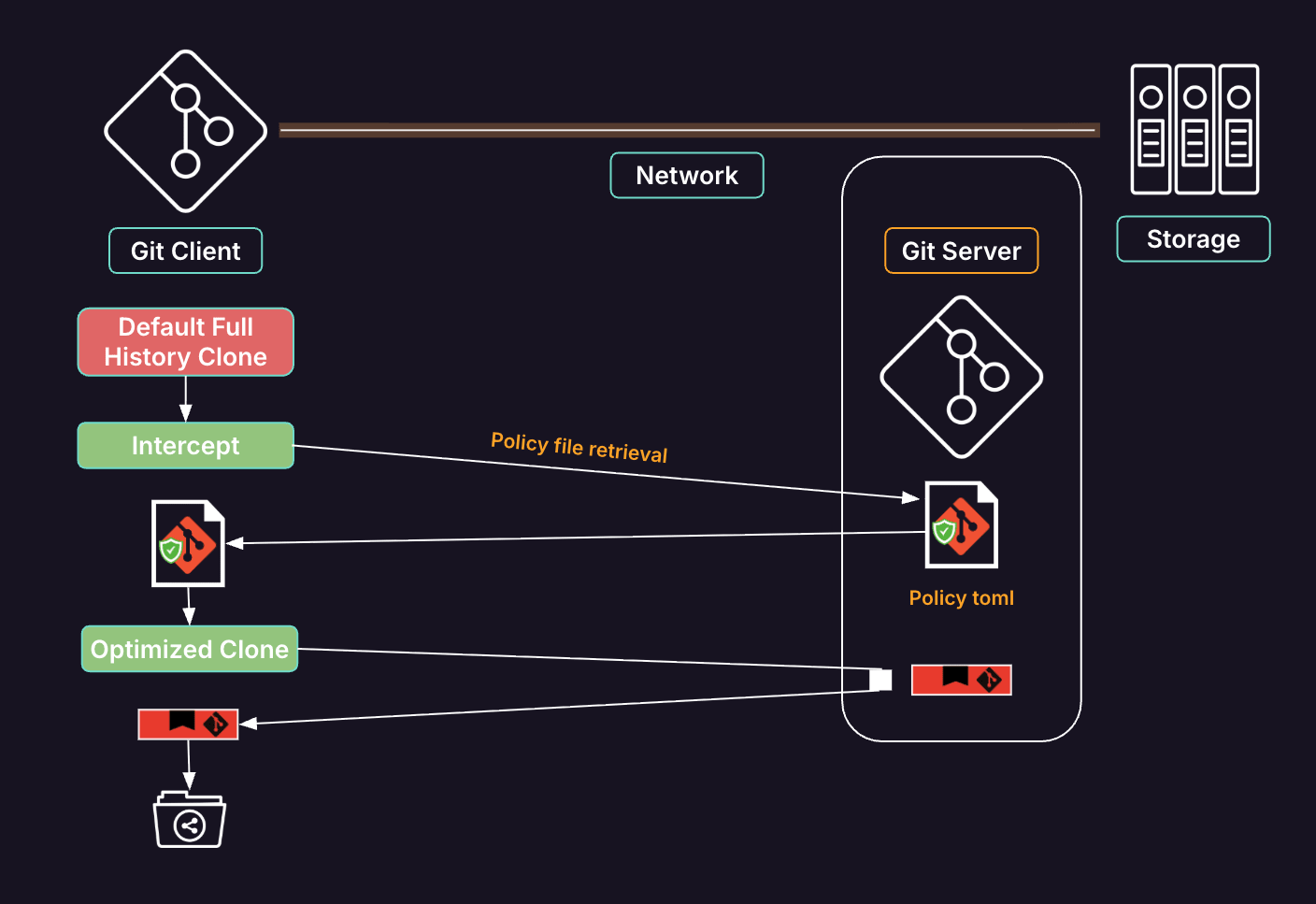
💡AI agents can multiply Git clone costs; learn how to enforce leaner checkouts across every sandbox and CI job.
⚡ 30-Second TL;DR
What Changed
Full-history clones require the server to scan repository history, build pack files, and transmit all requested data.
Why It Matters
For teams running coding agents or high-volume CI, reducing clone size can lower infrastructure costs and improve job reliability. Centralized enforcement also reduces the risk that newly created agent environments fall back to expensive full clones.
What To Do Next
Audit every AI-agent and CI checkout, then enforce --depth=1, single-branch fetching, and --filter=blob:none through a shared Git Clone Override Policy.
Key Points
- •Full-history clones require the server to scan repository history, build pack files, and transmit all requested data.
- •Agentic AI workflows may clone repositories more frequently and unpredictably than human developer workflows.
- •Shallow clones, single-branch clones, partial clones with --filter=blob:none, and sparse checkout can reduce clone time and storage.
- •GitLab reports that optimized settings in Git Much Faster reduced clone times by up to 93% and disk usage by up to 98%.
- •A Clone Override Policy centralizes optimization so laptops, CI jobs, and agent sandboxes do not require separate manual tuning.
🧠 Deep Insight
AI-generated analysis for this event.
🔑 Enhanced Key Takeaways
- •GitLab's implementation of Git Clone Override Policy leverages server-side configuration to override client-side Git settings, preventing 'configuration drift' where agents or CI runners ignore optimization best practices.
- •The use of --filter=blob:none in partial clones significantly reduces server-side CPU load by avoiding the need to compute and compress large binary objects that are not immediately required for the initial checkout.
- •GitLab's 'Git Much Faster' initiative integrates with Gitaly, the service that handles Git repository storage, to cache optimized packfiles specifically for shallow and partial clone requests.
- •The rise of 'Agentic CI' has shifted the bottleneck from developer-initiated clones to automated, high-concurrency clone requests, necessitating server-side rate limiting alongside clone optimization.
- •GitLab's optimization strategy includes support for 'sparse-checkout' patterns, which allows agents to download only the specific subdirectories needed for a task, further minimizing I/O overhead in large monorepos.
📊 Competitor Analysis▸ Show
| Feature | GitLab (Git Much Faster) | GitHub (Actions/Git) | Azure DevOps |
|---|---|---|---|
| Clone Optimization | Server-side Override Policy | Partial Clone/Shallow support | Limited native policy |
| Agent-Specific Tuning | Native/Automated | Via Action configuration | Manual/Scripted |
| Performance Impact | Up to 93% reduction | Variable (Action dependent) | Variable |
🛠️ Technical Deep Dive
- Gitaly utilizes a custom packfile negotiation mechanism that prioritizes serving cached objects for common shallow clone depths.
- The --filter=blob:none flag instructs the server to omit all file contents (blobs) from the initial packfile, sending only tree and commit objects.
- Sparse-checkout integration uses the Git 'sparse-index' feature to reduce the size of the index file, which improves performance for operations like git status and git add in large repositories.
- Server-side Git configuration overrides are enforced via the 'git config' protocol extensions, ensuring that even if a client requests a full history, the server can force a shallow depth.
🔮 Future ImplicationsAI analysis grounded in cited sources
⏳ Timeline
Weekly AI Recap
Read this week's curated digest of top AI events →
👉Related Updates

AI-curated news aggregator. All content rights belong to original publishers.
Original source: GitLab Blog ↗