Shenhai Zhiren Launches SEAgent 1.0
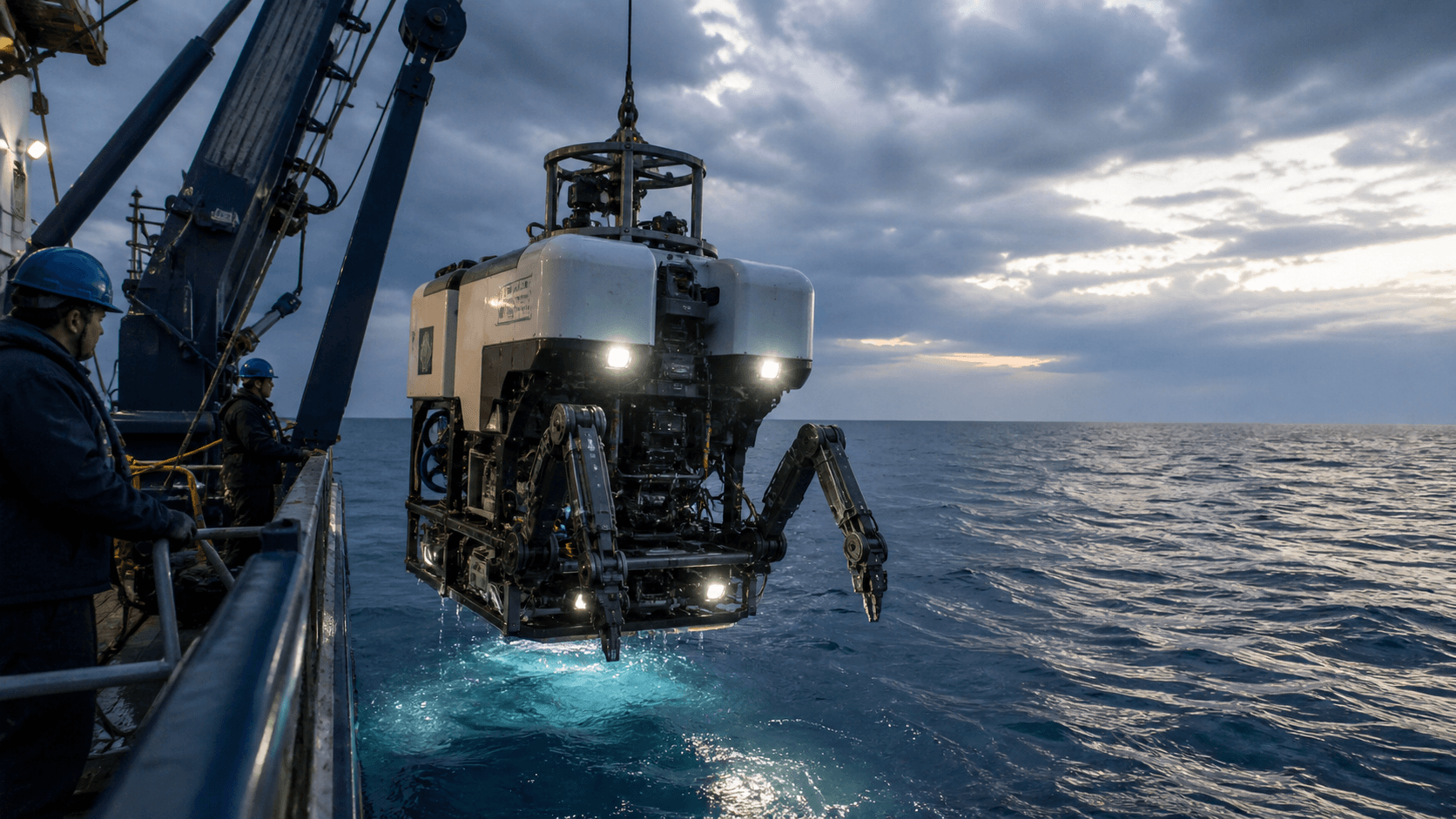
💡A major funding round and new underwater agent model point to accelerating embodied AI beneath the sea.
⚡ 30-Second TL;DR
What Changed
Shenhai Zhiren closed a 500 million yuan Series A financing round.
Why It Matters
The financing and commercial order indicate growing investment in AI-enabled deep-sea robotics and subsea infrastructure. SEAgent 1.0 could support more autonomous underwater operations, although the article does not specify its capabilities or deployment metrics.
What To Do Next
Track SEAgent 1.0's forthcoming autonomy and integration specifications to assess whether it can connect with your robotics control, perception, or mission-planning stack.
Key Points
- •Shenhai Zhiren closed a 500 million yuan Series A financing round.
- •New investors include GGV Capital and Cathay Capital's TotalEnergies-backed fund.
- •Existing backers BYD, Lightspeed China, and GGV Capital participated again.
- •The company debuted its underwater agent model, SEAgent 1.0.
- •Phoenix 600 operates at 3,000 meters and won a 100 million yuan UAE order.
🧠 Deep Insight
AI-generated analysis for this event.
🔑 Enhanced Key Takeaways
- •Shenhai Zhiren, formally known as Shenzhen Shenhai Zhiren Technology Co., Ltd., focuses on integrating AI-driven autonomous control systems into subsea infrastructure maintenance.
- •The SEAgent 1.0 model utilizes a multimodal architecture specifically trained on subsea sensor data, including sonar, visual, and pressure telemetry, to enable autonomous obstacle avoidance and path planning.
- •The Phoenix 600 cable-burial robot utilizes a proprietary high-pressure water jetting system that allows it to maintain structural integrity while operating in high-current, deep-sea environments.
- •The 100 million yuan order from the UAE telecom group is part of a broader regional initiative to expand subsea fiber optic connectivity across the Middle East and North Africa (MENA) region.
- •Shenhai Zhiren's R&D strategy emphasizes 'software-defined robotics,' aiming to reduce the reliance on human remote operation (ROV) pilots by increasing the autonomy of subsea assets.
📊 Competitor Analysis▸ Show
| Feature | Shenhai Zhiren (Phoenix 600) | Oceaneering (E-ROV) | Saipem (Hydrone) |
|---|---|---|---|
| Primary Focus | AI-Agent/Cable Burial | Subsea Services/ROV | Subsea Intervention |
| Max Depth | 3,000m | 3,000m+ | 3,000m |
| Autonomy Level | High (SEAgent 1.0) | Moderate (Remote Pilot) | High (Resident Drone) |
| Key Differentiator | BYD-backed supply chain | Global service footprint | Oil & Gas specialization |
🛠️ Technical Deep Dive
- SEAgent 1.0 Architecture: Employs a transformer-based foundation model adapted for underwater acoustic signal processing and real-time computer vision in low-light conditions.
- Phoenix 600 Propulsion: Features a multi-thruster configuration with dynamic positioning (DP) capabilities, allowing for station-keeping in currents up to 3 knots.
- Communication Interface: Utilizes a hybrid fiber-optic tether system for high-bandwidth data transmission, supporting real-time AI inference feedback loops.
- Power Management: Integrated with high-density battery modules optimized for deep-sea pressure, reducing the need for continuous surface power supply during short-duration missions.
🔮 Future ImplicationsAI analysis grounded in cited sources
⏳ Timeline
Weekly AI Recap
Read this week's curated digest of top AI events →
👉Related Updates



AI-curated news aggregator. All content rights belong to original publishers.
Original source: Pandaily ↗