Shadow APIs Scam Top LLMs to Researchers
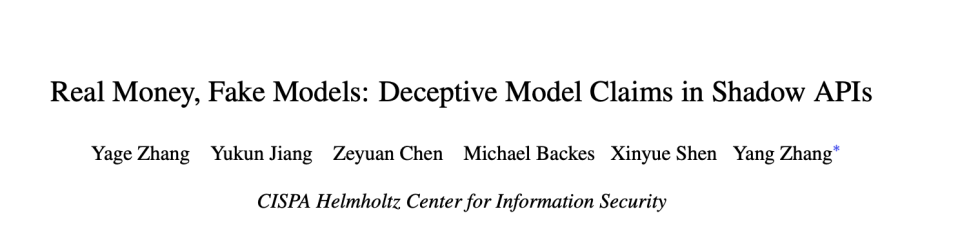
💡46% fake LLMs in papers—fingerprint your APIs to avoid bad science!
⚡ 30-Second TL;DR
What Changed
45.83% shadow APIs fail model fingerprint verification
Why It Matters
Undermines AI research reproducibility; practitioners risk faulty baselines. Economic loss: $11.5K-$14K direct costs for affected papers. Calls for better API verification standards.
What To Do Next
Implement model fingerprinting on any shadow/third-party LLM API before experiments.
Key Points
- •45.83% shadow APIs fail model fingerprint verification
- •Used in 116 ACL/CVPR/ICLR papers with 5966 citations
- •Performance drops up to 40% on AIME math benchmarks
- •Three scams: info premium, discount-substitution, resale markup
🧠 Deep Insight
Background and context from public sources — not the original article. 9 sources cited.
🔑 Enhanced Key Takeaways
- •CISPA researchers developed model fingerprint verification techniques to detect shadow APIs by analyzing response patterns and metadata mismatches with claimed proprietary models like GPT-5.
- •Shadow APIs often host vulnerable open-source LLMs such as Meta's Llama and Google DeepMind's Gemma variants with guardrails explicitly removed, enabling misuse in scams and fraud.
- •116 affected papers from ACL, CVPR, and ICLR conferences represent high-impact research, with 5966 citations amplifying the propagation of unreliable experimental results across AI literature.
🔮 Future ImplicationsAI analysis grounded in cited sources
📎 Sources (9)
Factual claims are grounded in the sources below. Forward-looking analysis is AI-generated interpretation.
- wqxc.com — Open Source AI Models Vulnerable to Criminal Misuse Researchers Warn
- netlibsecurity.com — Predictions 2026 AI Generated Scams and Phishing
- bankinfosecurity.com — Large Language Models Wont Replace Hackers a 24337
- okta.com — How Cybercriminals Are Using Gen AI to Scale Their Scams
- kychub.com — AI in Transaction Monitoring by 2026
- garymarcus.substack.com — The Long Shadow of Gpt
- aicerts.ai — AI Security Strategies for 2026 Fraud Surge
- thomsonreuters.com — 2025 Predictions Interplay Fraud AI
- darkreading.com — Seo Llms Fall Prey Phishing Scams
Weekly AI Recap
Read this week's curated digest of top AI events →
👉Related Updates

AI-curated news aggregator. All content rights belong to original publishers.
Original source: 虎嗅 ↗
This is a summary, not the original. Read the source, or get the weekly briefing.
Weekly AI briefing
One email a week. Unsubscribe anytime.