Sateliot seeks €150M to enable direct-to-smartphone 5G
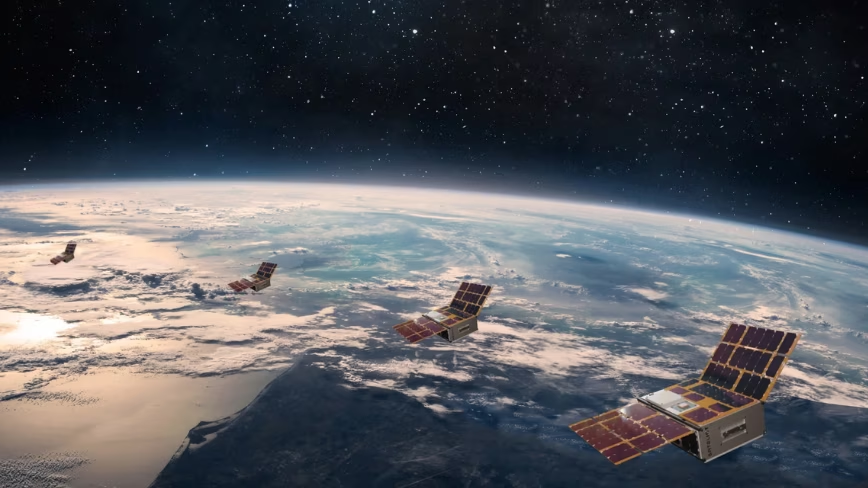
💡Direct-to-smartphone 5G from space is a critical infrastructure shift for global AI-powered edge and IoT deployments.
⚡ 30-Second TL;DR
What Changed
Sateliot is seeking €150 million in funding, a 50% increase from its previous round.
Why It Matters
This infrastructure development could significantly expand the reach of IoT and AI-driven edge applications by providing ubiquitous connectivity in remote areas. It reduces reliance on terrestrial cell towers for AI data synchronization.
What To Do Next
Monitor Sateliot's API documentation for future edge-computing integration opportunities in remote IoT deployments.
Key Points
- •Sateliot is seeking €150 million in funding, a 50% increase from its previous round.
- •The company plans to deploy 16 new low-Earth orbit satellites within the next year.
- •The core mission is to enable 5G connectivity directly on consumer smartphones from space.
🧠 Deep Insight
AI-generated analysis for this event.
🔑 Enhanced Key Takeaways
- •Sateliot utilizes a proprietary 'Store-and-Forward' mechanism combined with a standard 5G NB-IoT protocol to allow unmodified commercial smartphones to connect to their LEO constellation.
- •The company has secured strategic partnerships with major telecommunications operators, including Telefónica and Vodafone, to integrate satellite connectivity into existing roaming agreements.
- •Sateliot's technology operates in the S-band spectrum, which is specifically allocated for mobile satellite services, minimizing interference with terrestrial 5G networks.
- •The startup has successfully demonstrated the world's first 5G roaming service between a terrestrial mobile network and a satellite constellation, validating the 'seamless handover' capability.
- •Sateliot's business model focuses on a wholesale approach, acting as a 'carrier of carriers' rather than selling directly to end-user consumers.
📊 Competitor Analysis▸ Show
| Competitor | Technology Approach | Key Differentiator |
|---|---|---|
| AST SpaceMobile | Large-aperture phased array satellites | Supports high-bandwidth broadband (4G/5G) |
| SpaceX (Starlink) | Direct-to-Cell (DTC) via Starlink V2 | Massive constellation scale and global coverage |
| Lynk Global | 'Cell tower in space' architecture | Focus on SMS and basic IoT connectivity |
🛠️ Technical Deep Dive
- Sateliot employs a multi-constellation approach using LEO satellites at an altitude of approximately 500-600 km.
- The system utilizes the 3GPP Release 17 standard for Non-Terrestrial Networks (NTN), ensuring compatibility with existing 5G chipsets.
- The satellites act as transparent bent-pipe relays, though they incorporate onboard processing to manage the Doppler shift compensation required for high-speed LEO orbits.
- The architecture is designed to support NB-IoT (Narrowband Internet of Things) protocols, which are optimized for low-power, low-data-rate communication suitable for remote sensing and messaging.
🔮 Future ImplicationsAI analysis grounded in cited sources
⏳ Timeline
Weekly AI Recap
Read this week's curated digest of top AI events →
👉Related Updates

AI-curated news aggregator. All content rights belong to original publishers.
Original source: The Next Web (TNW) ↗