Sakana AI addresses user demand for JPY-based pricing
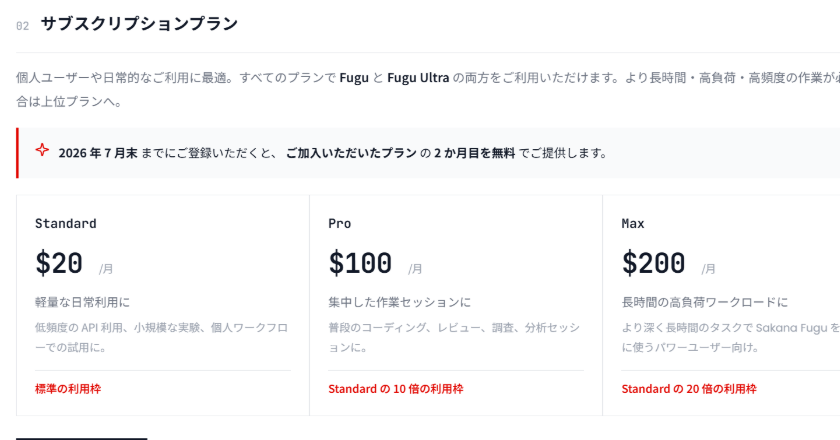
Sakana AI acknowledges Japanese market demand for JPY pricing, signaling a shift in their commercial strategy.
30-Second TL;DR
What Changed
Sakana Fugu currently uses USD-based pricing for its services.
Why It Matters
Shifting to local currency pricing could significantly increase the adoption rate of Sakana AI's models among Japanese SMEs and enterprises who prefer stable, predictable billing in their local currency.
What To Do Next
If you are a Japanese developer or founder, monitor Sakana AI's official announcements for the rollout of JPY billing to optimize your procurement budget.
Key Points
- •Sakana Fugu currently uses USD-based pricing for its services.
- •Japanese users have expressed a strong preference for JPY-based billing.
- •Sakana AI officially acknowledged the feedback and is considering implementation.
- •The move aims to lower the barrier for domestic Japanese enterprise adoption.
Deep Insight
AI-generated analysis for this event — not the original article.
Enhanced Key Takeaways
- •Sakana AI's 'Fugu' model series utilizes a unique evolutionary model merging architecture, which allows for efficient parameter optimization compared to traditional monolithic LLMs.
- •The push for JPY-based pricing is part of a broader 'Japan-first' enterprise strategy, aligning with the Japanese government's initiatives to promote sovereign AI infrastructure.
- •Currency volatility in the USD/JPY exchange rate has been cited by Japanese SMEs as a primary barrier to adopting SaaS-based AI services that lack localized billing.
- •Sakana AI has been actively collaborating with Japanese telecommunications giants and research institutions to integrate Fugu into local cloud environments, which typically require JPY-denominated procurement.
- •The company is exploring a tiered subscription model that would bundle JPY-based billing with localized technical support and compliance features tailored to Japanese data privacy laws.
Competitor Analysis
- Sakana AI (Fugu)
- USD (Transitioning to JPY)
- OpenAI (GPT-4o)
- USD
- Anthropic (Claude 3.5)
- USD
- Sakana AI (Fugu)
- Evolutionary Model Merging
- OpenAI (GPT-4o)
- Transformer (Dense/MoE)
- Anthropic (Claude 3.5)
- Transformer
- Sakana AI (Fugu)
- High (Japan-focused)
- OpenAI (GPT-4o)
- Low (Global)
- Anthropic (Claude 3.5)
- Low (Global)
- Sakana AI (Fugu)
- Sovereign AI/Local Cloud
- OpenAI (GPT-4o)
- Global API/Cloud
- Anthropic (Claude 3.5)
- Global API/Cloud
| Feature | Sakana AI (Fugu) | OpenAI (GPT-4o) | Anthropic (Claude 3.5) |
|---|---|---|---|
| Pricing Model | USD (Transitioning to JPY) | USD | USD |
| Architecture | Evolutionary Model Merging | Transformer (Dense/MoE) | Transformer |
| Localization | High (Japan-focused) | Low (Global) | Low (Global) |
| Enterprise Focus | Sovereign AI/Local Cloud | Global API/Cloud | Global API/Cloud |
Technical Deep Dive
- Fugu models leverage evolutionary algorithms to combine pre-trained models, significantly reducing the computational cost of training from scratch.
- The architecture emphasizes parameter-efficient fine-tuning (PEFT) techniques to allow for rapid adaptation to Japanese-specific linguistic nuances.
- Inference optimization is designed for deployment on edge devices and local Japanese data centers, minimizing latency for domestic users.
- The model utilizes a specialized tokenizer optimized for Japanese characters (Kanji, Hiragana, Katakana) to improve token efficiency and reduce costs.
Future ImplicationsAI analysis grounded in cited sources
Timeline
- 2024-01Sakana AI announces its founding in Tokyo by former Google researchers.
- 2024-03Release of initial research on evolutionary model merging techniques.
- 2025-02Launch of the 'Fugu' model series targeting Japanese language proficiency.
- 2025-11Sakana AI secures major funding round to expand enterprise-grade AI services.
- 2026-05Formal feedback collection begins regarding enterprise procurement pain points.
Weekly AI Recap
Read this week's curated digest of top AI events →
Related Updates
AI-curated news aggregator. All content rights belong to original publishers.
Original source: ITmedia AI+ (日本) ↗
This is a summary, not the original. Read the source, or get the weekly briefing.
The weekly digest
One email a week. Unsubscribe anytime.