☁️AWS Machine Learning Blog•Stalecollected in 26m
SageMaker Introduces Capacity-Aware Inference
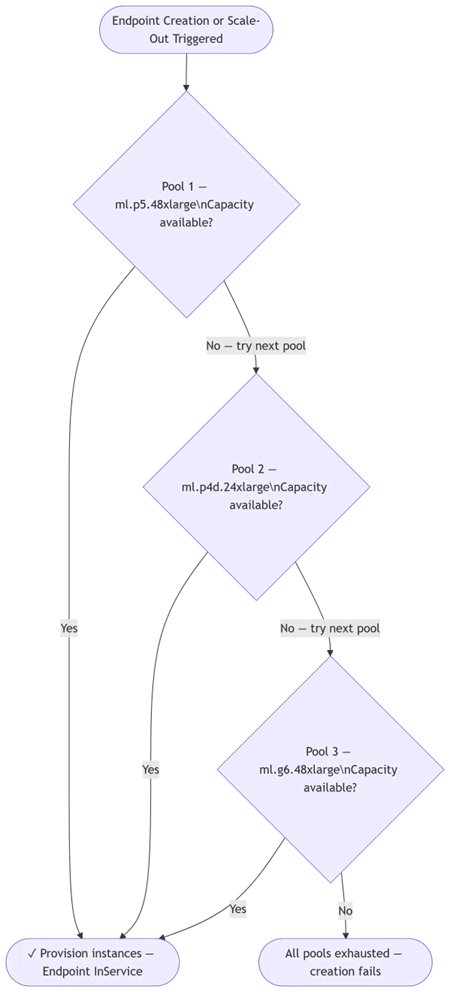
💡SageMaker auto-falls back instances on capacity crunch—no more provisioning delays
⚡ 30-Second TL;DR
What Changed
Automatic instance fallback on capacity issues
Why It Matters
Eliminates manual intervention for reliable AI endpoint provisioning, improving deployment speed and uptime for production ML inference.
What To Do Next
Configure prioritized instances in SageMaker endpoints to enable automatic fallback.
Who should care:Developers & AI Engineers
Key Points
- •Automatic instance fallback on capacity issues
- •Prioritized list of instance types
- •Works for creation, scale-out, and scale-in
- •Supports single model, component, async endpoints
🧠 Deep Insight
AI-generated analysis for this event.
🔑 Enhanced Key Takeaways
- •The feature addresses the 'InsufficientInstanceCapacity' error, which historically required manual intervention or complex custom logic to switch instance types during high-demand periods.
- •It integrates with SageMaker's existing Auto Scaling policies, allowing the capacity-aware logic to trigger automatically when scaling events encounter regional hardware shortages.
- •The implementation utilizes a weighted priority list where SageMaker attempts to provision the primary instance type first, only moving to secondary or tertiary options if the primary is unavailable in the target Availability Zone.
📊 Competitor Analysis▸ Show
| Feature | AWS SageMaker Capacity-Aware Inference | Google Vertex AI | Azure Machine Learning |
|---|---|---|---|
| Instance Fallback | Automated via prioritized list | Limited (requires custom orchestration) | Limited (requires custom orchestration) |
| Capacity Management | Native, integrated with Auto Scaling | Managed via regional quotas | Managed via regional quotas |
| Pricing | Pay-per-instance (varies by type) | Pay-per-instance (varies by type) | Pay-per-instance (varies by type) |
🛠️ Technical Deep Dive
- •The feature introduces a new 'InstanceTypePriorityList' parameter within the Endpoint Configuration API.
- •SageMaker's control plane performs a synchronous check against regional capacity pools before finalizing the provisioning request for a specific instance type.
- •Supports multi-model endpoints (MME) and inference components, allowing granular control over resource allocation for different models sharing the same underlying hardware.
- •The fallback mechanism is designed to be transparent to the application layer, maintaining the same endpoint URL and configuration settings regardless of the underlying instance type provisioned.
🔮 Future ImplicationsAI analysis grounded in cited sources
Reduction in inference endpoint deployment failures.
Automated fallback eliminates the need for manual redeployment cycles when specific instance types are temporarily unavailable in a region.
Increased adoption of heterogeneous instance clusters.
By abstracting capacity management, developers are more likely to mix instance families to optimize for both cost and availability.
⏳ Timeline
2017-11
Amazon SageMaker launched at AWS re:Invent.
2021-12
Introduction of SageMaker Inference Components for modular model deployment.
2023-04
Expansion of SageMaker multi-model endpoints to support GPU-based instances.
2026-05
Launch of Capacity-Aware Inference for automated instance fallback.
📰
Weekly AI Recap
Read this week's curated digest of top AI events →
👉Related Updates
AI-curated news aggregator. All content rights belong to original publishers.
Original source: AWS Machine Learning Blog ↗