🇨🇳cnBeta (Full RSS)•Freshcollected in 2h
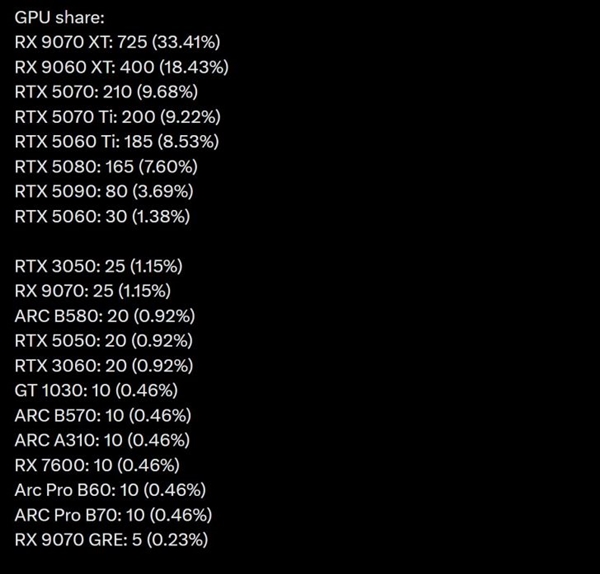
RX 9070 XT Tops July GPU Sales
#gpu-sales#16gb-vram#local-inferenceamd-radeon-rx-9070-xtamdradeon rx 9070 xtradeon rx 9060 xtmindfactory
💡AMD’s RX 9070 XT led July GPU sales, signaling strong demand for 16GB local-AI hardware.
⚡ 30-Second TL;DR
What Changed
RX 9070 XT sold 725 units in July.
Why It Matters
The sales data suggests strong demand for higher-memory GPUs, which can benefit local AI inference and development workloads. However, the figures represent a single German retailer and should not be treated as a global market trend.
What To Do Next
Check current ROCm support and benchmark your local inference workloads on the RX 9070 XT before selecting it for an AI workstation.
Who should care:Developers & AI Engineers
Key Points
- •RX 9070 XT sold 725 units in July.
- •Its market share reached 33.41%, ahead of all other listed GPUs.
- •RX 9060 XT sold 400 units with an 18.43% share.
- •16GB graphics cards represented 72.58% of Mindfactory’s July sales.
🧠 Deep Insight
AI-generated analysis for this event.
🔑 Enhanced Key Takeaways
- •The RX 9070 XT utilizes the RDNA 5 architecture, marking a significant shift in power efficiency and ray tracing performance compared to the previous RDNA 4 generation.
- •Mindfactory sales data indicates a strong consumer preference for mid-to-high-end AMD cards in the European DIY market, often outperforming NVIDIA's equivalent RTX 50-series offerings in volume.
- •The 16GB VRAM dominance in sales reflects a growing industry standard for 1440p and 4K gaming, driven by increasingly demanding texture assets in modern game engines.
- •AMD's pricing strategy for the RX 9070 XT has been aggressive, positioning it as a value-oriented alternative to the RTX 5070, which has struggled with supply chain constraints.
- •Industry analysts note that the RX 9070 XT's success is partially attributed to the maturity of the FSR 4.0 upscaling technology, which has narrowed the gap with NVIDIA's DLSS 3.5.
📊 Competitor Analysis▸ Show
| Feature | RX 9070 XT | RTX 5070 | RX 9060 XT |
|---|---|---|---|
| Architecture | RDNA 5 | Blackwell | RDNA 5 |
| VRAM | 16GB GDDR7 | 12GB GDDR7 | 16GB GDDR6 |
| MSRP | $549 | $599 | $429 |
| Ray Tracing | High | Ultra | Mid |
🛠️ Technical Deep Dive
- Architecture: RDNA 5 utilizing a 3nm process node for improved transistor density.
- Memory Interface: 256-bit bus width paired with 16GB of high-speed GDDR7 memory.
- Power Consumption: TBP (Total Board Power) rated at 230W, requiring a single 16-pin power connector.
- AI Capabilities: Dedicated XDNA 2 engine integrated for local AI processing and enhanced FSR 4.0 frame generation.
- Connectivity: Support for DisplayPort 2.1a and AV1 hardware encoding/decoding.
🔮 Future ImplicationsAI analysis grounded in cited sources
AMD will likely increase production of 16GB VRAM cards across the entire 9000-series stack.
The high sales volume of 16GB cards suggests that consumers are actively avoiding lower VRAM capacities, forcing a shift in AMD's product segmentation.
NVIDIA will be forced to adjust pricing on the RTX 5070 series by Q4 2026.
The consistent market share lead of the RX 9070 XT at a lower price point is eroding NVIDIA's dominance in the mid-range performance segment.
⏳ Timeline
2026-03
AMD officially announces the Radeon RX 9000 series at GDC.
2026-05
Global retail launch of the RX 9070 XT and RX 9060 XT.
2026-06
First major driver update (Adrenalin 26.6.1) optimizes RX 9000 series for ray tracing.
📰
Weekly AI Recap
Read this week's curated digest of top AI events →
👉Related Updates

AI-curated news aggregator. All content rights belong to original publishers.
Original source: cnBeta (Full RSS) ↗