Russian hackers target Jaguar Land Rover in massive breach
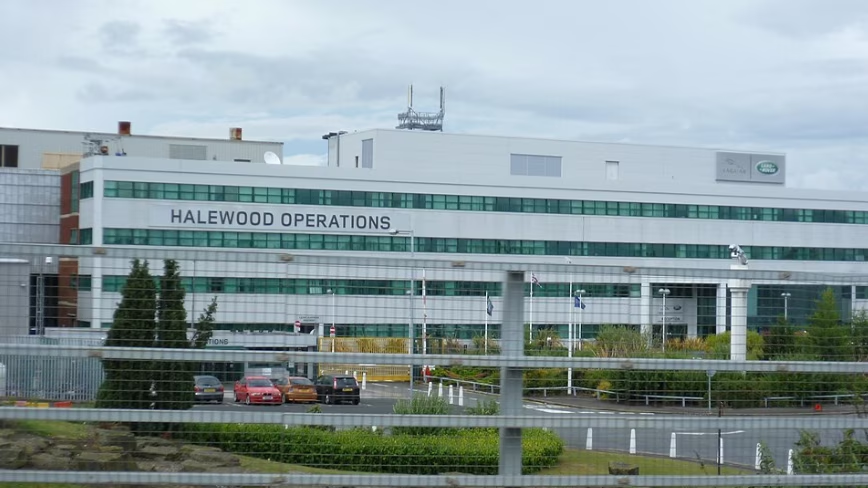
A massive $2.5B cyberattack on a major manufacturer serves as a critical warning for industrial security.
30-Second TL;DR
What Changed
Breach began on 31 August 2025
Why It Matters
This highlights the severe operational and economic risks large-scale manufacturing faces from state-sponsored cyber threats. It underscores the urgent need for robust industrial cybersecurity protocols.
What To Do Next
Audit your industrial control systems and supply chain security to prevent similar production-halting breaches.
Key Points
- •Breach began on 31 August 2025
- •Production halted for nearly six weeks
- •Total economic impact estimated at $2.5 billion
Deep Insight
AI-generated analysis for this event — not the original article.
Enhanced Key Takeaways
- •The attack was identified as a sophisticated ransomware campaign utilizing a previously unknown zero-day vulnerability in the company's supply chain management software.
- •Jaguar Land Rover (JLR) refused to pay the ransom demand, leading to the exfiltration of sensitive proprietary engineering schematics and employee personal data.
- •The UK's National Cyber Security Centre (NCSC) launched a formal investigation, later linking the attack to a Russia-based threat actor group known as 'Volt Typhoon's successor' or similar state-aligned entities.
- •The six-week production halt forced JLR to implement a temporary layoff scheme for thousands of factory workers across its Solihull and Halewood plants.
- •Insurance industry analysts noted that this incident triggered one of the largest cyber-insurance claims in the automotive sector's history, prompting a re-evaluation of premiums for UK manufacturers.
Technical Deep Dive
- The breach exploited a zero-day vulnerability in the third-party logistics (3PL) integration layer, allowing lateral movement into JLR's internal manufacturing execution system (MES).
- Attackers utilized a custom variant of the 'LockBit 4.0' ransomware strain, modified to bypass signature-based detection by encrypting only critical production-scheduling databases.
- The exfiltration process involved the use of encrypted tunnels over non-standard ports to evade Data Loss Prevention (DLP) monitoring systems.
- Post-incident forensic analysis revealed that the attackers maintained persistence within the network for approximately 14 days prior to the deployment of the ransomware payload.
Future ImplicationsAI analysis grounded in cited sources
Timeline
- 2025-08Initial network infiltration via third-party logistics software vulnerability.
- 2025-08Ransomware deployment and subsequent production shutdown across major UK plants.
- 2025-09JLR officially confirms the cyberattack and initiates incident response protocols.
- 2025-10Production lines gradually resume operations following extensive system restoration.
- 2026-01NCSC publishes preliminary findings linking the attack to Russian-aligned threat actors.
Weekly AI Recap
Read this week's curated digest of top AI events →
Related Updates


AI-curated news aggregator. All content rights belong to original publishers.
Original source: The Next Web (TNW) ↗
This is a summary, not the original. Read the source, or get the weekly briefing.
The weekly digest
One email a week. Unsubscribe anytime.