Running Local LLMs: Hardware and Model Selection Guide
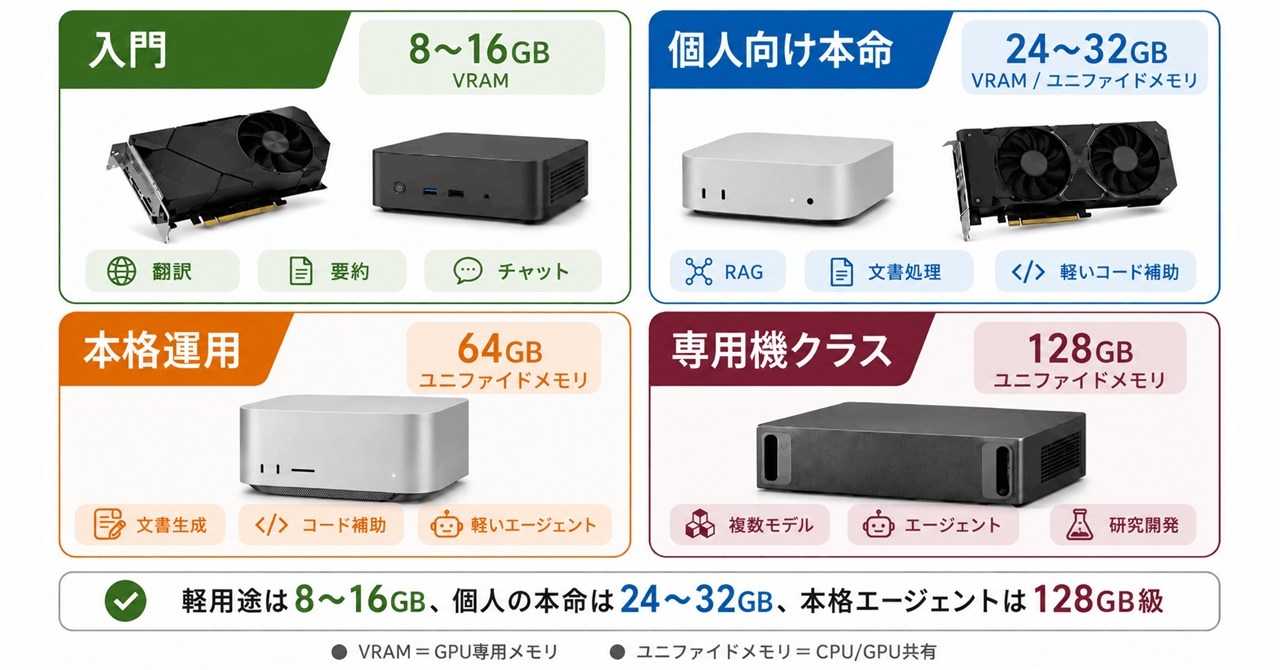
💡Learn how to practically run Gemma 4 locally and optimize your hardware setup for cost-effective AI inference.
⚡ 30-Second TL;DR
What Changed
Gemma 4 is confirmed to be practical for local translation and summarization tasks.
Why It Matters
Helps developers and enthusiasts optimize their local infrastructure, reducing dependency on cloud APIs for privacy-sensitive or cost-constrained tasks.
What To Do Next
Benchmark your current GPU against Gemma 4's memory requirements to determine if your local setup can handle efficient inference.
Key Points
- •Gemma 4 is confirmed to be practical for local translation and summarization tasks.
- •Provides a framework for balancing GPU performance and hardware costs for local AI.
- •Discusses the reality of running AI on consumer hardware versus dedicated AI machines.
🧠 Deep Insight
Web-grounded analysis with 29 cited sources.
🔑 Enhanced Key Takeaways
- •Gemma 4, released in April 2026 under the Apache 2.0 license, significantly expands multimodal capabilities beyond text to include native audio, image, and video input across its model sizes, enabling more complex on-device agentic workflows.
- •The Gemma 4 family introduces a Mixture of Experts (MoE) architecture in its 26B variant, allowing it to achieve near-31B model quality with only 3.8B active parameters, making it highly efficient for consumer GPUs with 16-24GB VRAM.
- •Gemma 4 models are designed with tiered context windows, offering 128K tokens for smaller edge models (E2B, E4B) and up to 256K tokens for larger workstation models (26B MoE, 31B Dense), supporting extensive document analysis and long-context agentic tasks.
- •The release of Gemma 4 underscores a broader industry trend in 2026 towards the consumerization of AI, with a focus on embedding advanced AI capabilities directly into physical devices and personal computing ecosystems for enhanced privacy, instant response, and personalized experiences.
📊 Competitor Analysis▸ Show
Competitor Analysis: Gemma 4 vs. Llama 4 vs. Qwen 3.5 (as of May 2026)
| Feature/Metric | Gemma 4 | Llama 4 | Qwen 3.5 |
|---|---|---|---|
| Developer | Google DeepMind | Meta | Alibaba / Qwen |
| Latest Release | April 2026 | Early 2025 (Llama 4) | 2026 (Qwen 3.5) |
| License | Apache 2.0 (Open-weight) | Apache 2.0 (Open-weight) | Apache 2.0 (Open-weight) |
| Parameter Sizes | E2B (~2B), E4B (~4B), 26B MoE (3.8B active), 31B Dense | 8B, 70B | 0.5B to 72B (including 30B/32B, 35B) |
| Context Window | 128K (E2B/E4B), 256K (26B MoE/31B Dense) | Up to 512K | Up to 262K (consistent across all sizes) |
| Multimodality | Text, Image, Video (all models); Native Audio (E2B, E4B) | Multimodal capabilities | Multimodal support |
| Key Benchmarks | MMLU Pro: 85.2% (31B), AIME 2026: 89.2% (31B), Arena AI: #3 (31B) | Strong GPQA scores (70B) | HumanEval: 87.3% (72B), Strong on Terminal-Bench 2, SWE-bench, TAU2 (full precision) |
| Hardware Fit | Phones (E2B), Edge (E4B), Consumer GPUs (26B MoE), Workstations (31B Dense) | Needs serious hardware for long context (Llama 4 Scout) | Laptop-friendly (Qwen3 30B/32B), runs on modest machines (Phi-4-mini) |
| Local Deployment | Optimized for Ollama, llama.cpp, NVIDIA TensorRT-LLM | Supported by Ollama, llama.cpp | Optimized for Ollama |
| Noteworthy | "Intelligence-per-parameter" focus, configurable thinking modes, native system prompt support. | MoE architecture for efficiency at large scales. | Excellent code generation, strong multilingual support (140+ languages) |
| Coding Performance | Excels in writing correct unit tests and refactoring, more consistent under quantization. | - | Fast but can be flaky under quantization, generates unnecessary boilerplate. |
| Japanese Support | Multilingual support (140+ languages) | - | Optimal for Japanese-only applications. |
🛠️ Technical Deep Dive
- Architecture: Gemma 4 models are based on a decoder-only transformer architecture.
- Attention Mechanisms: They utilize a hybrid attention mechanism that interleaves local sliding-window attention with global full-context attention layers. Smaller dense models use 512-token sliding windows, while larger models use 1024 tokens.
- Grouped-Query Attention (GQA): Gemma 2, a predecessor, incorporated Grouped-Query Attention, which likely continues in Gemma 4 for efficiency.
- Per-Layer Embeddings (PLE): Smaller Gemma 4 models (E2B, E4B) feature Per-Layer Embeddings, adding a parallel, lower-dimensional conditioning pathway alongside the main residual stream to enhance representation.
- Shared KV Cache: Gemma 4 employs a Shared KV Cache where the last N layers of the model reuse key-value states from earlier layers, reducing redundant Key-Value projections.
- Rotary Positional Embeddings (RoPE): The architecture includes dual RoPE configurations: standard RoPE for sliding layers and pruned RoPE for global layers, enabling longer context processing.
- Mixture of Experts (MoE): The Gemma 4 26B model uses an MoE architecture with 128 small experts, activating only 8 per token plus one shared expert, leading to high performance efficiency with fewer active parameters.
- Quantization: Quantized versions, such as 4-bit (Q4) or MXFP4, are available and significantly reduce VRAM requirements, making models like Gemma 4 26B feasible on consumer GPUs with 14-16GB VRAM.
- Multimodal Encoders: Gemma 4 integrates a SigLIP-style vision encoder for image and video understanding and a USM-style conformer encoder for native audio input (on E2B and E4B models).
- Context Window: The models support context windows up to 256K tokens, with E2B/E4B at 128K and 26B MoE/31B Dense at 256K.
🔮 Future ImplicationsAI analysis grounded in cited sources
⏳ Timeline
📎 Sources (29)
Factual claims are grounded in the sources below. Forward-looking analysis is AI-generated interpretation.
- mindstudio.ai
- aurigait.com
- google.dev
- blog.google
- huggingface.co
- qubrid.com
- oflight.co.jp
- mindstudio.ai
- medium.com
- ollama.com
- techindustryforum.org
- 36kr.com
- edge-ai-vision.com
- wikipedia.org
- oflight.co.jp
- huggingface.co
- mindstudio.ai
- instaclustr.com
- github.io
- blog.google
- unsloth.ai
- tenupsoft.com
- googleblog.com
- arxiv.org
- huggingface.co
- chatforest.com
- ibm.com
- localai.io
- milvus.io
Weekly AI Recap
Read this week's curated digest of top AI events →
👉Related Updates
AI-curated news aggregator. All content rights belong to original publishers.
Original source: ITmedia AI+ (日本) ↗