Rivian to launch supervised point-to-point self-driving
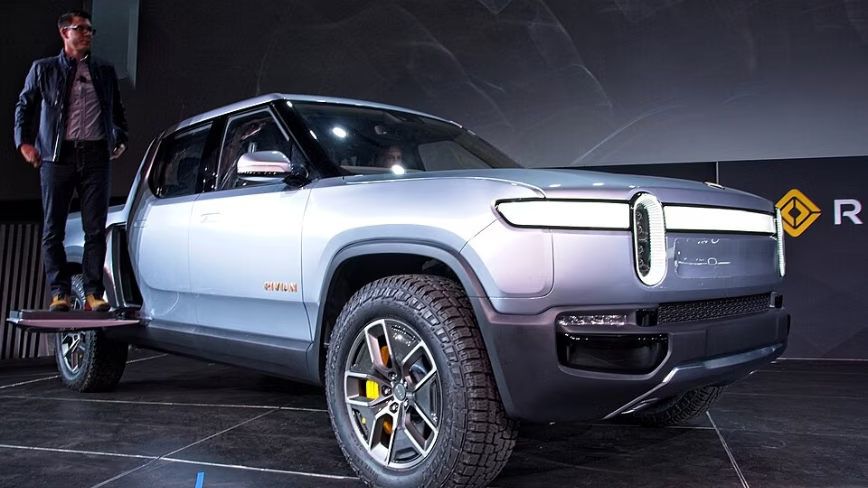
Major shift in the autonomous driving landscape as Rivian challenges Tesla's FSD dominance.
30-Second TL;DR
What Changed
Supervised point-to-point autonomy arriving later this year
Why It Matters
This move intensifies the race for autonomous driving market share among EV manufacturers. It signals a shift toward software-defined vehicle capabilities.
What To Do Next
Analyze Tesla's FSD whitepapers and Rivian's public technical disclosures to compare their sensor fusion and perception architectures.
Key Points
- •Supervised point-to-point autonomy arriving later this year
- •Deployment on second-generation vehicles and the upcoming R2
- •Direct strategic competition with Tesla's FSD platform
Deep Insight
Background and context from public sources — not the original article. 10 sources cited.
Enhanced Key Takeaways
- •Rivian's autonomy roadmap extends beyond supervised point-to-point driving, with plans for "eyes-off unsupervised driving" in 2027 and a commercial robotaxi service with Uber beginning in 2028.
- •Unlike Tesla's camera-only FSD, Rivian's platform integrates a multi-sensor suite, including 10 external cameras, five radar units, 12 ultrasonic sensors, and a high-precision GPS receiver, with future R2 models adding a roof-mounted LiDAR sensor.
- •The system is powered by Rivian's custom-designed Rivian Autonomy Processor 1 (RAP1), a 5nm chip delivering up to 1,600 trillion operations per second (TOPS) in its Gen 3 Autonomy Computer.
- •Rivian's autonomy software is built around a "Large Driving Model" (LDM), a foundational AI system trained end-to-end through reinforcement learning, similar in philosophy to Tesla's FSD v12 but leveraging Rivian's multi-sensor hardware.
- •Rivian secured a $1.25 billion deal with Uber in March 2026, committing to supply up to 50,000 fully autonomous R2 robotaxis for commercial deployment in cities like San Francisco and Miami starting in 2028.
Competitor Analysis
- Rivian Supervised Point-to-Point (Autonomy+)
- $2,500 one-time or $49.99/month
- Tesla Full Self-Driving (FSD) Supervised
- $8,000 one-time or $99/month
- Rivian Supervised Point-to-Point (Autonomy+)
- 10 cameras, 5 radar, 12 ultrasonic, high-precision GPS; R2 adds LiDAR
- Tesla Full Self-Driving (FSD) Supervised
- Exclusively cameras
- Rivian Supervised Point-to-Point (Autonomy+)
- Large Driving Model (LDM) trained end-to-end via reinforcement learning
- Tesla Full Self-Driving (FSD) Supervised
- End-to-end neural network (FSD v12)
- Rivian Supervised Point-to-Point (Autonomy+)
- Supervised point-to-point driving (planned for late 2026)
- Tesla Full Self-Driving (FSD) Supervised
- Supervised point-to-point driving
- Rivian Supervised Point-to-Point (Autonomy+)
- Eyes-off unsupervised driving (2027)
- Tesla Full Self-Driving (FSD) Supervised
- Unsupervised FSD (Q4 2026 at earliest, repeatedly pushed)
| Feature/Aspect | Rivian Supervised Point-to-Point (Autonomy+) | Tesla Full Self-Driving (FSD) Supervised |
|---|---|---|
| Pricing | $2,500 one-time or $49.99/month | $8,000 one-time or $99/month |
| Sensor Suite | 10 cameras, 5 radar, 12 ultrasonic, high-precision GPS; R2 adds LiDAR | Exclusively cameras |
| AI Architecture | Large Driving Model (LDM) trained end-to-end via reinforcement learning | End-to-end neural network (FSD v12) |
| Current Capability | Supervised point-to-point driving (planned for late 2026) | Supervised point-to-point driving |
| Next Stage Target | Eyes-off unsupervised driving (2027) | Unsupervised FSD (Q4 2026 at earliest, repeatedly pushed) |
Technical Deep Dive
- Sensor Suite: Rivian's Gen 3 Autonomy platform includes 11 HDR cameras (65 megapixels total for R2), five radar units, and 12 ultrasonic sensors. Future R2 models will also incorporate a roof-mounted LiDAR sensor.
- Compute Hardware: The system is powered by the Rivian Autonomy Processor 1 (RAP1), a custom 5nm chip developed in collaboration with Arm, utilizing Armv9 architecture with 14 high-performance cores.
- Processing Power: The Gen 3 Autonomy Computer, featuring two RAP1 SoCs, achieves up to 1,600 trillion operations per second (TOPS) of AI compute, capable of processing 5 billion pixels per second.
- Software Architecture: Rivian employs a "Large Driving Model" (LDM), an end-to-end foundational AI system trained through reinforcement learning, mapping raw sensor input directly to vehicle trajectory and using Group-Relative Policy Optimization for optimal path selection.
- Data Collection: Rivian utilizes a self-improving data flywheel, collecting pre-tagged instances from its fleet (including "Penguins" with extra sensors for "Ground Truth" data) to train its LDM.
Future ImplicationsAI analysis grounded in cited sources
Timeline
- 2009-06Rivian Automotive, Inc. founded as Mainstream Motors by R. J. Scaringe.
- 2021-09Rivian becomes the first automaker to bring a fully electric pickup (R1T) to the consumer market.
- 2021-11Rivian goes public through an IPO on Nasdaq under the ticker "RIVN".
- 2024-midRivian launches second-generation R1T and R1S with new electrical and electronic architecture, switching ADAS chips from Ambarella to dual Nvidia Orin SoCs.
- 2025-12Rivian holds its first "AI and Autonomy Day," unveiling its Gen 3 Autonomy Computer, custom RAP1 processor, and Large Driving Model, and rolling out Universal Hands-Free (UHF) to Gen 2 vehicles.
- 2026-03Rivian announces a $1.25 billion deal with Uber for up to 50,000 R2 robotaxis, with initial deployment planned for 2028.
Sources (10)
Factual claims are grounded in the sources below. Forward-looking analysis is AI-generated interpretation.
Weekly AI Recap
Read this week's curated digest of top AI events →
Related Updates


AI-curated news aggregator. All content rights belong to original publishers.
Original source: The Next Web (TNW) ↗
This is a summary, not the original. Read the source, or get the weekly briefing.
The weekly digest
One email a week. Unsubscribe anytime.