Ricoh Launches Japanese Reasoning Multimodal LLM
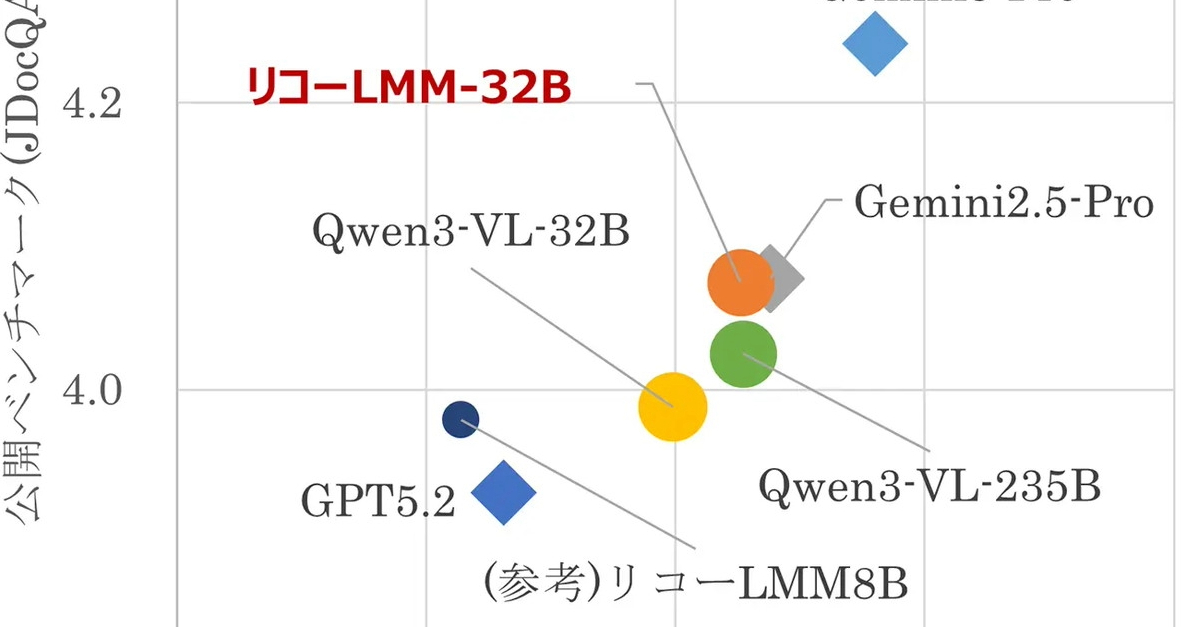
💡New 32B Japanese multimodal LLM rivals Gemini 2.5 Pro on docs/charts
⚡ 30-Second TL;DR
What Changed
32B parameter multimodal LLM optimized for Japanese reasoning
Why It Matters
This model advances Japanese language AI capabilities, potentially reducing reliance on English-centric LLMs for Japan-based practitioners. It could boost multimodal applications in document analysis for enterprises.
What To Do Next
Download and benchmark Qwen3-VL-Ricoh-32B-20260227 on Japanese OCR tasks via Hugging Face.
Key Points
- •32B parameter multimodal LLM optimized for Japanese reasoning
- •Handles complex Japanese documents including charts and figures
- •Performance claimed to match Gemini 2.5 Pro
🧠 Deep Insight
AI-generated analysis for this event — not the original article.
🔑 Enhanced Key Takeaways
- •The model is built upon the Qwen3-VL open-weights architecture, leveraging Ricoh's proprietary Japanese-language fine-tuning dataset focused on enterprise document workflows.
- •Ricoh is positioning this model as a core component of its 'RICOH Intelligent Workplace' suite, specifically targeting automated processing of Japanese-language invoices, contracts, and technical manuals.
- •Deployment is restricted to Ricoh's private cloud infrastructure to ensure compliance with Japanese data privacy regulations for corporate clients.
📊 Competitor Analysis▸ Show
| Feature | Qwen3-VL-Ricoh-32B | Gemini 2.5 Pro | GPT-4o (Japanese) |
|---|---|---|---|
| Primary Focus | Japanese Enterprise Docs | General Purpose Multimodal | General Purpose Multimodal |
| Deployment | Private Cloud (Ricoh) | Public/Private API | Public/Private API |
| Parameter Count | 32B | Undisclosed (Large) | Undisclosed (Large) |
| Japanese Reasoning | Optimized for Biz/Legal | High (General) | High (General) |
🛠️ Technical Deep Dive
- •Architecture: Based on the Qwen3-VL vision-language backbone, utilizing a 32-billion parameter dense transformer structure.
- •Vision Encoder: Employs a high-resolution vision encoder capable of processing complex charts, tables, and handwritten Japanese characters.
- •Training Data: Fine-tuned on a curated corpus of Japanese business documents, including OCR-processed legacy files and structured data formats.
- •Inference Optimization: Utilizes custom quantization techniques to allow deployment on Ricoh's edge-server hardware for low-latency document processing.
🔮 Future ImplicationsAI analysis grounded in cited sources
⏳ Timeline
Weekly AI Recap
Read this week's curated digest of top AI events →
👉Related Updates


AI-curated news aggregator. All content rights belong to original publishers.
Original source: ITmedia AI+ (日本) ↗
This is a summary, not the original. Read the source, or get the weekly briefing.
Weekly AI briefing
One email a week. Unsubscribe anytime.