Richard Hamming's insights on scientific excellence
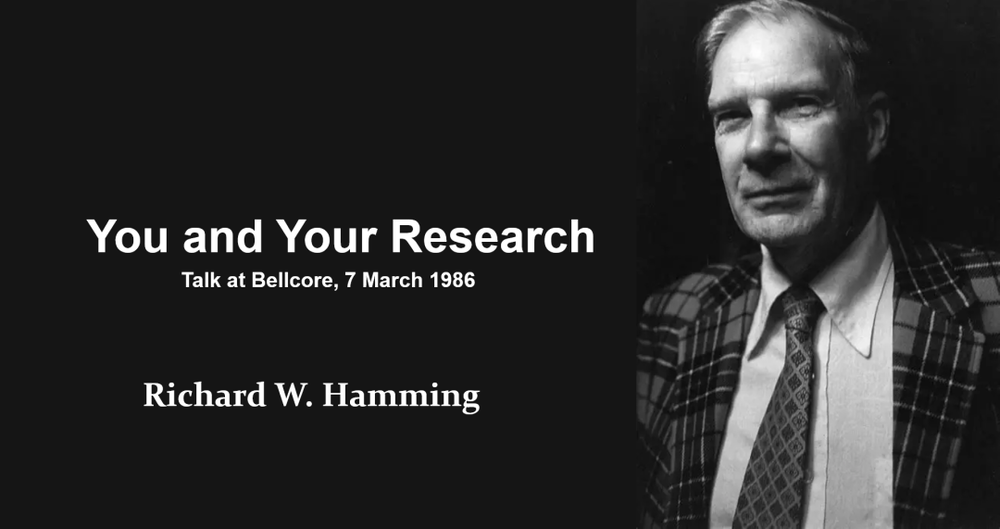
💡Timeless wisdom from a Turing Award winner on how to produce truly groundbreaking research.
⚡ 30-Second TL;DR
What Changed
Great scientists focus on solving the most important problems in their field, rather than 'safe' ones.
Why It Matters
Hamming's principles remain a foundational framework for researchers and AI practitioners aiming for breakthrough innovations rather than incremental improvements.
What To Do Next
Audit your current AI research projects: are you working on 'important' problems or just optimizing existing benchmarks?
Key Points
- •Great scientists focus on solving the most important problems in their field, rather than 'safe' ones.
- •Keeping your 'office door open' facilitates serendipitous cross-pollination of ideas.
- •Resource constraints can be a catalyst for innovation through inversion thinking.
- •Hard work and persistence are essential, but must be directed toward high-impact goals.
🧠 Deep Insight
Web-grounded analysis with 15 cited sources.
🔑 Enhanced Key Takeaways
- •Great scientists possess the courage to pursue independent thoughts and maintain a strong belief in their capacity to undertake important work, a trait often evident from a young age.
- •Successful researchers master the art of tolerating ambiguity, holding a theory with enough conviction to advance their work, yet doubting it sufficiently to identify flaws and pave the way for new theoretical frameworks.
- •Beyond conducting excellent research, scientists must effectively communicate and 'sell' their ideas to peers, management, and the broader community to secure recognition, resources, and impact.
- •Rather than exclusively pursuing monumental breakthroughs, effective scientists often 'plant little acorns' by working on smaller, foundational problems that have the potential to evolve into significant contributions over time.
🔮 Future ImplicationsAI analysis grounded in cited sources
⏳ Timeline
📎 Sources (15)
Factual claims are grounded in the sources below. Forward-looking analysis is AI-generated interpretation.
Weekly AI Recap
Read this week's curated digest of top AI events →
👉Related Updates



AI-curated news aggregator. All content rights belong to original publishers.
Original source: 虎嗅 ↗