Reserve GPU for SageMaker AI Inference
💡Lock in GPU capacity for SageMaker inference—no more hunting during peaks (saves time & costs).
⚡ 30-Second TL;DR
What Changed
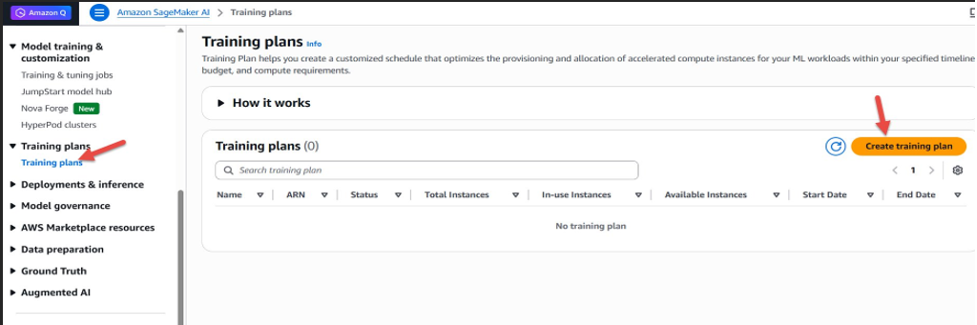
Search for available p-family GPU capacity
Why It Matters
Provides predictable GPU access for production inference, cutting costs and deployment delays for AI teams scaling models. Enhances efficiency in high-demand environments.
What To Do Next
Search p-family GPU availability in SageMaker console and reserve via training plan for your inference endpoint.
Key Points
- •Search for available p-family GPU capacity
- •Create training plan reservation specifically for inference
- •Deploy SageMaker AI inference endpoint on reserved capacity
- •Manage endpoint throughout the full reservation lifecycle
🧠 Deep Insight
AI-generated analysis for this event — not the original article.
🔑 Enhanced Key Takeaways
- •This capability leverages the existing AWS Training Plan infrastructure, originally designed for model training, to now provide guaranteed compute availability for inference workloads, effectively bridging the gap between training and deployment resource management.
- •The reservation model allows customers to commit to specific GPU instances (such as P4 or P5 families) for a fixed term, which helps mitigate the risk of 'capacity crunch' during high-demand periods or regional shortages.
- •By utilizing reserved capacity for inference, organizations can achieve more predictable cost structures compared to on-demand pricing, while ensuring that mission-critical endpoints remain operational without the risk of instance termination due to capacity constraints.
📊 Competitor Analysis▸ Show
| Feature | AWS SageMaker (Reserved Inference) | Google Cloud Vertex AI | Azure Machine Learning |
|---|---|---|---|
| Capacity Reservation | Training Plan-based GPU reservation | Reservations for GCE/TPU | Azure Dedicated Host/Capacity Reservation |
| Pricing Model | Term-based commitment | Committed Use Discounts (CUDs) | Capacity Reservation pricing |
| Inference Focus | Integrated with SageMaker Endpoints | Integrated with Vertex Endpoints | Integrated with Managed Endpoints |
🛠️ Technical Deep Dive
- Integration: The feature utilizes the SageMaker 'Training Plan' API to provision capacity, which is then mapped to SageMaker Inference Endpoints via the 'CapacityReservationSpecification' parameter.
- Instance Support: Primarily targets high-performance P-family instances (e.g., P4d, P4de, P5) which are optimized for large-scale LLM inference.
- Lifecycle Management: Reservations are managed via the AWS Management Console or AWS CLI, allowing users to associate specific endpoint configurations with a pre-purchased capacity block.
- Availability: The system performs a real-time check against regional capacity pools before allowing a reservation to be finalized, ensuring the requested GPU count is physically available.
🔮 Future ImplicationsAI analysis grounded in cited sources
⏳ Timeline
Weekly AI Recap
Read this week's curated digest of top AI events →
👉Related Updates
AI-curated news aggregator. All content rights belong to original publishers.
Original source: AWS Machine Learning Blog ↗
This is a summary, not the original. Read the source, or get the weekly briefing.
Weekly AI briefing
One email a week. Unsubscribe anytime.