RAG Tuning Risks 40% Retrieval Accuracy Drop
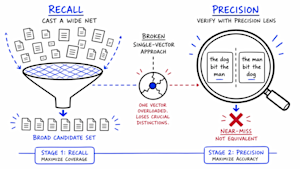
💡RAG fine-tuning can slash retrieval 40%—vital warning for agentic AI builders!
⚡ 30-Second TL;DR
What Changed
Fine-tuning for compositional sensitivity drops retrieval by 8-40% on production models
Why It Matters
Enterprise teams risk degrading RAG pipelines by prioritizing precision over recall. Agentic systems may deliver unreliable outputs from poor retrieval. Balancing training objectives is essential for production stability.
What To Do Next
Benchmark your fine-tuned embedding model's generalization on BEIR or MTEB benchmarks.
Key Points
- •Fine-tuning for compositional sensitivity drops retrieval by 8-40% on production models
- •Negation and spatial flips improve, but binding errors persist
- •Impacts agentic pipelines via cascading context errors
- •Semantic similarity does not equal exact intent matching
🧠 Deep Insight
AI-generated analysis for this event — not the original article.
🔑 Enhanced Key Takeaways
- •The research highlights a phenomenon known as 'catastrophic forgetting' in embedding models, where specialized fine-tuning for compositional tasks degrades the model's ability to perform general-purpose semantic retrieval.
- •Redis's findings suggest that current vector database architectures relying solely on dense embeddings are insufficient for complex agentic workflows, necessitating a shift toward hybrid search strategies that combine dense vectors with sparse keyword-based retrieval (e.g., BM25).
- •The study identifies that the 'binding problem'—the inability of models to correctly associate entities with their specific attributes or relationships—remains a fundamental bottleneck in transformer-based embedding architectures, even after fine-tuning.
🛠️ Technical Deep Dive
- •The research focused on the degradation of embedding models when subjected to contrastive fine-tuning specifically designed to improve compositional sensitivity (e.g., distinguishing 'A causes B' from 'B causes A').
- •The 40% accuracy drop was observed specifically in out-of-distribution (OOD) retrieval tasks, indicating that the fine-tuned models became over-fitted to the specific compositional patterns of the training dataset.
- •The study utilized benchmarks measuring performance on negation, spatial relationships, and logical conjunctions, revealing that while models improved on these specific synthetic tests, they lost the nuanced semantic coverage required for general-purpose RAG applications.
🔮 Future ImplicationsAI analysis grounded in cited sources
⏳ Timeline
Weekly AI Recap
Read this week's curated digest of top AI events →
👉Related Updates
AI-curated news aggregator. All content rights belong to original publishers.
Original source: VentureBeat ↗
This is a summary, not the original. Read the source, or get the weekly briefing.
The weekly digest
One email a week. Unsubscribe anytime.