Qwen Expands From Chatbot to AI Work Hub
💡Qwen is turning Alibaba’s models and services into an agent platform—here are the features, pricing, and competitive sta
⚡ 30-Second TL;DR
What Changed
The office assistant can operate computers and browsers, connect to calendars, email, and notes, call Skills, and deliver PPT, Word, and Excel files.
Why It Matters
Qwen is moving beyond model capability toward an integrated agent platform that combines productivity tasks, commerce, and Alibaba’s ecosystem. For AI product teams, the strategy reinforces that distribution, workflow completion, and ecosystem integrations may matter more than benchmark performance alone.
What To Do Next
Prototype one end-to-end workflow with Qwen’s office assistant, such as generating a spreadsheet and presentation from a connected email brief, then measure completion accuracy.
Key Points
- •The office assistant can operate computers and browsers, connect to calendars, email, and notes, call Skills, and deliver PPT, Word, and Excel files.
- •The open platform connects services such as SF Express, Ziroom, and Hello bike rental, with some workflows supporting ordering and payment.
- •Professional office memberships reportedly range from 19 to 128 yuan per month, while video generation is billed separately by quota.
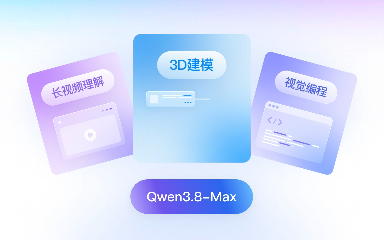
- •Qwen is backed by Qwen3.8-Max, Qwen-Image-3.0, and Wan3.0, adding long-context reasoning, image, and video capabilities.
- •Qwen’s June monthly active users reached 167 million, far below Doubao’s reported 382 million.
🧠 Deep Insight
AI-generated analysis for this event.
🔑 Enhanced Key Takeaways
- •Alibaba's Qwen strategy emphasizes 'Agentic AI' integration, shifting from simple conversational interfaces to autonomous task execution across enterprise software ecosystems.
- •The Qwen-3.8-Max model utilizes a Mixture-of-Experts (MoE) architecture optimized for low-latency inference to support real-time voice interaction and computer-use capabilities.
- •Alibaba Cloud is aggressively bundling Qwen's enterprise features with its existing DingTalk (DingDing) ecosystem to leverage its massive installed base of corporate users.
- •The new open platform utilizes a standardized API framework that allows third-party developers to register 'Skills' that Qwen can invoke dynamically based on user intent.
- •Qwen's video generation model, Wan3.0, incorporates a diffusion-transformer hybrid architecture designed to improve temporal consistency in long-form video clips.
📊 Competitor Analysis▸ Show
| Feature | Qwen (Alibaba) | Doubao (ByteDance) | Kimi (Moonshot AI) |
|---|---|---|---|
| Core Focus | Enterprise/Office Automation | Consumer/Social/Entertainment | Long-context Research/Writing |
| Pricing Model | Tiered Subscription + Usage-based | Freemium + Token-based | Freemium + Subscription |
| Ecosystem | Deep DingTalk Integration | Douyin/TikTok Integration | Standalone/API-first |
| Video Gen | Wan3.0 (Integrated) | Jimeng (Separate) | Limited/Partnerships |
🛠️ Technical Deep Dive
- Qwen-3.8-Max: Employs a multi-stage training pipeline including supervised fine-tuning (SFT) and reinforcement learning from human feedback (RLHF) specifically tuned for tool-use accuracy.
- Computer Use Capability: Implements a vision-language model (VLM) loop that captures screen frames at 2Hz, processes UI elements via OCR and object detection, and maps them to mouse/keyboard action tokens.
- Wan3.0 Architecture: Utilizes a latent diffusion model with a 3D-VAE (Variational Autoencoder) to compress video data while maintaining spatial-temporal coherence across frames.
- Context Window: Qwen-3.8-Max supports a native context window of 1 million tokens, utilizing Ring Attention mechanisms to handle long-document retrieval without significant performance degradation.
🔮 Future ImplicationsAI analysis grounded in cited sources
⏳ Timeline
Weekly AI Recap
Read this week's curated digest of top AI events →
👉Related Updates
AI-curated news aggregator. All content rights belong to original publishers.
Original source: 虎嗅 ↗