PyTorch 2.11 Simplifies CUDA Deployment on aarch64 Linux
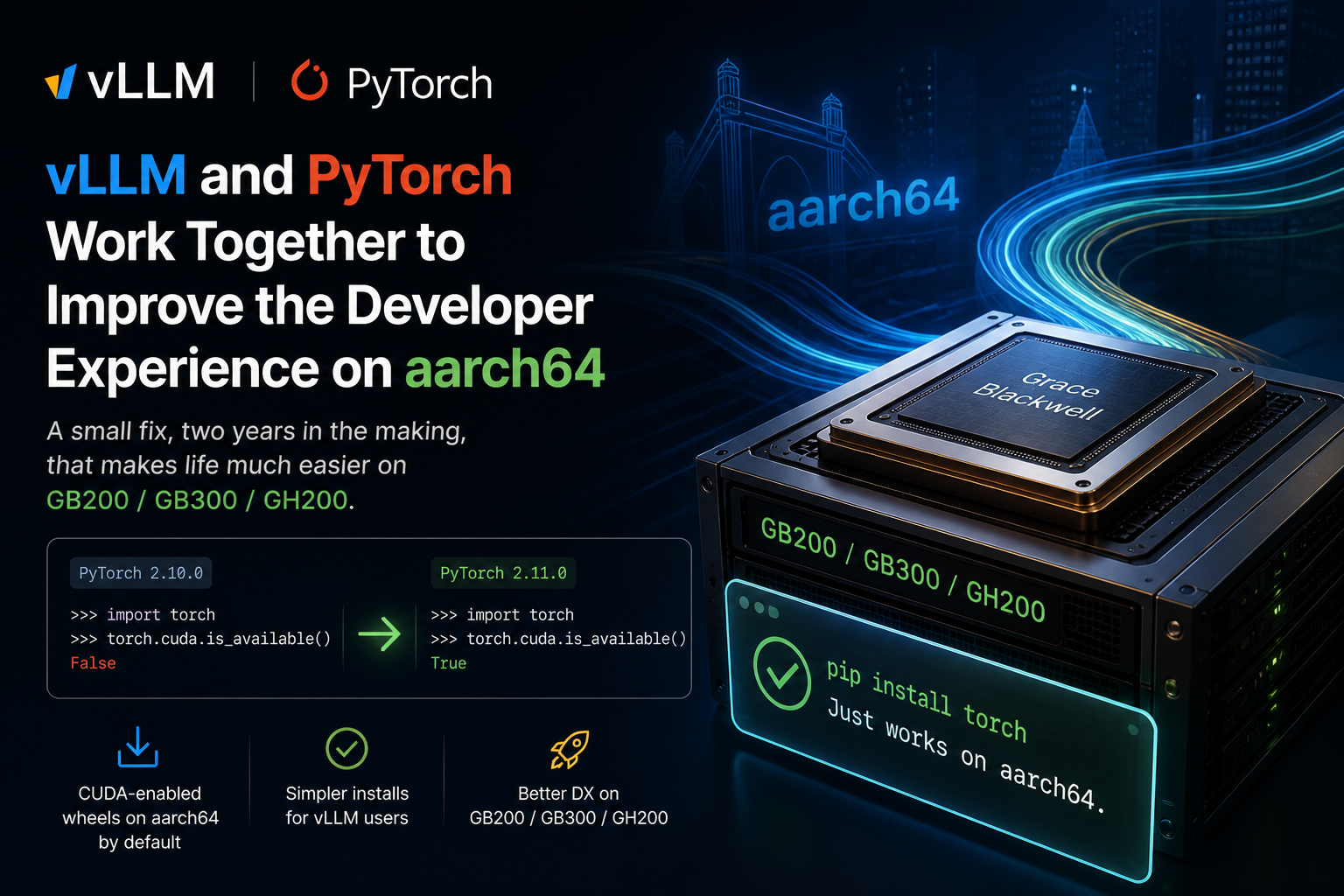
💡Stop struggling with ARM builds; official PyTorch CUDA wheels for aarch64 are finally here.
⚡ 30-Second TL;DR
What Changed
Official CUDA-enabled PyTorch wheels are now available for aarch64 on PyPI.
Why It Matters
This change streamlines the deployment pipeline for AI applications on ARM-based hardware, such as NVIDIA Jetson or cloud-based ARM instances. It reduces maintenance overhead for DevOps teams managing cross-platform AI environments.
What To Do Next
If you are deploying AI models on ARM-based hardware, update your requirements.txt to use the official PyTorch 2.11+ wheels directly from PyPI.
Key Points
- •Official CUDA-enabled PyTorch wheels are now available for aarch64 on PyPI.
- •Eliminates the need for custom package indexes or complex build workarounds.
- •Significantly improves the developer experience for ARM-based AI infrastructure.
🧠 Deep Insight
Web-grounded analysis with 12 cited sources.
🔑 Enhanced Key Takeaways
- •PyTorch 2.11 now defaults to CUDA 13.0 for both x86_64 and aarch64 Linux installations via PyPI, a significant upgrade from previous versions that typically shipped with CUDA 12.x and only offered x86_64 CUDA wheels on PyPI.
- •This release also extends support to NVIDIA's new Blackwell GPU architecture and provides pre-built wheels for CUDA 12.8 across both Linux x86 and arm64 architectures, enhancing hardware compatibility for cutting-edge deployments.
- •The simplified installation on aarch64 builds upon years of community efforts and unofficial wheel distributions, which were previously necessary before PyTorch 1.8.0 introduced official aarch64 CPU wheels.
📊 Competitor Analysis▸ Show
While PyTorch 2.11 now offers direct pip install for CUDA-enabled wheels on aarch64, simplifying GPU-accelerated AI development on ARM, TensorFlow's approach to ARM support is more fragmented. As of TensorFlow 2.10, Linux CPU builds for Aarch64/ARM64 are maintained by a third party (AWS), installing the tensorflow-cpu-aws package. TensorFlow's official GPU support primarily targets Ubuntu and Windows with CUDA-enabled cards, and historically, achieving GPU acceleration with NVIDIA drivers on ARM64 has been more complex, often requiring specific CUDA versions or nightly builds. This makes PyTorch's new direct PyPI availability for CUDA on aarch64 a notable advantage in ease of deployment for ARM-based GPU acceleration.
🛠️ Technical Deep Dive
- PyTorch 2.11 ships with CUDA 13.0 as the default for both Linux x86_64 and aarch64 PyPI installations. Users can still access CUDA 12.6 and 12.8 builds from specific download subfolders.
- The release drops support for Volta GPUs (compute capability 7.0, e.g., V100) in CUDA 12.8 and 12.9 pre-built binaries to enable compatibility with cuDNN 9.15.1. Users with Volta GPUs are advised to use CUDA 12.6 builds or compile from source.
- CUDA 13.0, the new default, requires Turing (SM 7.5) or newer GPU architectures on Linux x86_64, discontinuing support for Maxwell and Pascal GPUs.
- The minimum CUDA version required for building PyTorch from source has been updated to CUDA 12.6.
🔮 Future ImplicationsAI analysis grounded in cited sources
⏳ Timeline
📎 Sources (12)
Factual claims are grounded in the sources below. Forward-looking analysis is AI-generated interpretation.
Weekly AI Recap
Read this week's curated digest of top AI events →
👉Related Updates
AI-curated news aggregator. All content rights belong to original publishers.
Original source: PyTorch Blog ↗