PsiQuantum breaks ground on world's first utility-scale quantum computer
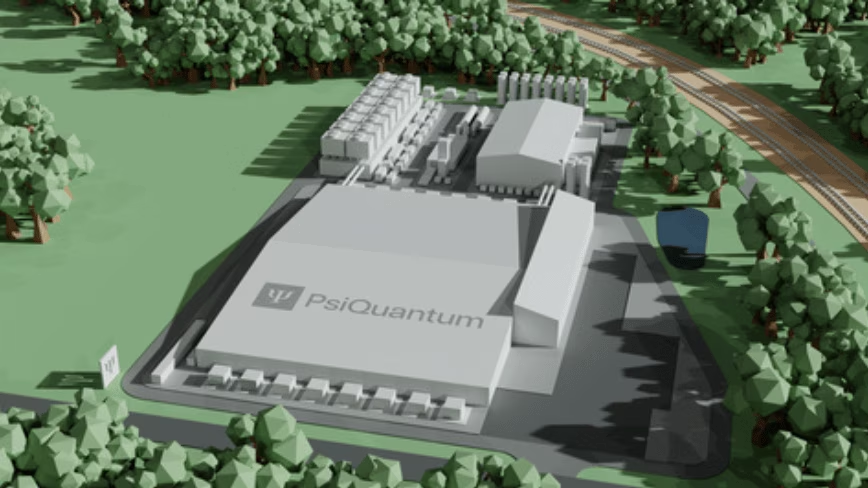
💡A major milestone in quantum hardware that could eventually provide the compute power for next-gen AI models.
⚡ 30-Second TL;DR
What Changed
Facility located in Moreton Bay, Queensland, Australia
Why It Matters
The successful deployment of a utility-scale quantum computer could revolutionize fields like material science and drug discovery by solving problems currently intractable for classical supercomputers.
What To Do Next
Monitor PsiQuantum's developer documentation for future cloud access to their photonic quantum processors for hybrid AI-quantum research.
Key Points
- •Facility located in Moreton Bay, Queensland, Australia
- •Goal is to build a utility-scale, fault-tolerant quantum computer
- •Architecture relies on thousands of photonic quantum chips
- •Requires one of the largest cryogenic systems ever built for quantum computing
🧠 Deep Insight
Background and context from public sources — not the original article. 23 sources cited.
🔑 Enhanced Key Takeaways
- •The project is backed by a significant investment of nearly $1 billion AUD (approximately $620 million USD) from the Australian Commonwealth and Queensland Governments, provided through a mix of equity, grants, and loans, with PsiQuantum also securing a $100 million Letter of Intent from the US Department of Commerce under the CHIPS and Science Act.
- •The facility's location was initially planned for Brisbane Airport but was later moved to Moreton Bay Central, Queensland, chosen for its superior infrastructure, scalability, and proximity to educational institutions like the University of the Sunshine Coast campus and a future TAFE Centre of Excellence in advanced manufacturing.
- •PsiQuantum's photonic quantum computing architecture, known as Fusion-Based Quantum Computing (FBQC), aims to achieve fault tolerance from the outset by using measurement-based quantum computing with photonic cluster states and leveraging existing semiconductor manufacturing processes for its Omega silicon photonic chips.
- •The required cryogenic system, being developed in partnership with Linde Engineering, is designed to operate at 4 Kelvin, a temperature hundreds of times warmer than the millikelvin temperatures typically needed for many other quantum computing technologies, offering a fundamental scaling advantage.
- •PsiQuantum has developed a software platform called 'Construct' specifically for designing, developing, and optimizing fault-tolerant quantum algorithms, and has also announced an 'active volume compilation' technique that is estimated to deliver a 50X improvement in the run-time efficiency of compiled applications.
📊 Competitor Analysis▸ Show
PsiQuantum's strategy is to bypass intermediate Noisy Intermediate-Scale Quantum (NISQ) devices and directly build a utility-scale, fault-tolerant quantum computer using silicon photonics. This contrasts with several other leading quantum computing companies that employ different qubit technologies and often follow more incremental roadmaps.
| Feature/Company | PsiQuantum (Photonic) | IBM Quantum (Superconducting) | Quantinuum (Trapped-Ion) | IonQ (Trapped-Ion) | Microsoft Azure Quantum (Topological/Platform) |
|---|---|---|---|---|---|
| Qubit Type | Photonic | Superconducting | Trapped-Ion | Trapped-Ion | Topological (Majorana) / Multi-hardware |
| Architecture | Fusion-Based Quantum Computing (FBQC), Measurement-Based Quantum Computing (MBQC) with cluster states | Transmon qubits, modular systems (e.g., Heron processors) | All-to-all connectivity, logical qubits | High-fidelity physical qubits | Majorana fermions (R&D), multi-vendor cloud platform |
| Fault Tolerance Strategy | Built-in from the start, direct to utility-scale, 1M physical qubits target | Roadmap targeting fault-tolerant systems by 2029, error correction experiments | Demonstrated logical qubits and error correction execution | Focus on high physical fidelity, less public on logical computing progress | High-risk, high-reward bet on topological qubits for inherent error resistance |
| Manufacturing/Scaling | Leverages commercial semiconductor foundries (GlobalFoundries) for silicon photonic chips | Proprietary fabrication, modular System Two architecture | Proprietary ion traps | Proprietary ion traps | R&D on topological qubits, leverages Azure cloud infrastructure |
| Current Stage/Availability | Building utility-scale facility, no public cloud access yet | Cloud access to multiple processors, production systems | Commercial systems, cloud access | Commercial NISQ systems, cloud access (AWS/Azure/GCP) | Cloud platform with multi-vendor hardware access, topological qubits in R&D |
| Funding/Valuation (approx.) | ~$2.37B raised (incl. gov't), $7B valuation (Sep 2025) | Significant corporate investment, $10B quantum commitment | Publicly traded, significant venture funding | Publicly traded, significant venture funding | Significant corporate R&D investment |
| Key Differentiator | "All-in" on fault-tolerant photonic systems, skipping NISQ | Broad ecosystem, industrial roadmap, large qubit fleet | Execution-oriented, logical qubit demonstrations | High physical qubit fidelity | Topological qubit bet, comprehensive platform approach |
🛠️ Technical Deep Dive
- Qubit Encoding: PsiQuantum's qubits are encoded using telecom-band (1550nm) single photons, generated on-chip via resonantly-enhanced spontaneous four-wave-mixing.
- Chip Architecture: The core is the Omega quantum chip, a silicon photonic platform that integrates superconducting single-photon detectors, single-photon sources, and high-performance optical switches into a single ultra-low-loss silicon nitride platform.
- Manufacturing Process: The Omega chipset is mass-manufactured at GlobalFoundries' Fab 8 facility in Malta, New York, utilizing standard 300mm wafer processes, which allows for high-volume production.
- Error Correction: The company's approach is predicated on fault tolerance from the start, employing Fusion-Based Quantum Computing (FBQC) and Measurement-Based Quantum Computing (MBQC) with photonic cluster states. This involves generating large entangled clusters of photons and performing measurements to implement logical gates, with fusion gates used to assemble smaller photonic entangled states into a large fault-tolerant cluster.
- Cryogenic Requirements: While all large-scale quantum systems require cryogenic environments, PsiQuantum's photonic approach is less demanding. Cryogenic cooling is specifically needed for its sensitive single-photon detectors, which operate at 4 Kelvin (approximately -269°C), a temperature significantly warmer than the millikelvin temperatures required by many other qubit technologies.
- Interconnectivity: The system scales beyond a single chip using standard telecom optical fiber, enabling long-range connections between different regions of the quantum computer without the need for transduction.
- Software Platform: PsiQuantum offers 'Construct,' a software suite designed for fault-tolerant quantum algorithm development, featuring tools for visual circuit design and Python-based optimization.
- Algorithmic Efficiency: A technique called 'active volume compilation' has been developed to more efficiently implement fault-tolerant quantum computations, estimated to deliver an approximate 50X improvement in the run-time efficiency of compiled applications by utilizing long-range connections.
🔮 Future ImplicationsAI analysis grounded in cited sources
⏳ Timeline
📎 Sources (23)
Factual claims are grounded in the sources below. Forward-looking analysis is AI-generated interpretation.
- psiquantum.com
- industry.gov.au
- statements.qld.gov.au
- thenextweb.com
- acs.org.au
- postquantum.com
- psiquantum.com
- wikipedia.org
- psiquantum.com
- psiquantum.com
- psiquantum.com
- psiquantum.com
- psiquantum.com
- techdogs.com
- newmarketpitch.com
- substack.com
- sacra.com
- startupstash.com
- clay.com
- businessmodelcanvastemplate.com
- startupintros.com
- quantumcareers.com
- forbes.com.au
Weekly AI Recap
Read this week's curated digest of top AI events →
👉Related Updates




AI-curated news aggregator. All content rights belong to original publishers.
Original source: The Next Web (TNW) ↗
This is a summary, not the original. Read the source, or get the weekly briefing.
Weekly AI briefing
One email a week. Unsubscribe anytime.