Prime Air Targets Nearly 500 U.S. Locations
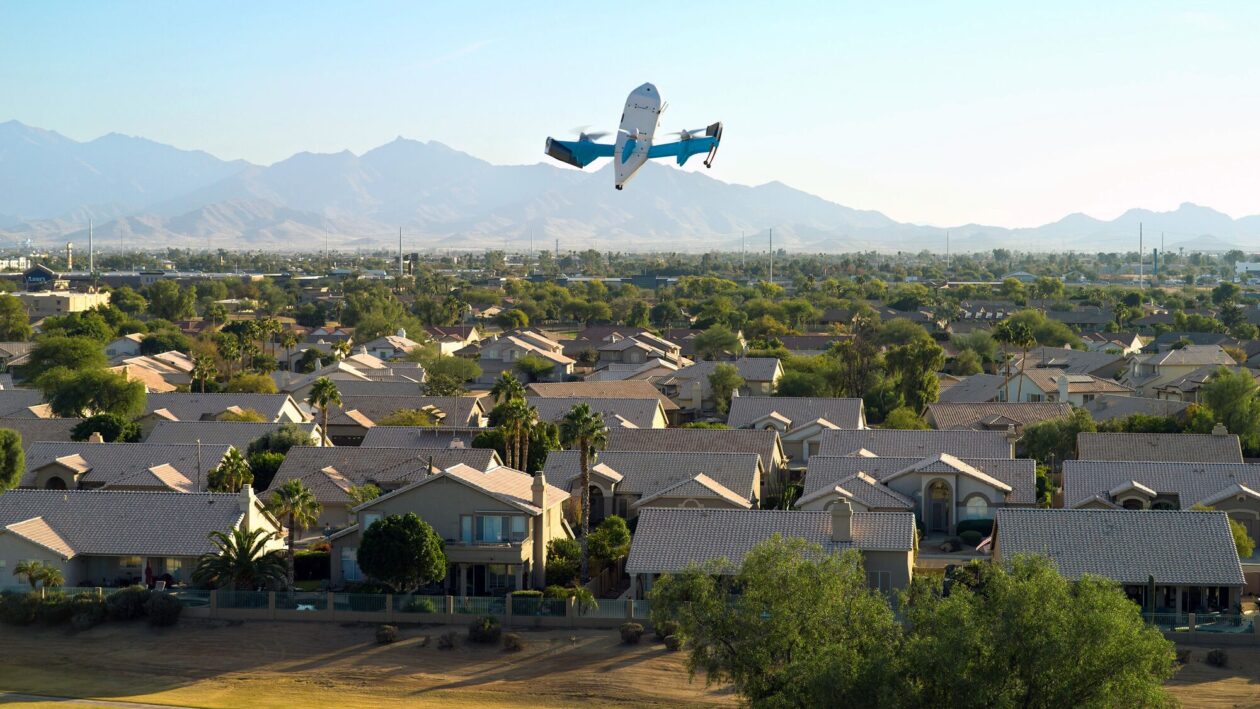
💡Amazon’s long-delayed drone program is approaching a 500-location U.S. deployment—an important robotics scale test.
⚡ 30-Second TL;DR
What Changed
Prime Air is expected to reach nearly 500 U.S. cities and towns by year-end.
Why It Matters
A large-scale rollout could provide a meaningful real-world deployment case for autonomous navigation, fleet coordination, and last-mile robotics. It may also increase competitive pressure on logistics companies exploring AI-enabled delivery systems.
What To Do Next
Map your autonomous-delivery use case against Prime Air’s rollout, focusing on navigation, fleet orchestration, and last-mile exception handling.
Key Points
- •Prime Air is expected to reach nearly 500 U.S. cities and towns by year-end.
- •Jeff Bezos unveiled the drone delivery program on 60 Minutes in December 2013.
- •The expansion advances Amazon’s long-delayed autonomous delivery strategy.
🧠 Deep Insight
AI-generated analysis for this event.
🔑 Enhanced Key Takeaways
- •Amazon is utilizing the MK30 drone model for this expansion, which features increased range and noise reduction capabilities compared to previous iterations.
- •The FAA granted Amazon expanded Part 135 air carrier certification, allowing for beyond visual line of sight (BVLOS) operations in specific urban environments.
- •Prime Air has integrated its delivery infrastructure directly into existing Same-Day Delivery fulfillment centers to streamline the transition from warehouse to drone launch.
- •Regulatory hurdles regarding 'detect and avoid' (DAA) technology have been a primary factor in the 13-year delay between the initial announcement and this widespread rollout.
- •The expansion includes a new 'Prime Air' interface within the Amazon mobile app that provides real-time tracking and precise delivery location customization for customers.
📊 Competitor Analysis▸ Show
| Feature | Amazon Prime Air | Wing (Alphabet) | Zipline |
|---|---|---|---|
| Primary Model | MK30 | Wing Delivery Drone | Platform 2 (P2) |
| Operational Focus | Urban/Suburban | Suburban/Campus | Medical/Retail/Food |
| Regulatory Status | Part 135 (BVLOS) | Part 135 (BVLOS) | Part 135 (BVLOS) |
| Delivery Mechanism | Drop-off | Winch/Tether | Droid/Tether |
🛠️ Technical Deep Dive
- MK30 Drone Architecture: Utilizes a hexagonal rotor configuration for enhanced stability and redundancy in adverse weather conditions.
- Noise Mitigation: Features custom-designed propellers that reduce the perceived sound profile by approximately 25% compared to the MK27-2.
- Detect and Avoid (DAA): Employs a multi-modal sensor suite including computer vision, ultrasonic sensors, and LiDAR to identify and navigate around static and dynamic obstacles.
- Flight Control System: Operates on a proprietary autonomous flight stack that performs real-time trajectory adjustments based on localized wind data and air traffic telemetry.
🔮 Future ImplicationsAI analysis grounded in cited sources
⏳ Timeline
Weekly AI Recap
Read this week's curated digest of top AI events →
👉Related Updates
AI-curated news aggregator. All content rights belong to original publishers.
Original source: GeekWire ↗