Polly Bidirectional Streaming for TTS
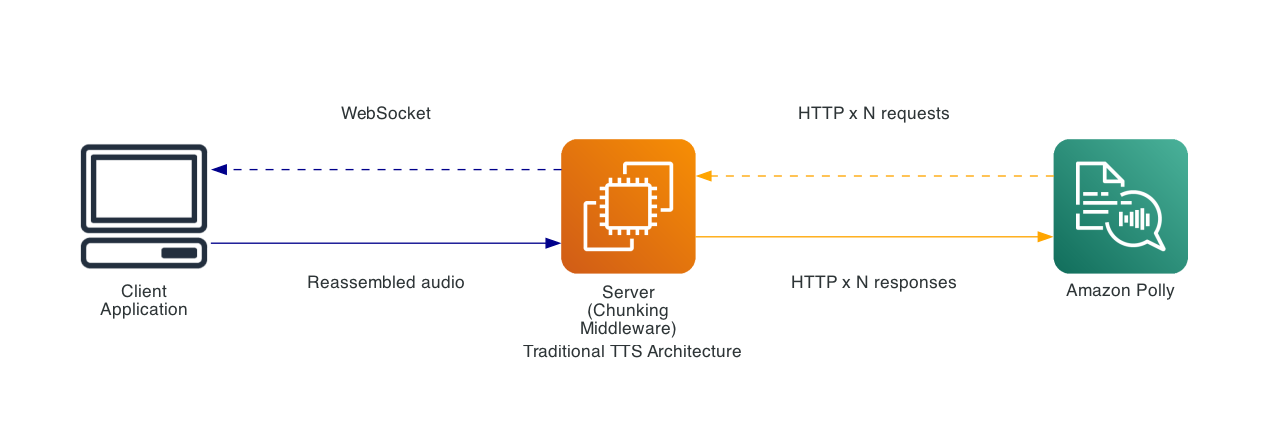
💡New Polly API enables real-time TTS for LLMs – perfect for low-latency voice AI.
⚡ 30-Second TL;DR
What Changed
New Bidirectional Streaming API for Amazon Polly
Why It Matters
Revolutionizes voice AI apps by enabling true real-time synthesis, improving user experience in chatbots and virtual assistants. Reduces latency for dynamic conversations powered by LLMs.
What To Do Next
Test Amazon Polly's Bidirectional Streaming API for your LLM-powered voice chatbot.
Key Points
- •New Bidirectional Streaming API for Amazon Polly
- •Simultaneous text-to-speech for real-time conversational AI
- •Supports incremental LLM-generated text and audio
🧠 Deep Insight
AI-generated analysis for this event — not the original article.
🔑 Enhanced Key Takeaways
- •The API utilizes a gRPC-based interface to facilitate full-duplex communication, significantly reducing the time-to-first-byte (TTFB) compared to traditional REST-based request-response patterns.
- •It integrates natively with Amazon Bedrock, allowing developers to stream partial tokens directly from LLM inference calls into Polly without needing to buffer complete sentences or paragraphs.
- •The implementation includes advanced prosody management, enabling the engine to adjust speech cadence dynamically as additional context from the LLM becomes available during the streaming session.
📊 Competitor Analysis▸ Show
| Feature | Amazon Polly (Bidirectional) | Google Cloud TTS | ElevenLabs | OpenAI Realtime API |
|---|---|---|---|---|
| Streaming Mode | Full-Duplex gRPC | Server-Sent Events (SSE) | WebSocket | WebSocket |
| Latency | Ultra-low (Incremental) | Low (Chunked) | Low (Chunked) | Ultra-low (Native) |
| Integration | AWS/Bedrock Native | Google Cloud/Vertex AI | API-first | OpenAI Platform |
| Pricing | Pay-per-character | Pay-per-character | Subscription/Usage | Usage-based |
🛠️ Technical Deep Dive
- Protocol: Implements a gRPC bidirectional stream, allowing the client to send text chunks while simultaneously receiving audio frames over the same connection.
- Buffer Management: Employs a sliding window mechanism to handle partial text inputs, ensuring that prosody and intonation are maintained across chunk boundaries.
- Latency Optimization: Bypasses standard HTTP/1.1 overhead by maintaining a persistent connection, reducing handshake latency for conversational turns.
- Encoding: Supports real-time transcoding into multiple formats (e.g., PCM, Opus) directly within the stream to minimize post-processing requirements.
🔮 Future ImplicationsAI analysis grounded in cited sources
⏳ Timeline
Weekly AI Recap
Read this week's curated digest of top AI events →
👉Related Updates
AI-curated news aggregator. All content rights belong to original publishers.
Original source: AWS Machine Learning Blog ↗
This is a summary, not the original. Read the source, or get the weekly briefing.
The weekly digest
One email a week. Unsubscribe anytime.