Polestar CEO: 'Pump Anxiety' Replacing Range Anxiety
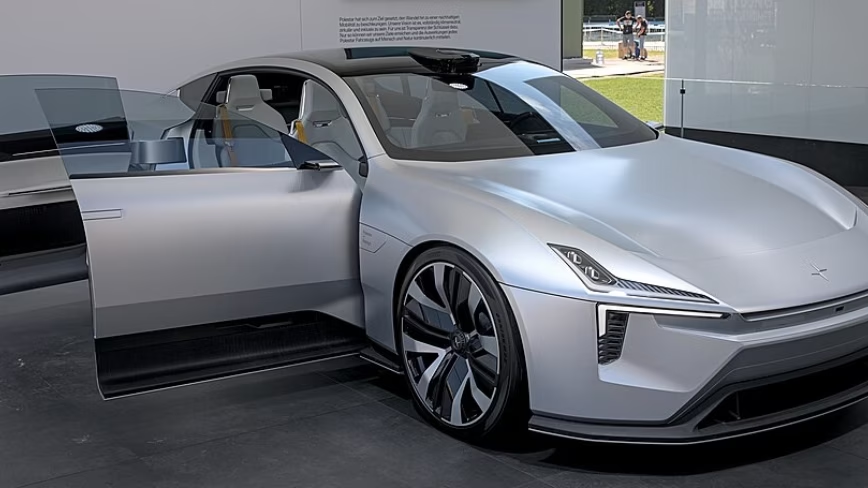
💡Understand how EV manufacturers are pivoting their marketing narrative to compete with traditional gas vehicles.
⚡ 30-Second TL;DR
What Changed
Polestar CEO coins 'pump anxiety' to describe consumer fear of gas prices.
Why It Matters
This shift in messaging could influence how EV companies market their products to price-sensitive consumers. It signals a move toward emphasizing total cost of ownership over technical range specifications.
What To Do Next
Analyze consumer sentiment data to determine if 'total cost of ownership' messaging outperforms 'range capability' in your AI-driven marketing campaigns.
Key Points
- •Polestar CEO coins 'pump anxiety' to describe consumer fear of gas prices.
- •EV industry narrative shifting from range limitations to economic benefits.
- •Company balance sheet remains a point of scrutiny despite marketing shifts.
🧠 Deep Insight
Web-grounded analysis with 17 cited sources.
🔑 Enhanced Key Takeaways
- •Polestar's Q1 2026 financial results reveal a significant net loss of $383 million, marking a 131% increase year-over-year, despite stable revenue of $633 million and a 7% growth in retail sales volume to over 13,100 cars.
- •The company's gross margin turned negative at -3.2% in Q1 2026, primarily due to intense competition, pricing pressures, EU and US tariffs on Polestars imported from China, and a product mix shift towards the lower-priced Polestar 4 and fewer Polestar 3 models.
- •Polestar CEO Michael Lohscheller attributes the rise of 'pump anxiety' to global tensions and disruptions, such as those in the Strait of Hormuz, which have caused fuel prices to surge, thereby making the economic benefits of EVs more apparent to consumers.
- •Despite the shifting narrative, 'range anxiety' persists as a significant concern for many potential EV buyers; an April 2026 study indicated that 46% cited charging station availability as a reason to avoid purchasing an EV, and 73% of those 'very unlikely' to consider an EV desired at least 500 miles of range.
- •Polestar is actively transforming its business model by expanding its global retail network to an anticipated 250 sales points by the end of 2026 and consolidating manufacturing operations to mitigate tariff impacts and enhance efficiencies.
🛠️ Technical Deep Dive
- Polestar vehicles, such as the Polestar 2, utilize Google's Android Automotive OS for their infotainment system, including built-in Google Maps.
- The Polestar 2 supports the CCS charging standard and offers Level 2 (AC) charging, taking 7-8 hours for a 0-100% charge, and Level 3 (DC Fast Charging) which can achieve 10-80% charge in approximately 28 minutes.
- Polestar 2 owners can access some Tesla Supercharger sites using an official NACS adapter.
- Real-world efficiency for the Polestar 2 typically ranges from 26-34 kWh per 100 miles, with home charging costs estimated at 4-7 cents per mile and public DC fast charging at 10-15 cents per mile in the U.S. in 2026.
- Polestar has a 'Polestar 0 project' with the goal of producing a truly climate-neutral car without offsets by 2035, and has reduced its GHG emissions per sold car by 31% since 2020.
🔮 Future ImplicationsAI analysis grounded in cited sources
⏳ Timeline
📎 Sources (17)
Factual claims are grounded in the sources below. Forward-looking analysis is AI-generated interpretation.
- Google Search Source
- Google Search Source
- Google Search Source
- Google Search Source
- Google Search Source
- Google Search Source
- Google Search Source
- Google Search Source
- Google Search Source
- Google Search Source
- Google Search Source
- Google Search Source
- Google Search Source
- Google Search Source
- Google Search Source
- Google Search Source
- Google Search Source
Weekly AI Recap
Read this week's curated digest of top AI events →
👉Related Updates
AI-curated news aggregator. All content rights belong to original publishers.
Original source: The Next Web (TNW) ↗