Pirated Data for AI Training: Copyright Risks?
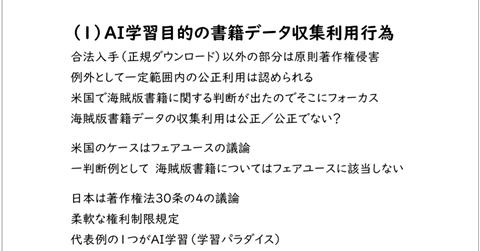
💡Lawyer weighs if pirate data for AI training breaks JP copyright—key for data compliance
⚡ 30-Second TL;DR
What Changed
Analyzes legality of pirate content collection for AI training
Why It Matters
Clarifies legal risks for AI data practices, crucial for compliance in training models.
What To Do Next
Review Kakinuma's seminar commentary before sourcing training data in Japan.
Key Points
- •Analyzes legality of pirate content collection for AI training
- •Reviews lawyer's take on Japan Patent Attorneys Association materials
- •Focuses on generative AI copyright issues in Japan
🧠 Deep Insight
Background and context from public sources — not the original article. 8 sources cited.
🔑 Enhanced Key Takeaways
- •Japan's Copyright Act Article 30-4 (amended 2018) permits use of copyrighted works for AI training if the use does not 'unjustly harm the legitimate interests of the copyright holder,' but rights holders argue extensive unlicensed use may not qualify for exemption[1]
- •The Content Overseas Distribution Association (CODA), representing major Japanese studios including Studio Ghibli, Bandai Namco, and Square Enix, formally demanded OpenAI halt unlicensed training use, emphasizing Japan requires prior licensing for copyrighted material rather than retrospective opt-outs[1]
- •Japan's AI Promotion Act (enacted May 2025, fully in force September 2025) establishes a 'deployment + guidance + safety capacity' regulatory model distinct from the EU's ex ante framework, relying on non-binding guidance rather than comprehensive horizontal regulation[4]
- •A large-scale survey of Japanese artists shows 92.8% support mandatory disclosure of copyrighted works in training data and 61.6% require prior permission rather than opt-out systems, with 26.6% preferring AI training be prohibited in principle[5]
- •The Cabinet Office completed public consultation (January 2026) on a draft 'Principles and Code on Generative AI' expected to issue non-binding guidance on IP protection and transparency, though industry groups warn overly prescriptive requirements risk undermining Japan's innovation-friendly environment[3][4]
🛠️ Technical Deep Dive
• Japan's statutory exception framework (Article 30-4) requires that AI training use not 'unjustly harm legitimate interests' of copyright holders—a narrowly interpreted standard that shifts burden to demonstrating fair use rather than obtaining prior consent[1] • Arbitration panels evaluating AI training disputes will consider: balance of contract clauses versus statutory rights, whether training harms legitimate interests, and interpretation of copyright law in light of generative AI capabilities[1] • Technical access restrictions (e.g., robots.txt) are frequently bypassed in large-scale training operations, creating enforcement challenges[1] • AI service providers argue training uses qualify as exempt under statutory exceptions or contract terms, and outputs lack infringement due to transformation or lack of direct replication[1] • Source-level attribution remains technically infeasible for large-scale models that do not store discrete records of individual training works, complicating transparency mandates[3]
🔮 Future ImplicationsAI analysis grounded in cited sources
Japan's regulatory approach creates ongoing tension between innovation incentives and creator protections. The non-binding 'Principles and Code' guidance (expected shortly after January 2026 consultation) will likely shape industry norms without legal mandate, potentially influencing arbitration outcomes in disputes like CODA v. OpenAI. Mandatory disclosure requirements and prior-consent frameworks could increase compliance costs for AI developers but may accelerate licensing frameworks and revenue-sharing models. The AI Safety Institute's evaluation capacity will provide technical assessment of generative AI systems, though without enforcement authority. Japan's permissive legal environment for AI development may attract continued investment, but growing artist opposition (89% view AI as serious threat) could pressure government toward stronger IP protections in future amendments.
⏳ Timeline
📎 Sources (8)
Factual claims are grounded in the sources below. Forward-looking analysis is AI-generated interpretation.
- lawgratis.com — Arbitration Over AI Copyright Infringement in Japan
- iapp.org — Global AI Law and Policy Tracker Highlights and Takeaways
- ccianet.org — Ccia Comments on Japans Draft Principle Code for Generative AI and IP Protection
- jdsupra.com — Post Election Japan AI Policy 1844208
- automaton-media.com — 89 of Japanese Artists Consider Generative AI a Serious Threat to Their Livelihood Large Scale Survey Shows
- law.asia — Media Industry Confronting AI Legal Risks
- jane.or.jp — 27067
- japantimes.co.jp — Japan Worlds Next AI Leader
Weekly AI Recap
Read this week's curated digest of top AI events →
👉Related Updates
AI-curated news aggregator. All content rights belong to original publishers.
Original source: ITmedia AI+ (日本) ↗
This is a summary, not the original. Read the source, or get the weekly briefing.
Weekly AI briefing
One email a week. Unsubscribe anytime.