Pi: Minimal Coding Agent Beats Claude Code
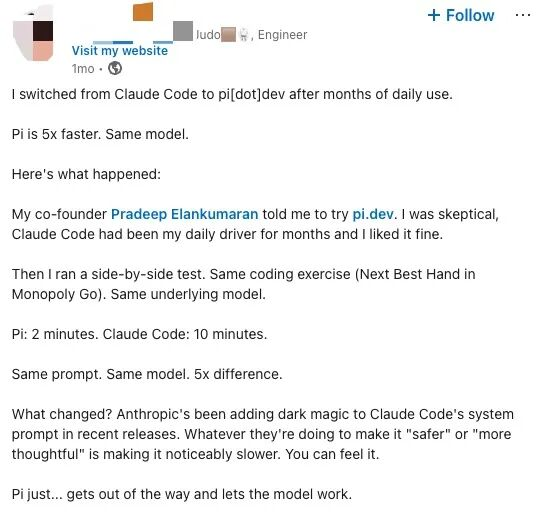
💡Minimal Pi agent 5x faster than Claude Code—ideal for builder workflows
⚡ 30-Second TL;DR
What Changed
Pi limits to four core tools: Read, Write, Edit, Bash, avoiding extra abstractions.
Why It Matters
Pi's minimalism offers a blueprint for building controllable, fast coding agents, challenging bloated frameworks. It highlights risks of overdesign in consumer-facing AI agents, promoting safer extensibility.
What To Do Next
Clone Pi repo and test its 4-tool loop on your Claude API for a coding task benchmark.
Key Points
- •Pi limits to four core tools: Read, Write, Edit, Bash, avoiding extra abstractions.
- •Designed as reaction to Claude Code's rapid complexity growth and unpredictability.
- •Achieves 2-minute vs 10-minute task times on same model/prompt per user tests.
- •Emphasizes engineering restraint: agents as code-writing/running machines, not smarter software.
🧠 Deep Insight
AI-generated analysis for this event — not the original article.
🔑 Enhanced Key Takeaways
- •Pi utilizes a 'state-machine' architecture that explicitly avoids the recursive planning loops found in larger agents, reducing token overhead and preventing 'agent drift' during long-running tasks.
- •The framework is built on a 'bring-your-own-model' (BYOM) philosophy, allowing developers to swap between local models like DeepSeek-R1 or cloud-based models like Claude 3.7 Sonnet without changing the agent's core logic.
- •Performance gains are attributed to a significant reduction in system prompt length, which minimizes the 'context pollution' that often causes larger agents to hallucinate or get stuck in repetitive tool-calling loops.
📊 Competitor Analysis▸ Show
| Feature | Pi | Claude Code | OpenDevin (All-Hands) |
|---|---|---|---|
| Architecture | Minimalist/Linear | Complex/Recursive | Modular/Extensible |
| Toolset | 4 (Read/Write/Edit/Bash) | 20+ (Integrated) | 50+ (Plugin-based) |
| Primary Focus | Speed/Controllability | Feature-rich Automation | Enterprise Integration |
| Pricing | Open Source (Free) | Usage-based (API) | Open Source (Free) |
🛠️ Technical Deep Dive
- •Core Loop: Implemented as a synchronous Python loop that executes a single turn: [Observe State] -> [Model Inference] -> [Tool Execution] -> [Update State].
- •Tool Interface: Uses a strict JSON-schema-based tool calling convention that maps directly to standard Unix shell commands, bypassing complex abstraction layers.
- •State Management: Maintains a minimal 'workspace context' consisting only of the current file tree and the last 5 terminal outputs to keep the context window under 8k tokens for most tasks.
- •Error Handling: Implements a 'fail-fast' mechanism where any non-zero exit code from the Bash tool immediately halts the agent and prompts for human intervention, preventing cascading errors.
🔮 Future ImplicationsAI analysis grounded in cited sources
⏳ Timeline
Weekly AI Recap
Read this week's curated digest of top AI events →
👉Related Updates



AI-curated news aggregator. All content rights belong to original publishers.
Original source: 虎嗅 ↗
This is a summary, not the original. Read the source, or get the weekly briefing.
The weekly digest
One email a week. Unsubscribe anytime.