๐ฑEngadgetโขStalecollected in 50m
Parker Solar Probe completes latest solar flyby
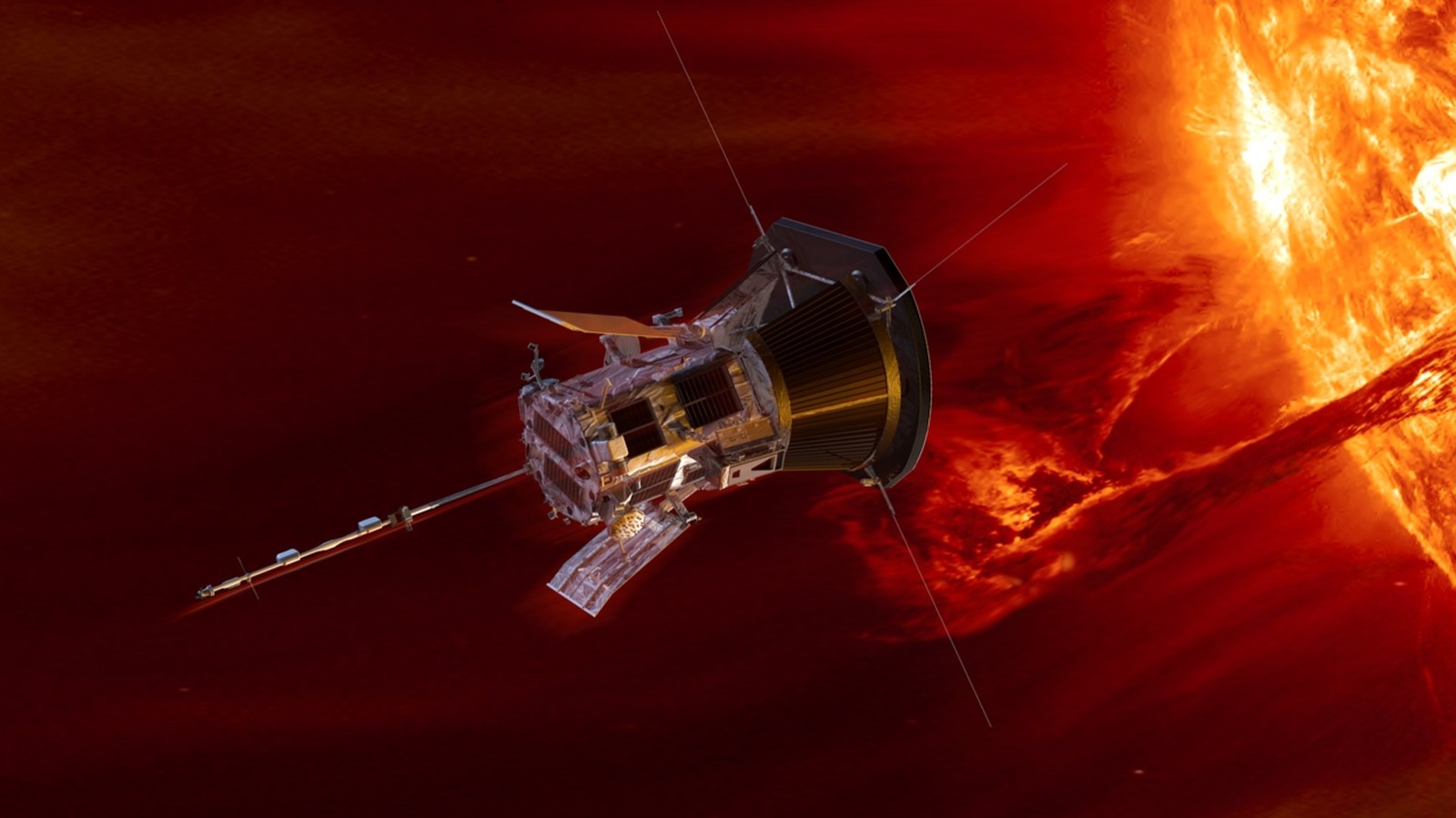
๐กScientific data collection that informs long-term energy infrastructure and climate modeling.
โก 30-Second TL;DR
What Changed
Successful completion of solar flyby mission
Why It Matters
Provides foundational data for energy research which may influence future sustainable AI infrastructure power sources.
What To Do Next
Monitor NASA's open data portals for datasets that could be used for climate modeling AI training.
Who should care:Researchers & Academics
Key Points
- โขSuccessful completion of solar flyby mission
- โขCollection of high-resolution solar atmospheric data
- โขAdvancements in solar energy research applications
๐ง Deep Insight
Web-grounded analysis with 19 cited sources.
๐ Enhanced Key Takeaways
- โขThe Parker Solar Probe's 28th close approach on June 8, 2026, matched its record distance of 3.8 million miles (6.1 million kilometers) from the Sun's surface and a speed of 430,000 mph (690,000 km/h).
- โขThe mission is currently gathering data during the Sun's solar maximum, providing unprecedented insights into an active solar cycle.
- โขIn December 2021, the probe made history by becoming the first spacecraft to fly through the Sun's upper atmosphere, the corona, directly sampling its particles and magnetic fields.
- โขSignificant discoveries include identifying a dust-depletion zone near the Sun and observing that the solar wind's rotation is stronger than previously predicted.
๐ ๏ธ Technical Deep Dive
- Instruments: The probe carries four primary instrument suites: FIELDS (Electromagnetic Fields Investigation) to measure electric and magnetic fields; SWEAP (Solar Wind Electrons Alphas and Protons) to count and measure properties of solar wind particles; ISโIS (Integrated Science Investigation of the Sun) to study energetic particles; and WISPR (Wide-field Imager for Solar Probe), the only imaging instrument, to observe the solar corona and wind.
- Thermal Protection System: A 4.5-inch-thick (11.43-centimeter-thick) carbon-composite heat shield protects the spacecraft and its instruments from extreme temperatures, capable of withstanding nearly 2,500 degrees Fahrenheit (1,400ยฐ Celsius) and radiation approximately 500 times the intensity at Earth's orbit.
- Trajectory and Speed: The probe utilizes seven Venus gravity assists to gradually reduce its orbital perihelion, enabling it to approach as close as 3.8 million miles (6.1 million kilometers) from the Sun's surface. At its closest approach, it achieves a record-breaking speed of approximately 430,000 mph (690,000 km/h) relative to the Sun.
- Mission Duration: The planned mission duration is seven years, with 24 highly elliptical orbits around the Sun.
- Science Phase: During each orbit, the probe actively collects data in a 'Science Phase' for a few days before and after perihelion, during which communication with Earth is largely limited.
๐ฎ Future ImplicationsAI analysis grounded in cited sources
Improved space weather forecasting capabilities.
Direct, in-situ measurements of the solar wind and magnetic fields close to the Sun will enhance our ability to predict solar events that can impact Earth's technology and infrastructure.
Revolutionary advancements in understanding stellar physics.
By studying our Sun up close, the mission provides unprecedented data to solve long-standing mysteries like coronal heating and solar wind acceleration, offering insights applicable to stars across the universe.
Enhanced safety protocols for future human deep-space exploration.
Characterizing the radiation environment in the inner heliosphere will contribute to better safeguarding astronauts on future missions to the Moon, Mars, and beyond.
โณ Timeline
1958-07
National Research Council recommends a mission to fly inside Mercury's orbit.
1958
Eugene Parker publishes his theory on the supersonic solar wind.
2017-05-31
Solar Probe Plus is renamed Parker Solar Probe, honoring physicist Eugene Parker.
2018-08-12
Parker Solar Probe is launched from Cape Canaveral.
2021-12-14
NASA announces Parker Solar Probe flew through the Sun's upper atmosphere (corona), becoming the first spacecraft to 'touch the Sun'.
2024-12-24
Achieved closest approach of 3.8 million miles (6.1 million km) from the Sun's surface and a record speed of 430,000 mph (690,000 km/h).
๐ Sources (19)
Factual claims are grounded in the sources below. Forward-looking analysis is AI-generated interpretation.
๐ฐ
Weekly AI Recap
Read this week's curated digest of top AI events โ
๐Related Updates
AI-curated news aggregator. All content rights belong to original publishers.
Original source: Engadget โ