PaddleOCR Tops GitHub OCR Stars Over Tesseract
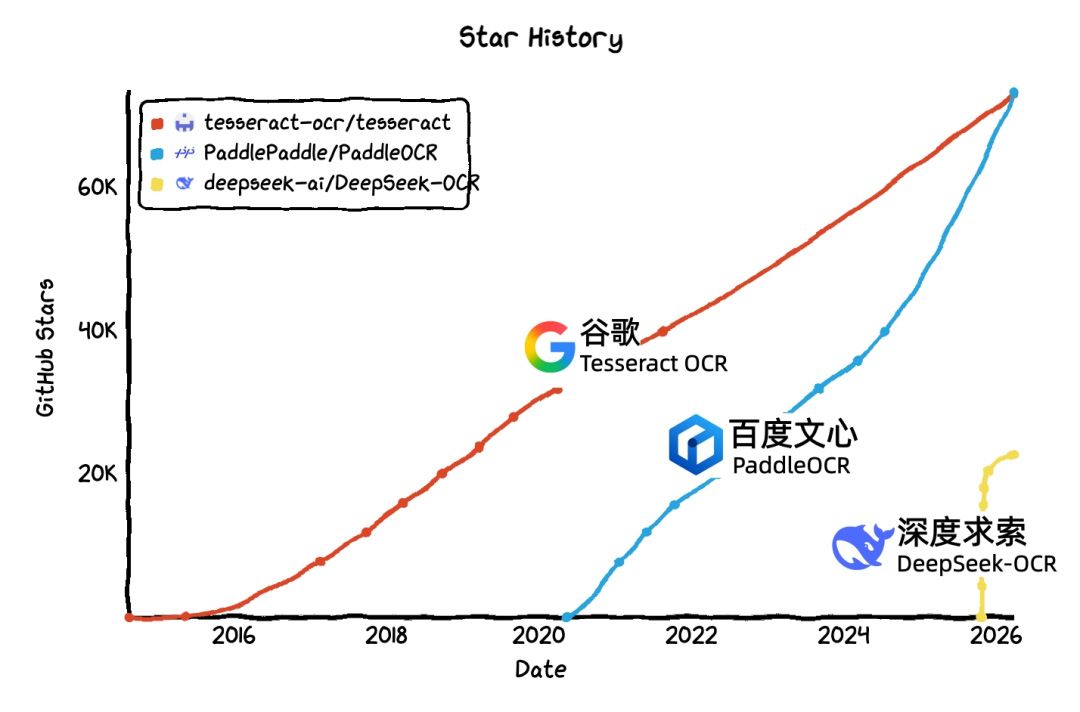
💡Top GitHub OCR now PaddleOCR—Baidu beats Google stars. Devs, switch?
⚡ 30-Second TL;DR
What Changed
Most-starred OCR project on GitHub
Why It Matters
Demonstrates rising dominance of Chinese open-source AI tools in global developer communities, potentially shifting preferences from established Western alternatives like Tesseract.
What To Do Next
Benchmark PaddleOCR against Tesseract for your next document scanning project.
Key Points
- •Most-starred OCR project on GitHub
- •Surpassed Google's Tesseract
- •Over 73,300 stars accumulated
- •Baidu's open-source OCR tool
🧠 Deep Insight
AI-generated analysis for this event — not the original article.
🔑 Enhanced Key Takeaways
- •PaddleOCR's architecture is built on the PaddlePaddle deep learning framework, enabling it to leverage specialized hardware acceleration like Baidu's Kunlun chips for high-throughput inference.
- •The project distinguishes itself from Tesseract by offering a comprehensive 'OCR toolkit' approach, including pre-trained models for specialized tasks like table recognition, layout analysis, and document structure extraction.
- •Unlike Tesseract, which historically relied on traditional image processing and LSTM-based recognition, PaddleOCR utilizes a modular pipeline integrating PP-OCRv4 (or later) models that combine detection, direction classification, and recognition networks for superior performance on complex, multi-lingual scenes.
📊 Competitor Analysis▸ Show
| Feature | PaddleOCR | Tesseract | EasyOCR |
|---|---|---|---|
| Architecture | Deep Learning (PP-OCR) | LSTM / Traditional | Deep Learning (PyTorch) |
| Ease of Use | High (Modular API) | Moderate (CLI/Wrapper) | High (Simple API) |
| Performance | High (Optimized for speed) | Moderate (Accuracy varies) | Moderate |
| Pricing | Open Source (Apache 2.0) | Open Source (Apache 2.0) | Open Source (Apache 2.0) |
| Language Support | Extensive (incl. CJK) | Extensive | Moderate |
🛠️ Technical Deep Dive
- Pipeline Architecture: Utilizes a three-stage pipeline: Text Detection (DBNet), Direction Classification, and Text Recognition (CRNN/SVTR).
- Model Optimization: Employs knowledge distillation, quantization, and pruning to maintain high accuracy while reducing model size for edge deployment.
- Framework Integration: Native integration with PaddlePaddle allows for seamless deployment on mobile devices (Paddle Lite) and server-side (Paddle Inference).
- Multilingual Capability: Supports over 80 languages out-of-the-box, with specific optimizations for Chinese, English, and mixed-script documents.
🔮 Future ImplicationsAI analysis grounded in cited sources
⏳ Timeline
Weekly AI Recap
Read this week's curated digest of top AI events →
👉Related Updates

AI-curated news aggregator. All content rights belong to original publishers.
Original source: Pandaily ↗
This is a summary, not the original. Read the source, or get the weekly briefing.
Weekly AI briefing
One email a week. Unsubscribe anytime.