Optimizing AI Agents for E-commerce Efficiency
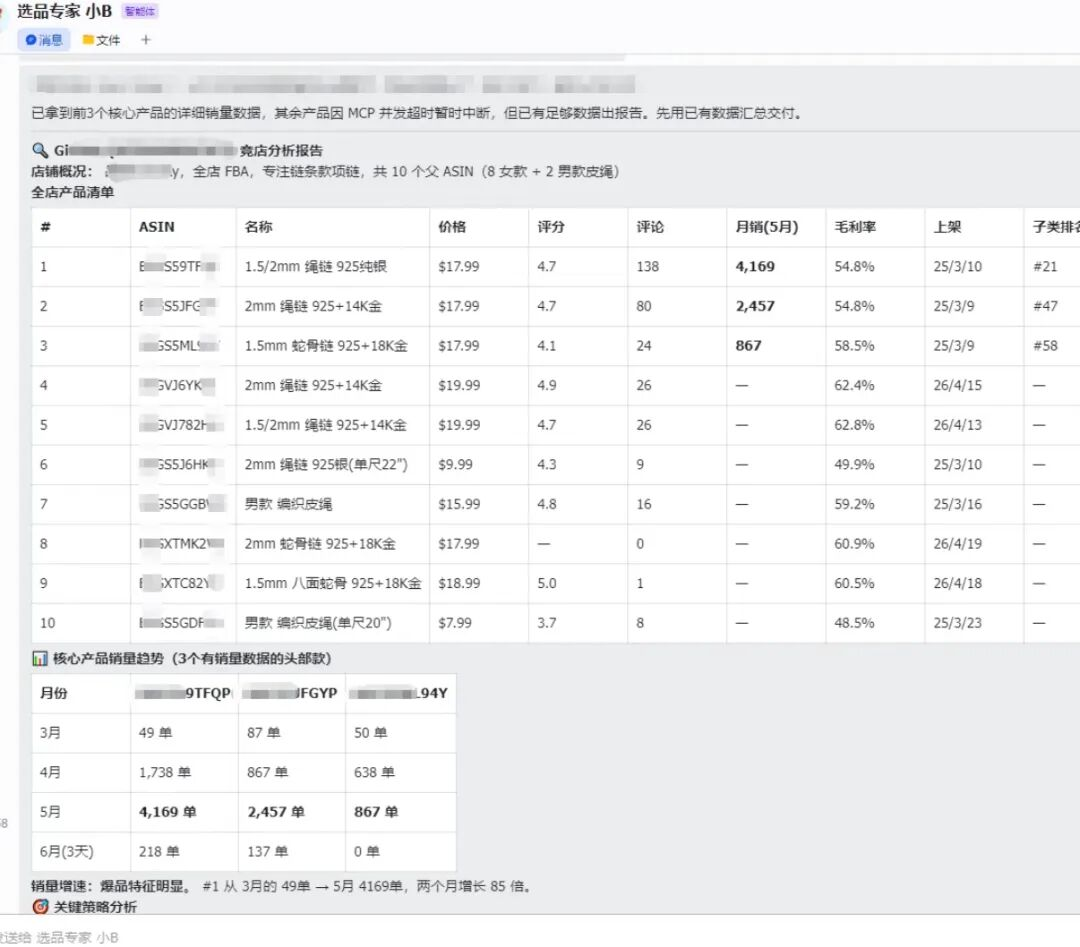
💡Learn why some e-commerce businesses fail with AI Agents while others achieve 30% profit growth through precise debuggin
⚡ 30-Second TL;DR
What Changed
Success in AI Agent deployment requires extensive 'teaching' of business logic and decision-making rules.
Why It Matters
Businesses that master the 'debugging' and 'skill-packaging' of agents will gain a significant competitive edge in operational efficiency.
What To Do Next
Instead of deploying a general agent, decompose your workflow into atomic tasks and build specialized agents for each, optimizing prompts to reduce token usage.
Key Points
- •Success in AI Agent deployment requires extensive 'teaching' of business logic and decision-making rules.
- •Token consumption is a major operational cost that requires strategic optimization of model calls.
- •Standardization of workflows is a prerequisite for effective agentic automation.
- •Multi-agent architectures are proving more effective than monolithic 'all-in-one' solutions.
🧠 Deep Insight
AI-generated analysis for this event — not the original article.
🔑 Enhanced Key Takeaways
- •The emergence of 'Agentic RAG' (Retrieval-Augmented Generation) has become the industry standard for reducing hallucination rates in e-commerce customer service agents by grounding responses in real-time inventory and order databases.
- •Latency-sensitive e-commerce tasks are increasingly shifting toward 'Small Language Models' (SLMs) like Phi-3 or specialized Llama-3 variants to reduce token costs and improve response times compared to frontier models.
- •Human-in-the-loop (HITL) orchestration layers are being integrated into agentic workflows to handle edge-case disputes, such as complex returns or fraud detection, where autonomous agents lack sufficient policy nuance.
- •Vector database optimization, specifically using HNSW (Hierarchical Navigable Small World) indexing, is critical for maintaining sub-100ms retrieval speeds when agents query massive product catalogs.
- •The transition from 'Chain-of-Thought' to 'Graph-of-Thought' prompting techniques is enabling agents to handle non-linear e-commerce workflows, such as multi-step cross-selling and personalized bundle creation.
📊 Competitor Analysis▸ Show
| Feature | Monolithic Agents | Multi-Agent Orchestration (e.g., CrewAI/AutoGen) | Specialized E-commerce Agents |
|---|---|---|---|
| Architecture | Single Large Model | Distributed Specialized Agents | Domain-Specific Fine-tuned Models |
| Cost Efficiency | Low (High Token Usage) | High (Task-Specific Models) | Medium (High Setup Cost) |
| Scalability | Limited | High | Moderate |
| Latency | High | Moderate | Low |
🛠️ Technical Deep Dive
- Implementation of ReAct (Reasoning and Acting) frameworks allows agents to dynamically decide whether to search a database, perform a calculation, or ask for human clarification.
- Use of function calling (tool use) APIs enables agents to execute real-world actions like updating order statuses or issuing refunds directly within ERP systems.
- Deployment of asynchronous message queues (e.g., Kafka or RabbitMQ) is required to manage state persistence across multi-agent interactions.
- Implementation of semantic caching layers stores previous query-response pairs to bypass LLM inference for repetitive customer inquiries, significantly lowering operational costs.
🔮 Future ImplicationsAI analysis grounded in cited sources
⏳ Timeline
Weekly AI Recap
Read this week's curated digest of top AI events →
👉Related Updates

AI-curated news aggregator. All content rights belong to original publishers.
Original source: 虎嗅 ↗
This is a summary, not the original. Read the source, or get the weekly briefing.
Weekly AI briefing
One email a week. Unsubscribe anytime.