Operationalizing FDT
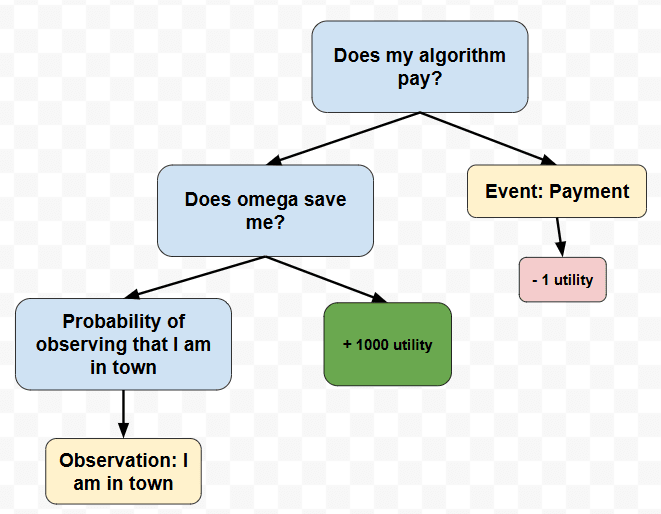
💡Formalizes FDT's logical do-operator—essential for building predictor-proof AI agents.
⚡ 30-Second TL;DR
What Changed
Defines logical do-operator via 2x2 table with cut/forget options for logical causal graphs.
Why It Matters
Advances FDT formalization, aiding robust AI agent design in predictor scenarios. Helps alignment researchers implement decision theories without commitment hacks.
What To Do Next
Implement option 2 logical do-operator in your FDT agent simulator for hitchhiker tests.
Key Points
- •Defines logical do-operator via 2x2 table with cut/forget options for logical causal graphs.
- •Option 2 (cut incoming, forget downstream, condition) enables FDT to pay in Parfit's hitchhiker.
- •Distinguishes logical causality from physical, requiring forget step for observed downstream nodes.
- •Explains FDT vs EDT/CDT, addressing anthropic updating and need for logical counterfactuals.
🧠 Deep Insight
Background and context from public sources — not the original article. 8 sources cited.
🔑 Enhanced Key Takeaways
- •FDT was formally introduced by Eliezer Yudkowsky and Nate Soares as a successor to Timeless Decision Theory (TDT), outperforming CDT and EDT by treating decisions as outputs of a fixed mathematical function[3].
- •ACDT, a related acausal approach, extends CDT by adding potential logical links from the decision node to other nodes in causal graphs, enabling one-boxing in Newcomb's problem through empirical learning of graph structures[1].
- •FDT is characterized as a meta-causal theory emphasizing subjunctive dependence via source code correlations that resist confounding by choice, avoiding risks like dynamic updating exploited by predictors[6].
- •Critiques highlight FDT's vulnerability in adversarial settings, such as XOR blackmail, where predictors might manipulate agents into switching to exploitable decision theories like EDT[6].
🔮 Future ImplicationsAI analysis grounded in cited sources
⏳ Timeline
📎 Sources (8)
Factual claims are grounded in the sources below. Forward-looking analysis is AI-generated interpretation.
- alignmentforum.org — Acdt a Hack Y Acausal Decision Theory
- andrew.cmu.edu — Tickledefenseintro
- lesswrong.com — Functional Decision Theory
- plato.stanford.edu — Decision Causal
- risingentropy.com — Causal Decision Theory
- lesswrong.com — Dissolving Confusion Around Functional Decision Theory
- en.wikipedia.org — Causal Decision Theory
- scribd.com — Soares Levinstein Cheating Death in Damascus
Weekly AI Recap
Read this week's curated digest of top AI events →
👉Related Updates
AI-curated news aggregator. All content rights belong to original publishers.
Original source: AI Alignment Forum ↗
This is a summary, not the original. Read the source, or get the weekly briefing.
Weekly AI briefing
One email a week. Unsubscribe anytime.