Opera Connector Shares Context with AI Models
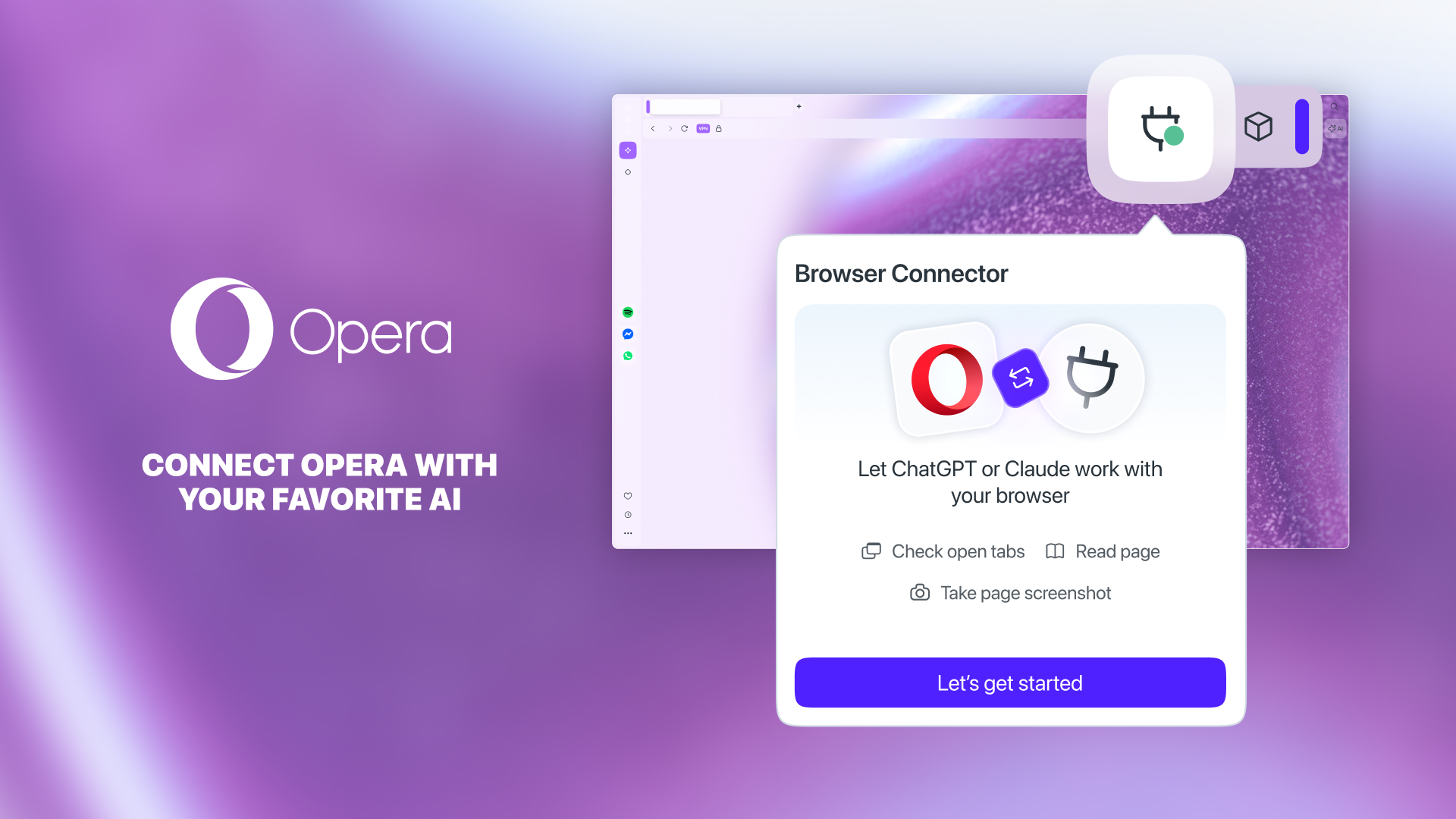
Feed live browser context to ChatGPT/Claude—boost AI research without copy-paste
30-Second TL;DR
What Changed
Available for Opera One and GX
Why It Matters
Streamlines AI-assisted browsing and research by feeding real-time context. AI practitioners gain seamless integration for dynamic prompting without manual copy-paste.
What To Do Next
Install Opera GX, enable Browser Connector, and link to Claude for context-rich prompts.
Key Points
- •Available for Opera One and GX
- •Links to ChatGPT and Claude
- •Shares live browsing context
- •Passes context to external AI
- •Enables context-aware AI queries
Deep Insight
AI-generated analysis for this event — not the original article.
Enhanced Key Takeaways
- •The feature utilizes a 'Context-Aware' architecture that allows users to manually toggle which specific browser tabs or active page content are sent to the LLM, prioritizing user privacy and data minimization.
- •Opera implements a 'Context-Bridge' API layer that sanitizes and structures DOM data before transmission, ensuring that sensitive user information like passwords or private session cookies are excluded from the AI prompt payload.
- •This integration is part of Opera’s broader 'Aria' AI ecosystem strategy, designed to transition the browser from a passive navigation tool to an active, intent-based assistant that maintains state across different AI providers.
Competitor Analysis
- Opera Connector
- Manual/Selective
- Microsoft Copilot (Edge)
- Deep OS/Browser Integration
- Arc Browser (Max)
- Automated Page Summarization
- Opera Connector
- Multi-model (ChatGPT/Claude)
- Microsoft Copilot (Edge)
- Exclusive (GPT-4o)
- Arc Browser (Max)
- Multi-model (GPT/Claude)
- Opera Connector
- User-controlled payload
- Microsoft Copilot (Edge)
- Enterprise-managed
- Arc Browser (Max)
- Local-first processing
| Feature | Opera Connector | Microsoft Copilot (Edge) | Arc Browser (Max) |
|---|---|---|---|
| Context Sharing | Manual/Selective | Deep OS/Browser Integration | Automated Page Summarization |
| Model Choice | Multi-model (ChatGPT/Claude) | Exclusive (GPT-4o) | Multi-model (GPT/Claude) |
| Privacy Focus | User-controlled payload | Enterprise-managed | Local-first processing |
Technical Deep Dive
- •Implementation relies on a browser-side extension framework that captures the active tab's text content and metadata via the Chrome Extensions API.
- •Data transmission is handled via an encrypted WebSocket connection to Opera’s backend proxy, which then forwards the context to the respective AI provider's API.
- •The system employs a token-budgeting mechanism to truncate excessively long web pages, ensuring the context fits within the context window limits of the selected LLM.
- •Supports 'Context-Injection' prompts, where the browser-provided data is prepended to the user's natural language query as a system-level instruction.
Future ImplicationsAI analysis grounded in cited sources
Timeline
- 2023-03Opera announces the integration of ChatGPT into the sidebar.
- 2023-05Launch of 'Aria', Opera's native browser AI.
- 2024-01Opera One introduces modular AI architecture to support multiple LLMs.
- 2025-09Opera expands Aria capabilities to include image generation and advanced data analysis.
- 2026-04Release of Browser Connector for Opera One and GX.
Weekly AI Recap
Read this week's curated digest of top AI events →
AI-curated news aggregator. All content rights belong to original publishers.
Original source: TestingCatalog ↗
This is a summary, not the original. Read the source, or get the weekly briefing.
The weekly digest
One email a week. Unsubscribe anytime.