OpenClaw Token Bills Shock Users
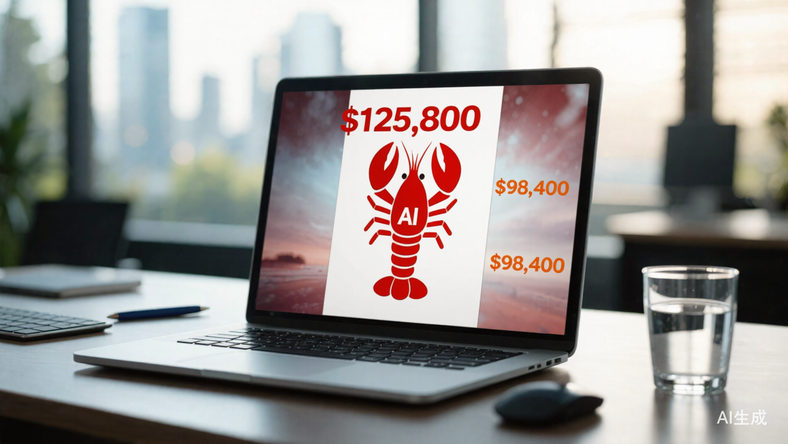
💡OpenClaw's 100x token costs + security holes: must-read for agent builders
⚡ 30-Second TL;DR
What Changed
Users lose $100+ in 2 hours; one night chats cost 100万 tokens.
Why It Matters
Highlights agent economics: high costs limit mass adoption but fuel model providers' growth. Practitioners must budget carefully amid security warnings.
What To Do Next
Set strict API quotas and monitor OpenClaw token spend via provider dashboards.
Key Points
- •Users lose $100+ in 2 hours; one night chats cost 100万 tokens.
- •Agent tasks multiply token use 10-100x via decomposition and iterations.
- •MiniMax ARR hits $1.5B; Chinese models top global usage charts.
- •Security flaws: exposed instances, prompt injection risks reported.
- •China gov offers up to 6M RMB for OpenClaw 'one-person' firms.
🧠 Deep Insight
Background and context from public sources — not the original article. 8 sources cited.
🔑 Enhanced Key Takeaways
- •OpenClaw's memory system uses Markdown files with hybrid BM25 and vector search indexing (via Milvus) to reduce token consumption by enabling selective context retrieval instead of loading entire conversation histories into the context window[1].
- •Critical security vulnerability CVE-2026-25253 allows attackers to steal authentication tokens through malicious WebSocket servers and two-stage webpage exploits, granting full system access since OpenClaw agents run with elevated privileges[4].
- •OpenClaw supports multi-model access through a unified API gateway, with pricing ranging from 4 cents per million tokens (Kimi K 2.5) to $3 per million tokens (Claude Sonnet 4.6), enabling cost optimization through model selection[2].
📊 Competitor Analysis▸ Show
| Capability | Mem0 / Zep | memsearch (OpenClaw) | |--|--|--| | Source of Truth | Vector database (sole) | Markdown files + Milvus index | | Transparency | Black box API | Open .md file inspection | | Editability | API calls only | Direct text editor editing | | Version Control | Separate audit logging | Native Git support | | Migration Cost | Export → convert → re-import | Copy Markdown folder | | Human-AI Collaboration | AI writes, humans observe | Humans edit, supplement, review |[1]
🛠️ Technical Deep Dive
- Message Flow Architecture: Six-phase pipeline—Ingestion → Access Control & Routing → Context Assembly → Model Invocation → Tool Execution → Response Delivery[5]
- Authentication Model: Device-based tokens issued by Gateway after initial approval, preventing unauthorized access even if authentication token is compromised; Control UI requires HTTPS or localhost for secure device identity generation via crypto.subtle[5]
- Platform Integration: WhatsApp (QR code pairing via Baileys library), Telegram/Discord (bot tokens via environment variables), iMessage (native macOS integration)[5]
- Token Streaming: Responses streamed token-by-token from model providers (Anthropic Claude, OpenAI GPT, Google Gemini, local models) instead of waiting for complete responses[5]
- Security Gaps: No enforced password/token complexity requirements; trivial strings like 'a' accepted as valid credentials, enabling brute-force attacks on exposed instances[6]
🔮 Future ImplicationsAI analysis grounded in cited sources
⏳ Timeline
📎 Sources (8)
Factual claims are grounded in the sources below. Forward-looking analysis is AI-generated interpretation.
- milvus.io — Why AI Agents Like Openclaw Burn Through Tokens and How to Cut Costs
- youtube.com — Watch
- youtube.com — Watch
- hackers-arise.com — Cve 2026 25253 How Malicious Links Can Steal Authentication Tokens and Compromise Openclaw AI Systems
- ppaolo.substack.com — Openclaw System Architecture Overview
- bitsight.com — Openclaw AI Security Risks Exposed Instances
- tencentcloud.com — 140897
- malwarebytes.com — Openclaw What Is It and Can You Use It Safely
Weekly AI Recap
Read this week's curated digest of top AI events →
👉Related Updates

AI-curated news aggregator. All content rights belong to original publishers.
Original source: 虎嗅 ↗
This is a summary, not the original. Read the source, or get the weekly briefing.
Weekly AI briefing
One email a week. Unsubscribe anytime.