OpenClaw Agent Runtime Teardown
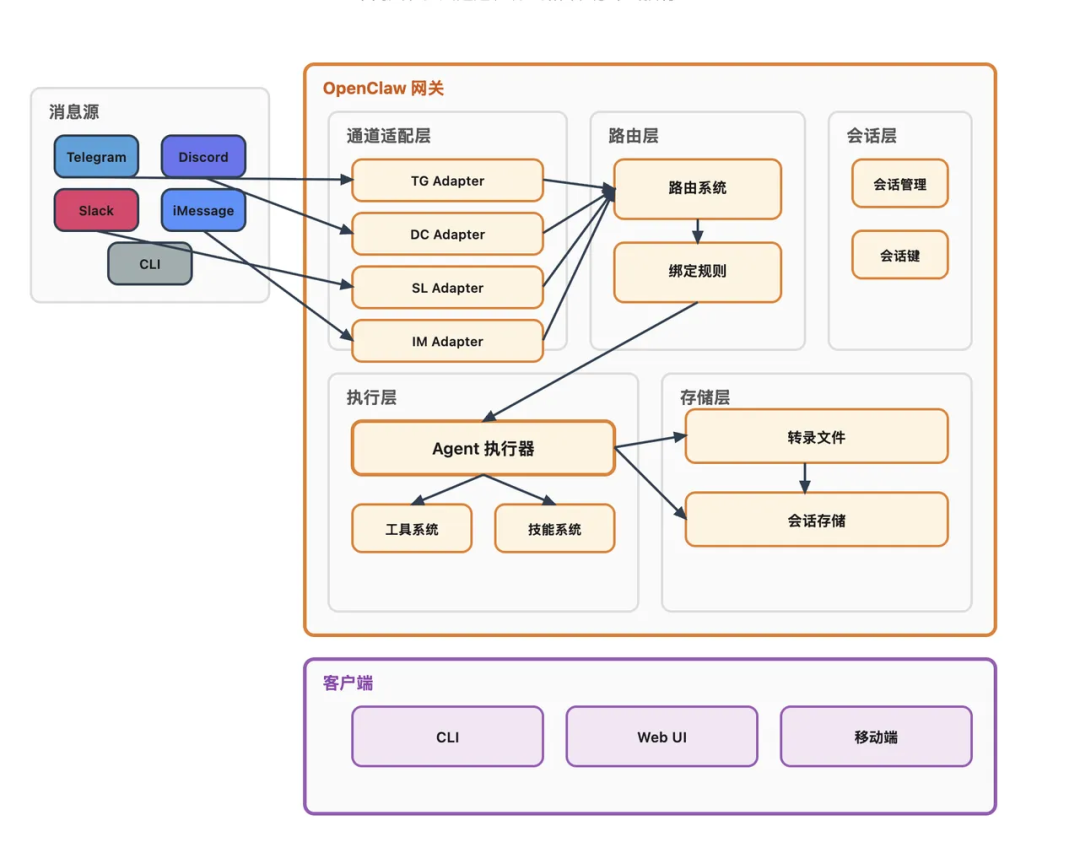
💡Master engineering multi-agent runtimes like OpenClaw for prod-scale apps
⚡ 30-Second TL;DR
What Changed
Five-layer stack: User interfaces, Gateway core, Message processing, Extensions/plugins, Infrastructure.
Why It Matters
Provides blueprint for production-grade agent runtimes, enabling scalable multi-platform deployments and complex task orchestration beyond simple chatbots.
What To Do Next
Clone OpenClaw repo and build a custom ChannelPlugin for your messaging app.
Key Points
- •Five-layer stack: User interfaces, Gateway core, Message processing, Extensions/plugins, Infrastructure.
- •Protocol adapters unify heterogeneous messages into standard MsgContext interface.
- •dispatchInboundMessage centralizes inbound routing, session building, and Agent execution.
- •Plugin system enables easy addition of channels, skills, and multi-agent collaboration.
- •Full chain: ingress → adaptation → dispatch → execution → outbound → persistence.
🧠 Deep Insight
Background and context from public sources — not the original article. 7 sources cited.
🔑 Enhanced Key Takeaways
- •OpenClaw's Gateway emits six event types including agent, chat, presence, health, heartbeat, and cron, enabling proactive behavior beyond user messages via timers and webhooks[2][3].
- •Agent Runtime uses hybrid memory with semantic search on prior turns and notes, loading from JSON session files and composing dynamic system prompts from workspace Markdown files like AGENTS.md and SOUL.md[1][5].
- •Skills ecosystem via ClawHub features over 5,700 to 10,000 community-contributed extensions, supporting tool calls executed in Docker sandboxes based on session policy[1][2].
🛠️ Technical Deep Dive
- •Agent Runtime implemented in
src/agents/piembeddedrunner.tsusing@mariozechner/pi-agent-corelibrary with RPC-style invocation and streaming responses[1]. - •Execution loop: resolves session, assembles context (history from JSON files, semantic memory search, dynamic prompts), streams LLM response while intercepting and executing tool calls (e.g., bash, file ops, browser via CDP) in Docker sandbox, then persists state to disk[1][2].
- •System prompt composition from workspace files: AGENTS.md (core instructions/constraints), SOUL.md (personality/tone), TOOLS.md (tool guidance), USER.md (user profile), with truncation for lean prompts[1][5].
- •Gateway uses WebSocket control plane with TypeBox schema validation, supports 15+ messaging platforms, and Canvas/A2UI for agent-driven interactive HTML UIs updated via WebSocket[2].
- •Queue modes: 'steer' injects messages mid-run after tool calls; 'followup/collect' holds until turn ends; built-in tools like read/exec/edit/write always available, gated by policy[5].
🔮 Future ImplicationsAI analysis grounded in cited sources
📎 Sources (7)
Factual claims are grounded in the sources below. Forward-looking analysis is AI-generated interpretation.
- ppaolo.substack.com — Openclaw System Architecture Overview
- youtube.com — Watch
- youtube.com — Watch
- generativeai.pub — Inside Openclaw How a Persistent AI Agent Actually Works 44a2aa5cc1d9
- docs.openclaw.ai — Agent
- madplay.github.io — Openclaw Overview and Usage
- advenboost.com — Openclaw Agent Explained 2026 Setup Guide Live Example
Weekly AI Recap
Read this week's curated digest of top AI events →
👉Related Updates

AI-curated news aggregator. All content rights belong to original publishers.
Original source: 虎嗅 ↗
This is a summary, not the original. Read the source, or get the weekly briefing.
Weekly AI briefing
One email a week. Unsubscribe anytime.