📱Engadget•Stalecollected in 23m
OpenAI Launches Codex Chrome Plugin
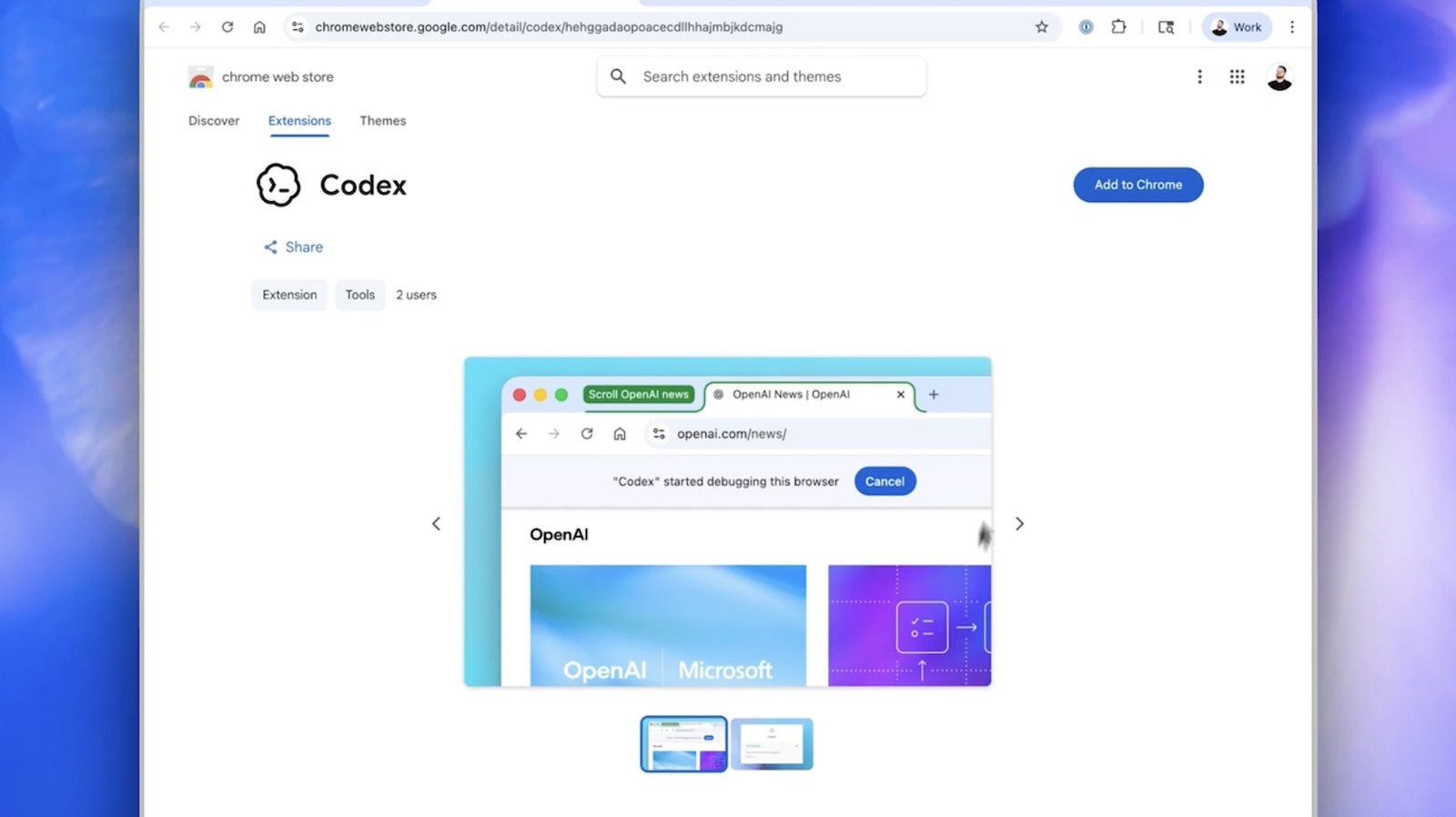
💡Codex Chrome plugin turns coding AI into browser superpower for devs
⚡ 30-Second TL;DR
What Changed
Codex plugin debuted for Chrome
Why It Matters
Developers gain seamless browser integration for AI coding help, potentially boosting productivity tools in web-based workflows.
What To Do Next
Install the Codex Chrome plugin and test it in your dev workflow.
Who should care:Developers & AI Engineers
Key Points
- •Codex plugin debuted for Chrome
- •Expands beyond coding assistance
- •Potential for new non-coding use cases
🧠 Deep Insight
AI-generated analysis for this event.
🔑 Enhanced Key Takeaways
- •The Codex Chrome plugin leverages OpenAI's latest multimodal reasoning models to interpret browser-based UI elements, allowing users to automate complex web workflows through natural language commands.
- •This release marks a strategic pivot for OpenAI, transitioning Codex from a specialized developer tool (formerly powering GitHub Copilot) into a general-purpose agentic framework for web-based productivity.
- •The plugin includes a 'Privacy Sandbox' feature that allows users to restrict the model's access to specific domains, addressing enterprise concerns regarding data leakage and browser-based security.
📊 Competitor Analysis▸ Show
| Feature | OpenAI Codex Plugin | Microsoft Copilot (Edge) | Google Gemini (Chrome) |
|---|---|---|---|
| Primary Focus | Agentic Web Automation | Integrated Search/Summarization | Ecosystem Integration |
| Pricing | Freemium (Tiered) | Included in M365/Free | Included in Workspace/Free |
| Benchmarks | High (Task Completion Rate) | High (Contextual Accuracy) | High (Speed/Latency) |
🛠️ Technical Deep Dive
- •Architecture: Utilizes a fine-tuned version of the GPT-4o-based reasoning engine optimized for DOM (Document Object Model) parsing and interaction.
- •Interaction Model: Employs a 'Vision-Language-Action' (VLA) loop where the model captures screenshots and accessibility trees to map UI elements to executable JavaScript actions.
- •Latency Optimization: Implements a local caching layer for frequently accessed web elements to reduce round-trip time for repetitive automation tasks.
- •Security: Uses a local-first execution environment for sensitive browser data, ensuring that raw session tokens are not transmitted to OpenAI servers.
🔮 Future ImplicationsAI analysis grounded in cited sources
OpenAI will eventually deprecate the standalone Codex API in favor of agentic browser-based interfaces.
The shift toward browser-native automation suggests that OpenAI is prioritizing end-to-end user workflows over raw code generation APIs.
The plugin will trigger a new wave of 'AI-proof' web design standards.
As agentic plugins become common, websites will likely implement stricter bot-detection and DOM-obfuscation techniques to prevent unauthorized automation.
⏳ Timeline
2021-08
OpenAI announces the initial release of the Codex model via private beta API.
2021-10
GitHub launches Copilot technical preview, powered by OpenAI's Codex.
2023-03
OpenAI shifts focus toward GPT-4, leading to the gradual sunsetting of the original Codex API.
2026-05
OpenAI reintroduces the Codex brand as a browser-based productivity plugin.
📰
Weekly AI Recap
Read this week's curated digest of top AI events →
👉Related Updates
AI-curated news aggregator. All content rights belong to original publishers.
Original source: Engadget ↗