OpenAI launches AI personal finance features
💡Learn how OpenAI is solving LLM 'hallucinations' in finance through vertical integration and specialized data engines.
⚡ 30-Second TL;DR
What Changed
ChatGPT is adding personal finance tools via the integration of Hiro's financial reasoning engine.
Why It Matters
This move signals a shift towards vertical AI applications where specialized reasoning engines are combined with real-world financial data APIs.
What To Do Next
If building financial AI, prioritize integrating with established financial data APIs rather than relying solely on LLM reasoning for calculations.
Key Points
- •ChatGPT is adding personal finance tools via the integration of Hiro's financial reasoning engine.
- •Partnerships with firms like Plaid and Intuit are critical for accessing real-time financial data.
- •The US market's reliance on complex tax and budgeting software makes it a prime candidate for AI financial assistants.
- •China faces challenges in personal finance AI due to lack of open banking APIs and different user savings behaviors.
🧠 Deep Insight
Web-grounded analysis with 27 cited sources.
🔑 Enhanced Key Takeaways
- •OpenAI officially launched a preview of its personal finance experience for ChatGPT Pro users in the United States on May 16, 2026, accessible via both web and iOS platforms.
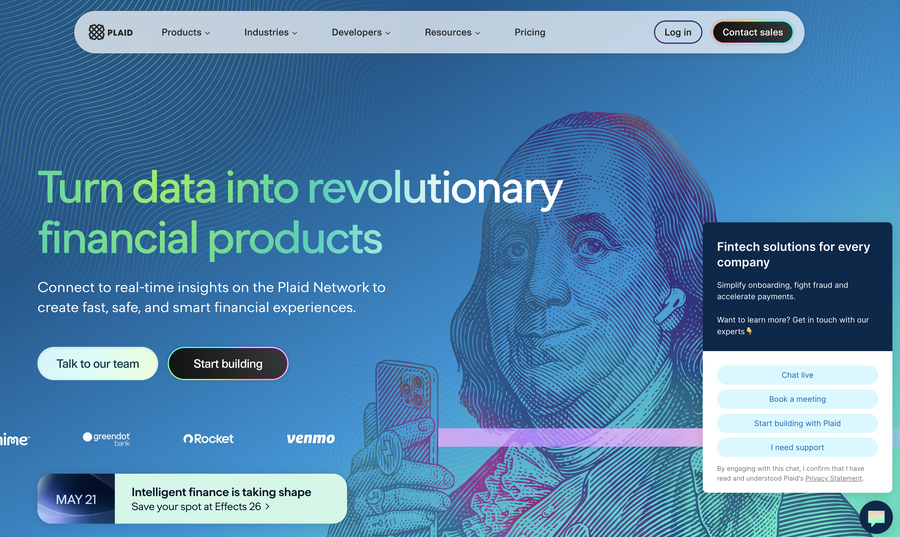
- •The new feature enables users to securely link their financial accounts from over 12,000 institutions through a partnership with Plaid, with future support planned for Intuit.
- •The personal finance capabilities are powered by OpenAI's GPT-5.5 Thinking model, which achieved a score of 82.5 out of 100 in internal benchmark tests for complex financial tasks, validated by over 50 finance professionals.
- •OpenAI's acquisition of Hiro Finance in April 2026 was an 'acqui-hire' aimed at integrating Hiro's expertise in high-precision financial modeling and 'what-if' scenario simulations, crucial for ChatGPT's ability to provide accurate, context-aware financial advice and overcome the 'reasoning gap' in complex financial mathematics.
- •OpenAI prioritizes user control and data security, implementing 'read-only' access to financial accounts, preventing ChatGPT from initiating transactions or making investments. Users retain the ability to disconnect accounts and delete financial data at any time.
📊 Competitor Analysis▸ Show
| Competitor | Key Features | Pricing | Benchmarks |
|---|---|---|---|
| OpenAI ChatGPT (Personal Finance) | Connects to 12,000+ financial institutions via Plaid; integrated dashboard (cash flow, spending, subscriptions, portfolio); context-aware financial advice; "read-only" access; powered by GPT-5.5 Thinking. | ChatGPT Pro subscription required. | GPT-5.5 Pro scored 82.5/100 on complex personal finance tasks in internal tests. |
| Cleo | AI chatbot for budgeting and cash flow; gamified savings challenges; "Cleo Roast" mode; cashback offers; works across multiple bank accounts. | Free version; Cleo Grow ($2.99/month); Cleo Plus ($5.99/month); Cleo Pro ($8.99/month); Cleo Builder ($14.99/month). | Null |
| YNAB (You Need A Budget) AI | Predictive analytics for budgeting; goal-based tracking; syncs with multiple accounts; AI spending alerts & future projections. | Subscription required. | Null |
| Rocket Money | Expense tracking; subscription cancellation; savings automation; limited AI-driven insights. | Null | Null |
| Magnifi | Conversational AI for investment questions; natural language search across 15,000+ investment options; portfolio analysis; multi-account integration; commission-free trading. | Null | Null |
| Origin | Advisor-grade AI financial planning platform; full-context reasoning; unified visibility across accounts; integrated compliance checks. | Cost lower than traditional advisory relationships. | Null |
| Perplexity AI | Connects to financial accounts via Plaid for read-only analysis; conversational interface for finances; provides insights on spending, balances, cash flow. | Perplexity Pro subscription required. | Null |
| Anthropic (via Intuit partnership) | Custom AI agents for mid-market businesses; personalized experiences for consumers; integrates with TurboTax, Credit Karma, QuickBooks, Mailchimp. | Null | Null |
🛠️ Technical Deep Dive
- The personal finance features are powered by OpenAI's GPT-5.5 Thinking model.
- Hiro's technology, now integrated, was specifically designed for verifiable accuracy in financial mathematical problems, including interest calculations, return on investment (ROI), tax estimation, and loan repayment simulations.
- Integration with Plaid enables secure, read-only access to various financial data points such as account balances, transaction history, investment portfolios, and liabilities from over 12,000 financial institutions.
- OpenAI utilizes a Model Context Protocol (MCP) Server to connect its AI agents directly to Plaid's developer tools, facilitating real-time data access and diagnostics.
- OpenAI introduced the 'OpenAI Privacy Filter' on April 22, 2026, an open-weight model designed for detecting and redacting personally identifiable information (PII) in text with high accuracy.
🔮 Future ImplicationsAI analysis grounded in cited sources
⏳ Timeline
📎 Sources (27)
Factual claims are grounded in the sources below. Forward-looking analysis is AI-generated interpretation.
- houdao.com
- 9to5mac.com
- macrumors.com
- thestreet.com
- americanbanker.com
- mlq.ai
- medium.com
- thegreatentrepreneurs.com
- thelec.net
- mashable.com
- useorigin.com
- devopsschool.com
- aifinsage.com
- mindstudio.ai
- mindstudio.ai
- plaid.com
- intuit.com
- intuit.com
- plaid.com
- openai.com
- whistl.app
- comply.com
- advisorhub.com
- smarsh.com
- orion.com
- mofo.com
- wealthmanagement.com
Weekly AI Recap
Read this week's curated digest of top AI events →
👉Related Updates



AI-curated news aggregator. All content rights belong to original publishers.
Original source: 虎嗅 ↗