OpenAI Integrates Codex into ChatGPT Mobile for Remote Coding
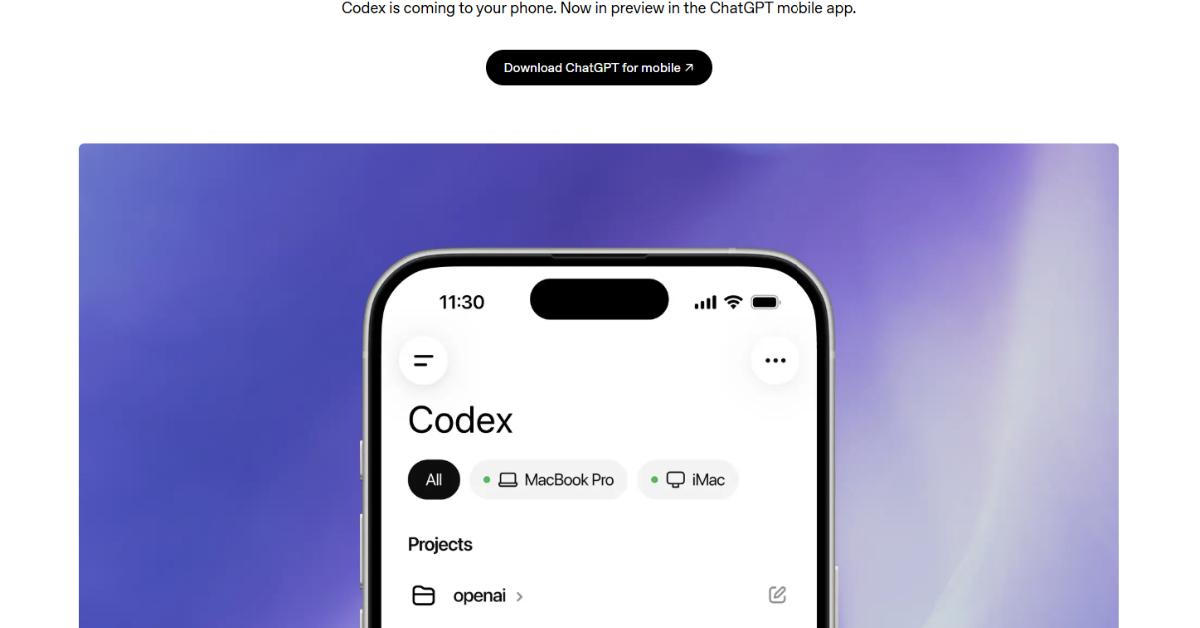
💡Manage your autonomous coding agents on the go with new mobile integration for real-time task approval.
⚡ 30-Second TL;DR
What Changed
Codex agent now available on iOS and Android ChatGPT apps
Why It Matters
This integration bridges the gap between mobile accessibility and desktop development workflows, allowing for faster response times in autonomous coding environments.
What To Do Next
Download the latest ChatGPT mobile app and check the settings to link your macOS development environment for remote task approval.
Key Points
- •Codex agent now available on iOS and Android ChatGPT apps
- •Enables real-time monitoring and approval of PC-based coding tasks
- •Currently supports macOS, with Windows support coming soon
🧠 Deep Insight
Web-grounded analysis with 40 cited sources.
🔑 Enhanced Key Takeaways
- •The 'Codex agent' mentioned is a new, autonomous iteration launched in May 2025, distinct from the original Codex model that powered GitHub Copilot, functioning as a cloud-based software engineering agent capable of parallel task execution within a sandboxed environment.
- •The mobile integration allows developers to monitor progress, review outputs, approve changes, switch AI models, and launch new tasks remotely, acting as an intermediary to keep files and credentials secure on the connected machine.
- •Windows support for the dedicated Codex app was officially launched on March 4, 2026, featuring a native agent sandbox and PowerShell support, making the 'coming soon' status in the original article outdated.
- •Codex is included with most paid ChatGPT plans (Plus, Pro, Business, Enterprise/Edu) and is also available for Free and Go tiers with stricter rate limits.
- •The mobile integration utilizes a secure relay layer to enable trusted machines to be reachable across devices without direct exposure to the public internet, while also syncing active session state and context.
📊 Competitor Analysis▸ Show
Competitor Analysis: AI Coding Agents with Mobile Integration
| Feature / Product | OpenAI Codex (via ChatGPT Mobile) | GitHub Copilot (via GitHub Mobile) | Anthropic Claude Code (via RemoteCode/Claude Code Dispatch) | MiraBridge AI Code Remote |
|---|---|---|---|---|
| Core Functionality | Autonomous coding agent for end-to-end task execution, bug fixing, feature development, code review, and repository analysis. | AI pair programmer, code suggestions, chat, issue-to-PR conversion, code review. | Autonomous coding agent for reading/editing files, running commands, and complex engineering problems. | Mobile control surface for supervising AI coding work, approving changes, monitoring terminal output. |
| Mobile Integration | Real-time monitoring and approval of PC-based coding tasks; acts as an intermediary. | Chat integration, agent task management, code review, issue-to-PR conversion, and code navigation. | Mobile access for monitoring and steering agentic coding sessions. | Supervises AI coding work on desktop from Android, follows active sessions, approves tool actions, reviews code changes. |
| Execution Environment | Cloud-based sandboxed environment for autonomous execution. | Primarily IDE-based suggestions; agent tasks can run in cloud or local environments. | Terminal-based agent, can run locally. | Connects to local desktop client; code never leaves the machine. |
| Supported Platforms (Desktop) | macOS (Apple Silicon & Intel), Windows (native app with sandbox, WSL2 support), Linux (CLI). | VS Code, Visual Studio, JetBrains IDEs, Neovim, GitHub CLI, Windows Terminal Canary. | Terminal-based, compatible with various systems. | Desktop client for Mac. |
| Pricing/Access | Included with ChatGPT Plus, Pro, Business, Edu, and Enterprise plans; also available for Free and Go tiers with stricter rate limits. | Individual, Business, and Enterprise licenses; Chat available for all plans. | Specifics not detailed, but often involves API keys for underlying models. | Free on local network/VPN; Pro subscription for remote access. |
| Key Differentiator | Focus on full autonomous task delegation and parallel multi-agent workflows with robust sandboxing and remote approval. | Deep integration with GitHub ecosystem, strong code completion, and conversational assistance within the IDE and mobile. | Strong reasoning models for planning and execution, often praised for complex, instruction-heavy work. | Emphasizes local control and privacy, ensuring code remains on the user's machine while offering remote monitoring. |
🛠️ Technical Deep Dive
- Agent Loop Architecture: Codex operates through a sophisticated agent loop that orchestrates interactions between users, language models, and various tools. This loop manages prompt incorporation, inference calls, tool execution, and conversation state, with a clear distinction between the reasoning model and the execution harness.
- Cloud-based Sandboxed Execution: The Codex agent runs in a secure, isolated cloud sandbox environment. This architecture allows it to execute code, run tests, and produce changes in a controlled setting, connect with GitHub repositories, and operate independently.
- Underlying Models: The current iteration of Codex is powered by specialized models, including
codex-1(a variant of OpenAI'so3reasoning model) and laterGPT-5.2-CodexandGPT-5.3-Codex. These models are fine-tuned descendants of the GPT family, optimized for code understanding, generation, and long-horizon tasks, with improvements in context compaction and performance in Windows environments. - Multi-surface App Server Architecture: OpenAI utilizes a detailed App Server architecture, a bidirectional JSON-RPC protocol, to decouple the core agent logic from its various client surfaces (CLI, IDE extensions, web app, macOS/Windows desktop apps, and third-party integrations). This server acts as the source of truth for long-running tasks.
- Windows-Native Sandbox: For Windows, OpenAI developed its own native sandbox implementation, which includes PowerShell support and uses restricted tokens/Access Control Lists (ACLs) and network controls to enforce isolation. Alternatively, Codex can be configured to run within Windows Subsystem for Linux 2 (WSL2).
- macOS 'Computer Use' Feature: On macOS, Codex can interact with graphical user interfaces by leveraging an advanced accessibility feature (AX Tree) to see and operate Mac applications in the background, based on technology acquired from the 'Sky' app. This enables automation of GUI tasks where command-line tools or APIs are insufficient.
- Conversation Primitives: The system models interactions using three primitives: an 'Item' (atomic unit of input/output with a lifecycle), a 'Turn' (sequence of items from a single unit of agent work), and a 'Thread' (a long-running conversation).
- Security Measures: Codex incorporates robust security features including sandboxing, explicit approval policies for actions (with an auto-review mode for low-risk actions), network policies, and agent-native telemetry for auditing and understanding agent behavior.
🔮 Future ImplicationsAI analysis grounded in cited sources
⏳ Timeline
📎 Sources (40)
Factual claims are grounded in the sources below. Forward-looking analysis is AI-generated interpretation.
- Google Search Source
- Google Search Source
- Google Search Source
- Google Search Source
- Google Search Source
- Google Search Source
- Google Search Source
- Google Search Source
- Google Search Source
- Google Search Source
- Google Search Source
- Google Search Source
- Google Search Source
- Google Search Source
- Google Search Source
- Google Search Source
- Google Search Source
- Google Search Source
- Google Search Source
- Google Search Source
- Google Search Source
- Google Search Source
- Google Search Source
- Google Search Source
- Google Search Source
- Google Search Source
- Google Search Source
- Google Search Source
- Google Search Source
- Google Search Source
- Google Search Source
- Google Search Source
- Google Search Source
- Google Search Source
- Google Search Source
- Google Search Source
- Google Search Source
- Google Search Source
- Google Search Source
- Google Search Source
Weekly AI Recap
Read this week's curated digest of top AI events →
👉Related Updates

Optimizing Microsoft Edge for Professional Productivity

TapNow launches Creative OS for AI video production

Vercel Observability adds structured search for workflow runs
Anthropic AI Models Accidentally Hacked Three Organizations During Testing
AI-curated news aggregator. All content rights belong to original publishers.
Original source: ITmedia AI+ (日本) ↗